Showing posts with label seventies. Show all posts

Tuesday, June 4, 2024

New products!

As you undoubtedly know, going to the market is one of the highlights of my week. When I was a wee tot I liked going to the supermarket with my mom, and there's still something quite satisfying in it. Perhaps it's the hunter-gatherer in me. 

But often we gather things, or at least take a gander at things, we perhaps shouldn't. Here I am with a new edition of What's New In The Store, a.k.a. What The Hell Is That Thing? 


Sorry for the poor picture. What we have here is a room-temperature ice cream bar, not just dehydrated but hyper dehydrated, like the so-called "astronaut ice cream" on steroids. Those of us who remember that unusual but tasty treat were saddened when we found out that the stuff was not good in space because it was too crumbly, and crumbs are a menace to equipment in low- and zero-G environments. 

The bar you see above dispenses with the astronaut hoopla and goes right for the tongue: crunchy and flavorful, concentrated goodness for any time or place (except outer space). It comes from an outfit called Sow Good, although it is not made from pig milk. I don't know why they call it that. Maybe it's "sow" as in "sew." The whole things is weird. They make freeze-dried candy, and they made this freeze-dried ice cream bar. I could not resist trying it, even though it was pricey -- I forget how much, but more than five bucks. 
 
As it turned out, it was pretty good, with a strong fruit and ice cream flavor, like an Atomic Dreamsicle. Probably not worth the price. But as of this writing the company has dropped its ice cream line to focus on its candy products. Maybe they found out people don't want to pay six bucks for dry ice cream when they can get the real thing for a third of that price. Well, it was tasty, and I wish them well, and hope for their sake they can work that price point down. 

Now that you're in the mood for food, how about: 


Uh, yeah. "Smell funky? Get Skunky." Skunky is a pack of 25 rinse-free sponge sheets, useful for camping, for travel or water emergencies, for the nearly bedridden (you still gotta be able to move to some degree), or anytime you might get slimed and need to de-stink yourself without a bath or shower available. I think the name needs work, although it did get my attention. 

I did not buy a pack to field-test it. I didn't have to. I've been getting Scrubby Dog Bath Mittens for years, and they work the same way -- just add a little water. They came in very handy for the late, large mud-loving dog Tralfaz. I don't think Scrubby and Skunky are made by the same company, but it's the same principle.  

I think Skunky would be helpful for campers and for people who can't shower and don't have health aids to help. I don't camp and I'm not that far gone -- yet. 

We'll end with these beauties, which people Of A Certain Age will be shocked to see making a comeback:


Yes! Wooden salad bowls! They roamed the fruited plains of our great nation unhindered throughout the 1970s and 1980s, then suddenly seemed to go extinct around the time MTV stopped being a music channel. Scientists thought they were gone forever, but no! Like it or not, they have been spotted in the wild! By the time you read this, you may have a set of six with the big bowl and a large fork and spoon for serving in your cabinet! Resistance is futile!  

Monday, June 12, 2023

Southerners on Broadway.

Contrary to some people's reminiscences, our culture in the 1970s was not all America hating post-Vietnam Watergate-obsessed conspiracy theories.  

In fact, almost 50 years ago a musical hit the Broadway boards, based on a Civil War story and starring Southerners. It was called Shenandoah.


The musical was based on a 1965 Jimmy Stewart film, and written by Peter Udell, Philip Rose, and James Lee Barrett (who wrote the movie), with music by Gary Geld. It ran for more than a thousand performances. It told the story of a family of yeoman farmers in the Shanandoah valley, a large non-slave-owning family who wanted nothing to do with the burgeoning war but were caught up in the horror of it anyway. These were the kind of people who in real life caused West Virginia to split from the eastern side and join the Union. 

Shenandoah starred John Cullum -- familiar to many people today from his appearances on Law & Order. He had been blowing the doors off the 46th Street Theater as South Carolina's John Rutledge in 1776 a few years earlier -- a role he repeated in the 1972 film version -- and played a scheming playwright in Ira Levin's Deathtrap a few years later. A very versatile actor, who would win the Tony for Shenandoah. (It did not win Best Musical; that was the year of The Wiz. The book got Best Book of a Musical, though.) It was promoted heavily on local TV, something that didn't happen only at Christmastime in those days. 


Shenandoah was typical of the Americana that was in the air leading up to the Bicentennial. People who think of seventies culture as nothing but disco and pet rocks and cheesy sitcoms might be surprised how reflective the nation was in that era, and yet celebratory. This musical entered that spirit. The story is tough -- the large family suffers at the hands of Union soldiers and Confederate deserters, a dramatic example of Trotsky's line that “You may not be interested in war, but war is interested in you.” Moreover, the patriarch, Charlie, is a man whose faith in God has been wrecked before the play begins by the loss of his wife, and his is a spiritual journey as tragedy unfolds. I can't imagine a current musical even taking religion seriously enough to make it the dramatic center of the story. Audiences now would be yelling, like Job's wife, "Curse God and die!" 

And it's hard to imagine that a play about sympathetic Southerners, even those opposed to slavery and the War Between the States, would be a hit on Broadway. It would be panned as being a musical about "nice Nazis." Because people are stupid and know nothing and just want to shout. 

Shenandoah was revived in 2019, although not on Broadway. I'm not certain it could run on the Great White Way at all, not just because it takes place in the Confederacy. Broadway musicals are ridiculously expensive to produce, far more so than in 1974, and these days there has to be a built-in audience before the thing even opens or investors won't touch it. So a musical has to be constructed like a commodity around well-known pop songs (Jersey Boys, Smokey Joe's Café, MJ, Beautiful, and on and on) (and even then it can be a disaster) or be built around a movie that has a strong following (Elf, Legally Blonde, Back to the Future, all that Disney crap, and oh so much more). Foreign performance rights are also crucial to recouping investment, and a play based on a time in American history does not sound like a layup for audiences in Europe and Asia. While revivals of past hits are a good bet, Shenandoah never reached the rarified atmosphere of a few megahits like Oklahoma!, My Fair Lady, The Wiz, or Gypsy. Investors may take a flyer on something new, if it's woke enough, and take a bath on it, patting themselves on the back all the way to the tax write-off. 

As we gear up for our Semiquincentennial in 2026, I see no sign in the current culture of reflection or celebration. They revived 1776 with stunt casting -- an "All-Female, Transgender, and Non-Binary Broadway Revival," although the internal contradictions of that casting requirement will make your head spin. It makes one wonder if the John and Abigail Adams numbers are based on hot girl-on-girl action, because that's where our culture is now. Ahistorical, childish, and stupid. 

I doubt we're going to make it to the Tricentennial at this rate. 

Wednesday, January 18, 2023

Bygone favorites.

Calvin Trillin is still kicking. He's always been a terrific writer, great at the long-form feature, but like most people I was drawn to his short humor pieces. One I remember well was the essay pondering the disappearance of Chicken à la King. Chicken à la King was once a mighty dish that crossed the continent, then suddenly vanished. To quote from the piece:
There must be billions of gallons of chicken à la king somewhere. There was a time--in the 1950s, say--when the whole country seemed to be awash in chicken à la king. Thousands of Kiwanians ate it at Kiwanis luncheons. Kiwanians ate so much chicken à la king that whenever I heard them sing their song, "I'd Rather be a Kiwanian Than in Any Other Club," I expected to hear a few lines in there about the health-giving qualities of the dish that was giving strength and succor to all Kiwanians everywhere:

There's nothing can defeat us, 
Whatever life may bring. 
'Cause we can go and eat us 
Some chicken à la king. 
So I'd rather be a Kiwanian than in any other club.
It may be small succor to the Kiwanians and others that Swanson still makes a canned variety of the stuff, but perhaps it's cold comfort. The canned stuff cannot match the majesty of Chicken à la King in the wild!


Just in the time I've been hanging around the earth being a nuisance, I have seen ubiquitous foods vanishing into obscurity. Once exotic or high-falutin', these popular meals became a symbol of American yahooism and were discarded. Or maybe everyone just got bored. Also, following the Kingsley Amis rule of More will mean worse, the more popular a food becomes, the less likely it will be prepared well. 

Here are some that have gone the way of the dodo, Howard Johnson's, and the Automat:

Beef Stroganoff: Such a delight when done well! Which means, you can't go cheap on the beef. And no mushrooms. So simple, yet so many ways to screw it up, and oh so many did.

Chicken Chow Mein: The staple of every Chinese restaurant in America, now shuffled off to the side like a poor relation. I once saw it in a buffet. It was the only remotely Asian dish there. 

Duck à l'Orange: Duck was much more a mainstay of the American diet in the past. This fancy dish was a great way to serve it, the citrus counteracting the fattiness of the duck.

Turkey Tetrazzini: Once a popular way to get rid of leftover Thanksgiving turkey. No one ever asked "How do Italians know how to cook turkey?" Just eat it, kid. Santa's watching.

Chicken Cacciatore: Another beloved Italian dish, barely seen outside of Grandma's kitchen now. That Corningware casserole of hers must be at least 80 years old, right?  

Salisbury Steak: Did they ever eat this in Salisbury? Who cares? If you didn't get it from Mom or Grandma, you got it from Swanson, and were glad to get it. 

Fondue: Children, the legend says that once upon a time, if you got married, you got a Crock-Pot and a fondue set. Maybe a blender. The slow-cooker might become a real life-saver for busy families, and Dad might have fun on the weekends with the blender, but the fondue set? Used five times the first year and never after. 

Boeuf Bourguignon: The sign of high-class cooking in the mid-seventies, boeuf bourguignon was even a favorite of Superman's. 


But by the mid-1980s, for fine dining, zee boeuf was not considered enoeuf. Also in the boozy French meat department:

Coq au Vin: One cup of wine for the chicken, three cups for the chef...

Coquilles Saint Jacques: A fantastic way to cook scallops, but a good bit of work. Plus, scallops are excellent with very little frou-frou stuff, so why bother?

Salad Bars: As a food class, the American salad bar of the seventies was an amazing leap forward in food service. It actually got Americans of the era to eat some raw vegetables, although probably most of them also took five rolls and some chow mein.

Fried Oysters: This one goes way back, but people still alive remember when oysters were no big deal and frying them a perfectly reasonable way to eat them. Snobs might go the Oysters Rockefeller route, which is to oysters what Clams Casino is to clams. Come to think of it:

Clams Casino: There.

Veal Oscar: A shockingly complicated dish with crabmeat, asparagus, demi-glace, clarified butter, Béarnaise sauce, and so on -- no wonder restaurants don't want to bother with it. 

Lobster Newburg: I had it once in Maine, and it was really salty. I ate lobster at almost every meal and this was the only thing I didn't like. Sorry, Mr. Newburg (or Wenburg); probably just a bum cook that day. Also on the lobster end of obscurity: Lobster Thermidor. 

Shrimp Cocktail: Sure, you see it around, but not like in times past. Why, we had hot-and-cold running shrimp cocktail! Meaning, boiled and chilled or fried. Excellent either way.

Baked Alaska: The king of desserts! A spectacular presentation of fire (browned meringue, often done by setting booze ablaze) and ice cream! 

Time passes, and yesterday's snobby dish becomes today's nouveau riche garbage. Prime rib and chateaubriand may hang around thanks to wedding caterers, but the trendsetters have gone somewhere else. Lately they're snacking on whatever they find in the dirt or traveling to countries with very poor sanitation to pester the natives and eat there. I think I'd rather stick with Salisbury steak, tell you the truth.

Wednesday, January 4, 2023

Wacky li'l boxes.

Americans of a certain age will remember Wacky Packages, a line of cards and later stickers that parodied consumer products in a very MAD magazine style. In fact, they featured the work of some MAD creators like Drew Friedman. Wacky Packages were made by Topps, the premier baseball card company, and if memory serves also came with a stick of that lousy gum. Wacky Packages were one generation back from the Garbage Pail Kids, with that same gross-out humor.

I had plenty of the stickers, but never used them except on my loose-leaf binder and the like. A friend of mine plastered his bedroom door with Wacky Packages stickers (Comic Book Heroes stickers too, also made by Topps). That kind of thing didn't fly in my house. My dad wouldn't have killed me, but the disgust and disappointment radiating off him while he gently scraped the stickers off my door would have made me glow with shame for days. 

Nevertheless, I was amused to see this box of fun at the checkout at Walmart. 

Wacky Packages


Topps, through Super Impulse, has released the classic Wacky Packages as packages, tiny little 3-D replicas sold in containers like this. You get five products in a package for six bucks, which may be overpriced, but who cares? It's nostalgia! (Super Impulse, by the way, also makes a whole lot of fun stuff in small form, including the miniature Pac-Man console I got as a stocking stuffer a couple of years ago.) 

Let's see what Wacky Packages came in this set. (Thanks to the Wacky Packages fanpage and mall for historical information.) This is what's stuffed in the box:

No gum.


First, there's the paperwork --  a checklist so you can collect 'em all! It even notes which ones are rare, meaning they're holding back production to increase collectability and value on a handful. 


On to my packages! You'll note that no products have been updated; some of the actual products parodied on the checklist don't even exist anymore, like Duz detergent, Mr. Big bread, and Chun King foods. The packaging for the others has changed a lot since then. But these are still the same wacky parodies they were in the '60s, '70s, and '80s. Otherwise, what's nostalgia for? 

First, for old times' sake we have an actual sticker, a miniature replica of the Grazin' Bran from the fourth original series. 


In the packages themselves, we have 


Liptorn, one of the very first products from the 1967 trading-card era, before they were stickers.


Windaxe is fun -- "Break Glass to Remove Axe." From the 13th series


Saran Wrap as Sorry Wrap, 7th series


A takeoff of Birdseye's International Recipes from the period, specifically the Bavarian Style Beans & Spaetzle (11th series).


Hey, I got a rare one! Pupsi-Cola (original sticker: 10th series) was called Rare on the Super Impulse checklist. I'm rich! Let's see... Nah, looks like I didn't get the really rare red sparkle edition. Meh -- best offer?

It was a fun trip down memory lane, although seeing these Wacky Packages and others online reminded me that most of the humor came from the shock value of looking at brands adults valued treated like garbage. Some are more clever than others, but most are kinda dumb. Nothing wrong with a dumb joke, though. Never stopped me!

I doubt I'll be holding on to these. Except for books -- and I want to trim down that library whenever we move -- I don't collect anything on purpose anymore. Ever since I had to sell my comic books in a hurry before my parents moved (I had no room in my little apartment), the collecting bug has gone out of me. But like so many things, it was fun while it lasted. 

Thursday, October 27, 2022

Pour one for the big guy.

Readers of a certain age will remember President Jimmy Carter's beloved but somewhat bumbling kid brother Billy Carter. Billy seemed much more like a good ol' boy than his big brother, and that in an era that honored rural down-home working folks.

Typical of Billy, though, he got in trouble. He once peed on an airport runway in full view of the press; worse, he got a $220,000 loan from Libya after registering as a representative of the country. That led to a Congressional investigation into Billy's influence peddling, which kind of ruined his good-ol'-boy-ness. It's not a good look for American small business owners and sons of the soil to represent OPEC nations. 

But while Billy's star was in the firmament, he inspired and recommended a beer called Billy Beer, sold in fine stores everywhere. 


Sure, the Secretary of the Treasury signs the money, but does he get to sign beer cans? No way.

Anyway, I've come up with a real winner of an idea. There's a little-known relative of the president, a son named Hunter, and I hear he likes to have a drink or two himself. I think we can make a deal to get him to endorse something like Billy Beer, maybe a malt liquor. Maybe a "fortified" malt liquor, you know? The way some delicious wines like M/D 2020 and Wild Irish Rose are fortified. And of course he would be paid in Fredcoin, the world's most Fred-like crytocurrency. 

Here's a mock-up of the label:


Trying to think of a good slogan, like "It'll Get You There" or "Throw Away Your Laptop and Forget Your Troubles" or "It's Like Kissing Your Sister-in-Law." I'm sure we can come up with something better. 

I'll be reaching out to the younger Biden soon to see what we can work out. Apparently Congress is just great with influence peddling now, so I doubt anyone will give him a problem on that end. And you know, they tell me that this Hunter fellow is a successful painter, which is great. My bathroom could use a fresh coat -- maybe we can add that to the deal.

Tuesday, September 6, 2022

Whoziwatsis?

Cast your minds back to the sad-sack seventies, my friends; it wasn't all ABBA and Happy Days. We had fuel shortages, stagflation, Communism on the march, fearmongering of every sort in the media (disaster would soon strike from ice age / aliens / nuclear war / complete economic collapse / overpopulation / starvation / running out of oil / labor strikes / nuclear plant meltdown / crime / government corruption), and polyester as far as the eye could see.  

Into this grim landscape appeared something that would provide a turning point. Picture: It's 1978. We're a year away from Carter's Malaise Speech, but things look awful. The Great Blizzard of 1978 strikes the U.S. The Soviets are pushing "Russification" on all their republics. Aldo Moro is assassinated. Paul John Paul I dies after 33 days in the Chair of Peter. The Afghan war begins and is still going on to this day. Ashton Kutcher and Hannah Gadsby have been born and Charles Boyer and Louis Prima have died. But then a light shines in the darkness....


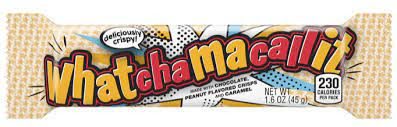
Yes, Hershey introduces the Whatchamacallit, a candy bar made with peanut butter crisps and chocolate (later to include caramel and whatnot inside to create the bar sold today, according to NEPA Scene). The Whatchamacallit was touted with the slogan, “It’s almost as much fun to say as it is to eat!”


Am I saying that the Whatchamacallit is what turned the misery of the seventies into the dynamism of the eighties? Well. not exactly, but it didn't hurt.

Let's bring the timeline up to date. Here we are in 2022. Everything looks like crap. The government is compromised and can't be trusted. The Chinese threaten war. The Russians are bumbling around with heavy ordnance and still have those nukes. Global warming has pretty much pushed the other world-ending disasters off the front pages, except that we all saw how a (likely Chinese engineered) virus spread quickly and probably accidentally -- maybe the next one will be a lot more fatal. Inflation is out of control; we have a labor shortage and high unemployment at the same time; the younger generation is hopeless and the older ones just want to hang on to what they have until the Grim Reaper comes. The music is terrible. The movies are worse. Incompetence by people convinced of their own value is the order of the day, and it shows. 

And now, into this bleached and burned landscape, Hershey brings us....


The Whozeewhatzit is a new candy bar, and it's great. It has a layer of peanut butter under the chocolate coating, not enough to dominate the flavor, and a thick brick of Krackel-type chocolate crisp below. The flavor balance and the texture are right on target. I say this one is a winner. 

Will it be enough to turn the tide? Who can say? We can't be cocky. Hershey introduced the Thingamajig bar in 2009, another bleak era, and discontinued it in 2012. Sometimes the problems are not done getting worse, and that was surely the case in the tremulous oughts and early teens. 

But like its ancestor, the Whatchamacallit, the Whozeewhatzit could be a harbinger of a prosperous age to come. And if the age doesn't arrive, at least we can eat good candy while we shiver in the dark. 

Friday, August 5, 2022

A test of Mettle.

It's been very pleasant to see the Beloved Mets riding in first place in the National League East. They've mostly had trouble with West Coast NL teams so far, but aside from that have been true powerhouses this season. Of course, taking the two-game set from the Yankees for city bragging rights was most excellent. 


In the midst of this I was reminded of something I had forgotten, if in fact I ever knew it. 

Everybody knows that Mr. Met, abetted by the lovely and talented Mrs. Met, is the mascot of the New York Metropolitans and has been since the team's inaugural year of 1962 -- except for a period in the late seventies when he was put in cold storage. 

It's more proof that everything sucked in the seventies. 

Cast your mind back to 1976. Disco, polyester, The Big Bus, Ford and Carter. The Yankees were heading for the World Series. The Mets had treaded away Tom Seaver, the Franchise, for nothing much, and Tom was leading the Reds to the World Series and a four-game sweep of the Yankees. The previous two years the Yankees had been playing at Shea Stadium, and all Yankees fans could do was whine about how bad Shea was, while the House that Ruth Built was literally falling apart. 

Mets fans forget that '76 was not a terrible year for the Mets, who finished with a winning record but in third place. But for half of 1977, and for the next four seasons as well, Joe Torre was the manager of the Mets, and the Mets lost games by the dozen. None of that Torre brilliance on display twenty years later with the Yankees was seen with the Mets. 

Stepping into this hot, dreary era of stagflation and shame was a mule named Arthur, now rechristened Mettle the Mule, as the new mascot. 

He looks happy.

Mettle's new name came from fan Dolores Mapps, reflecting the name Mets (duh) and the fighting spirit of the ballclub. Little of this spirit was visible, as the team would lose more than 90 games a season. 

Mettle was kept in a pen near the bullpen, and was probably better behaved than the relief pitchers. Loren Mathews, the promotions manager for the team, told the Chicago Tribune in 1992, "Actually, there was serious talk in spring training [in 1979] by the de Roulets [the team owners] to have the relievers come in from the bullpen on the mule. I told them there was no way I could in good conscience tell Bob Apodaca that from now on he’d be coming into a game with the tying runs on base, bottom of the ninth inning, riding in from the outfield on a mule."

This was still the era where relievers were brought out in bullpen carts, some of which were weird, so the idea of a pitcher coming into a game on a mule, or maybe a mule-powered chariot, was not all that way out. Stupid, but not especially so. 

It's no fault of Mettle's that the team was so bad, but after the last-place 1979 season, new ownership came in and Mettle was put out to pasture. No one seems to know what became of him afterward, but we thank him for his service. Anyone can be a supporter of a winning team, but it takes a little badassery (har!) to be there for the team when they suck. 

Thursday, April 28, 2022

What we deserve.

This item on the Great Lileks's site incited a riot -- well, some worthy comments -- the other day:


The 70's-era ad, from Penny's (the supermarket, not J.C. Penney's) makes an assumption that goes back at least to that decade -- that "you" the customer, deserve something special. I noted that in that same decade McDonald's had success with its "You Deserve a Break Today" campaign. 


The question was: Who says? What's the standard for deserving? Why does someone deserve the best just for reading this ad? I could be an absentee dad grifter with a long history of broken hearts and stolen wallets, but reading this ad makes me deserving of the best? 

Pure flattery, I know, but it is everywhere these days and as empty as ever. Because they don't know me and they don't know what I deserve. Why should I take that any more seriously than I'd take a random person insulting me online? 

Here's another one, garnered from social media. It's trying to be nice, but how does it know anything? How do you know I'm worthy of anything more than a fist to the face, CryptoNaturalist? What are you, Thor's hammer?


Then there's the ones that go beyond the affirmations to stupidity, the kind that assume you're awesome and you know you're awesome and tell you how to go out and spread your awesomeness to the world. Dove chocolates, which are in fact awesome, has apparently solicited various dumdums to promote these kinds of messages: 

Could I be authentically fearless instead?

Isn't the word "tribe" racist now?

I was making fun of affirmations years ago, and the ones I see now are even worse than the ones I was targeting then. Knowing that the writers don't know anything about the readers ought to give the latter an empty feeling, because the only thing the writers really seem to believe is that the readers are suckers for flattery. Even children know when affirmations are worthless, and know better than to trust adults who spew them. 

Anyway, I have enough trouble believing compliments when they come from people who do know me, because I expect they don't know the real me. And if they did, they'd be disgusted. But maybe that's where affirmations leave off and my own neuroses take over.  

Wednesday, April 14, 2021

Fred's Book Club: And What About Shrinky Dinks?

It's Hump Day! And that means it's time for our Wednesday book feature, the Humpback Writers! It's the stress of carrying Wednesday on their backs that causes the injury, you know, and.... Oh, skip it. I'm thinking of changing the name of the feature to the U#TIG’Hd836& Writers, which will make about as much sense. 

Today we go back in time, back to our younger days, or even the days before we were born, to ask the musical question... Whatever Happened to Pudding Pops?


Freelance journalist Gael Fishingbauer Cooper and PR agent Brian Bellmont created this project, and publisher Perigree turned it into a book in 2011. It's a fabulous collection of things pegged to the 1970-1990 era, especially for things that kids loved. That's an important feature, because most of us are at least a little nostalgic for the world of our childhood, and because nothing goes in and out of fashion faster than kid stuff. 

The book is a series of articles, arranged alphabetically, about the things of the past, and at the end of each there's a summation of its status in the current time (as of 2011), written as its "X-Tinction Rating." Here's one:

TIME FOR TIMER

TV was pretty lecturey in the 1970s and 1980s. Somewhere along the line, someone panicked that kids weren't eating proper snacks and decided the way to solve that was to offer nutritional advice from a yellow blob of fat with spindly legs and a ginormous hat. Thus, the birth of Timer, a disturbing but memorable PSA star whose segments were apparently dashed off by a bored but starving copywriter who had to make deadline before he could hit the drive-thru for a Big Mac.
     Timer's most memorable video has him "hankering for a hunka cheese," but any kid who needed to be shown how to place cheese between two crackers was really too dumb to be allowed to watch TV. In another, Timer takes a tour of the stomach and then apparently just gives up, encouraging kids to eat random leftovers out of the fridge. "Sunshine on a Stick" oversells the result by half, as it's just orange juice frozen in ice-cube trays. Timer also shows up in a segment demonstrating toothbrushing, which is odd when you consider that his teeth are as yellow as the rest of him.


X-TINCTION RATING: Gone for good.
REPLACED BY: Nothing. Television networks have since decided that kids can eat random food out of the fridge without frightening cartoon guidance. 

You get the idea. Each little profile is snappily written, with good humor, and appropriate kudos for products and other cultural phenomena that really came through.

Not everything is X-Tinct, either. Take those Shrinky Dinks:

SHRINKY DINKS

Invented in 1973, Shrinky Dinks brought into play the one appliance that Mom never really wanted you to mess with: the oven. In fact, the whole Shrinky Dink process seemed kind of like a joyous, don't-tell-the-parents experiment. Melting plastic on a hot cookie sheet without getting yelled at? Sign us up! 
     Shrinky Dinks never looked like they were going to work. You colored in the shape, be it a Smurf, Mr. T, or a rainbow-maned unicorn, threw it on a cookie sheet, and hoped for the best. Watching through the oven door, you were convinced you'd done it wrong and nothing would ever happen when suddenly it started to curl up like an old sheet of fax paper. It twisted, and then fixed itself, and the end product was tiny, bright and colorful, and thick and strong. As with Homer Simpson and his Flaming Moe drink, fire made it good.
     Few kids really knew what to do with Shrinky Dinks once they were shrunky dunk. One can only have so many zipper pulls, key chains, and napkin rings, after all. But no one ever thought about that when they were watching the plastic writhe in its little kitchen torture chamber. Sometimes the journey is indeed way more fun than the destination.

X-TINCTION RATING: Still going strong.
FUN FACT: In the 1970s, superheroes were the bestselling Shrinky Dinks theme; in the 1980s, it was the Smurfs. 

And indeed, in 2021, Shrinky Dinks are still out there, making kids ask themselves: What shall I create? And why is the oven door so grungy? Can't see nothin'!

As I noted, the book covers all sorts of cultural items, like typing classes, Bicentennial mania, Roosevelt Franklin, Jolt Cola, Halloween costumes "with unbreathable plastic masks," killer animal movies, Judy Blume books, and Gee, Your Hair Smells Terrific shampoo. If you were alive and aware in the United States in the two decades covered, there's some cultural resonance for you in this book.

The authors have since moved on with their careers. They did a sequel book about the nineties, which looks like fun, but the original Web site for the project has been allowed to turn into a cobweb. I guess my looking back at this book that looks back at the past is like being nostalgic for Happy Days ("Fascination with the 1950s" is an entry in the book as well, by the way). 

And say -- before I close this entry, whatever DID happen to Jell-O Pudding Pops? Well, despite their popularity in the eighties, thanks to pitchman Bill Cosby (whose life went in the toilet after this book was published), the company had trouble making a profit from them. Then, "the Jell-O name was later licensed to Popsicle, which reintroduced the Jell-O Pudding Pops in 2004. Sadly, sharp-eyed eaters say its just not the same." And have since been discontinued. 

Well, sic transit Jell-O Pop mundi, I guess.  

Saturday, January 16, 2021

Heavy metal classics.

This could also be called "What's on Fred's Phone?" Here are the latest pictures I took, which I suppose is a pretty dumb way to compose a blog entry. Welp, here we go!

📷📷📷

Friday morning was the foggiest I can recall around here. The weather center issued a heavy fog / black ice warning, which is a nice way to start the day. Here is the shot I took, which I think is worthy of hanging in MOMA (MOM's Art collection on the fridge):

Frederick Key, Fog and More Fog (2021)


Fortunately the black ice was not too bad here, and I got to play light saber with my flashlight.

whoom.... whoom

Now, I promised heavy metal classics, and here's one:


It's upside down, but by gum that's an old-fashioned metal garbage can. You hardly ever see these around anymore, since they have have no wheels and have to be carried. But Home Depot does sell the classic galvanized steel one, a 31-gallon model by Behrens, for $25. They can be racoon-proofed with a bungee cord, as long as your racoons are not especially smart or determined. Anyway, I'm glad to see the metal trash can tradition being kept alive. It's almost like finding a rotary phone.

Speaking of old stuff....


So RC Cola, the distant #3 behind Coke and Pepsi, is bringing back the old "Me and My RC" slogan that was in use in the mid-seventies, complete with groovy font. I wonder why. I suppose it was successful, more so than the "Decide for Yourself" campaign of the eighties. but a forty-five-year-old slogan doesn't seem like it would hit that youth demographic sought by beverage manufacturers. I have nothing against RC, but I wonder what they're thinking. Maybe they figure they can snag the old-timers while Coke and Pepsi fight for the Millennials. It's as if in 1975 they revived this campaign, except it would have been only thirty years old at the time, not forty-five.


But I think most of us feel that 1945 feels culturally a lot further from 1975 than 1975 feels from 2021. 

Finally, we have one more chunk of heavy metal, the base for a steampunk automobile.  


Nah, this is part of that annoying cable project they started a couple of weeks ago. The flatbed trailer brought a backhoe to the party, and the wheel was one of several that held a cable sleeve to run underground to allow the cable to be slipped along the curb. It was a pretty big project. They've moved on to running cables along telephone lines now. Since I took the photo the flatbed is gone, but the stupid reel is still sitting there, just off the road. If they don't come back for it by February, I'm selling it for scrap.

 📷📷📷

And that's what was on my camera app. Be here next time when you get to see five shots of my index finger!

Sunday, October 25, 2020

WINning?

This American artifact may ring a bell for those who lived through the 1970s.  


For those whom 1974 is as distant as World War II or the reign of Ramesses II, here is the story, from the Gerald R. Ford Presidential Library and Museum in Grand Rapids, Michigan: 
President Gerald R. Ford inherited a nation in dire economic straits. A debilitating recession that combined high unemployment and a stagnant economy with rampant inflation posed many difficult challenges. With a degree in economics and 25 years of Congressional budgeting experience, President Ford plunged headfirst into the crisis. His first and most public move was to combat inflation. He declared inflation “public enemy number one.” Ford’s economic advisors devised a Whip Inflation Now or WIN program in the fall of 1974. It focused on a variety of voluntary anti-inflationary initiatives that individual citizens and businesses could embrace. Early enthusiasm for the program generated massive quantities of handmade and mass-produced material, including buttons, signs, clothing, stickers, ephemera, and much more. Unfortunately, enthusiasm waned by the New Year as the program failed to generate the results people had hoped for and the program quickly died out.
Inflation was and often is pretty damn serious. At the time it was a disaster for people on a fixed income, like many who had been paying into the Social Security fund for thirty years. The dollars that they received were worth far less than the dollars they had paid in; a dollar in autumn 1935, when Social Security was implemented, was equivalent to $3.65 in autumn 1974, but the recipient got that same dollar back -- which had depreciated by 83 cents, according to the Bureau of Labor Statistics' Inflation Calculator. News stories of little old ladies surviving on cat food led to the general cheerfulness of the era. 

And the little old ladies were just the tip of the dwindling iceberg. Inflation was eating invested money faster than it could be returned, which was discouraging all sorts of investments. As Amy Farber of the Federal Reserve Bank writes: 

In October 1974, with consumer inflation running at more than 10 percent annually, President Gerald Ford gave a now famous speech (watch video or read text) in which he proclaimed: “There is only one point on which all advisers have agreed: We must whip inflation right now.”

    “Whip Inflation Now” was not just a speech—it was a public relations campaign to enlist American citizens to hold back the increases in wages and prices of the 1970s, supposedly by increasing personal savings and taming spending habits. The symbol of the campaign was the large round red button with bold, white uppercase letters: W I N.

    According to the American Presidents blog, “The campaign did not work as President Ford had hoped. Inflation remained a threat to the economy well into the Reagan presidency … the pins were widely mocked and it gave Ford’s opponents an easy target for criticism.” 

Was the WIN campaign a failure? Economists may argue the point, but I think by every conceivable measure there's no question that it was. Inflation got worse into the late 1970s, and Ford's successor (just like his two predecessors) were incapable of formulating a policy that went beyond Ivory Tower economics and rather encouraged economic growth. This appears to be at least to be part of the massive, crushing failure of academia to teach the truth from at least the start of the postwar era to the present day. They were and are in love with socialism, and every policymaker who falls for that inflicts misery on his constituents.
I believe most of the disastrous ideas of public and social policy have come out of Western universities. I'm far from alone in that belief. Maybe WIN would have looked better in retrospect if a non-nuclear nation had declared war on us, just as FDR's New Deal looks like an economic powerhouse because war was breaking out and someone had to make all those tanks and planes.

For Ford, personally, the WIN campaign was a disaster. People may note that WIN was mocked, and Ford made fun of by Chevy Chase (a one-time show business personality), but most Americans thought Ford was a decent man. There was a lot of talk (in my family, for one) that if Ford had not pardoned Nixon he might have been elected in 1976, but I have my doubts. I think Ford was right on that one, that most Americans didn't want a Nixon clown show trial sucking all the oxygen out of the room. 

I think if Ford had not studied economics, and had a better plan than a vague FDR-ish call for normal people to go out and whip inflation (how does one do that? No one who was an adult at the time has ever been able to explain what they were supposed to do), the economy might have improved. He still would have had an uphill fight in 1976, with the swine flu disaster and the general hatred and fear of Washington everywhere, but an improving economy might have saved him from the juggernaut that was James Earl Carter. Despite everything, Ford carried 27 states in the election, but lost by about 1.7 million votes and got clobbered in the Electoral College.

I mention all this today not just because it's an excuse to talk about what was briefly a major cultural item -- WIN buttons -- but also to show that good intentions and college degrees don't always make for good results, especially in government. Reagan was an economic wonder in spite of rather than because of his economics degree from Eureka College; he spent decades learning about economics in the real world as his acting career dwindled. And Trump's bachelor's is also in economics, but I'm not sure he ever paid much attention in school. He probably learned more about economics at his father's knee. 

In the end, you can call for the people to rise up and whip that inflation, beat that poverty, conquer that cancer, declare war on bad weather, stop the tide from going out, but some battles can't be won by good intentions. 

Wednesday, July 15, 2020

Fred's Book Club: Another Brick.

Welcome to Wednesday, or whatever it is when you see this. It's Wednesday here, and that means it's Hump Day, and time for the Humpback Writers, who don't actually have humps, unless they have some around that they haven't shown me. Nobody tells me anything.

Today we delve into recent history to have another look at "real" communism in action.


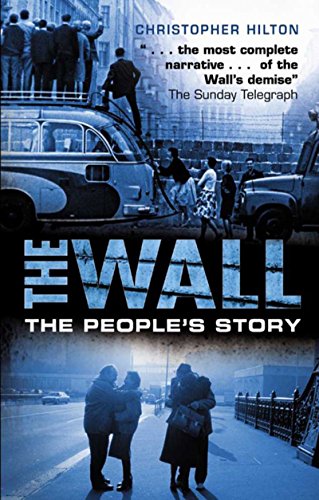
British journalist Christopher Hilton, who was a sportswriter for most of his career, compiled an amazing collection of stories of the Berlin Wall in 2001's The Wall: The People's Story. It's a street-level view of the rise and fall of the famous barrier that came crashing down in 1989. For almost forty years it was at the eye of the Cold War, and by the start of the eighties it felt as if all the world was watching, as if Berlin was at the very center of the world. Not the Middle East, nor Kabul, nor Tokyo, nor even New York City, where I lived, but that bisected German city, one half of which was an outpost of freedom in a desert of communism.

Hilton seems to have talked to a lot of people; in fact, he seems to have talked to everybody. After summarizing the tensions between the East and West in the postwar period, he describes the origins of the wall that began in the city and spread its arms across Germany. Prior to that, thousands of East Berliners traveled to the western half every day to work, the half that had shops filled with goods. Many tried to move permanently, leading to worker shortages, particularly of the smarter workers (the "brain drain"). For that reason and a number of others, the East Germans, despite prior assertions to the contrary, decided that a wall must go up.

It didn't start with bricks at mortar; on the night of August 13, 1961, it started with wire. The East German Factory Fighters, a kind of civilian reserve, began the installation.
Two Factory Fighters in shirt sleeves walked with a coil of the wire wrapped in a ball round a stout stick, a Fighter holding each end of the stick. As they walked, the wire automatically uncoiled and another Fighter, kneeling, lifted a strand of it and hammered it into a concrete post using cleats, gathered another strand and hammered that in, then another -- row upon row, neatly spaced -- until the wire was head high. An elderly couple were escorted from the wire by a policeman, the sadness and the powerlessness expressed by the stoop of their shoulders.
That very night, illegal crossings began.
At 10.30, a crowd of 4,000 lingered on the Western side of the Brandenburg Gate but for an insurrection to occur would mean bursting past their own police, then the cordon of Factory Fighters, then the armoured personnel carriers with the water cannons, then the Eastern police, before reaching Unter den Linden; and Unter den Linden had been cleared, anyway. At 10.45, a report came in that ‘a male person’ had swum the Teltow Canal.
They would continue into 1989.

Part of the new wall ran right along apartment buildings, and East Berliners started jumping out the windows to escape to the West.
In Bernauer Strasse workmen swarmed the ground floors of the apartment buildings, bricking up windows from the inside. Residents called to people in the West for help and clambered onto window ledges to drop to the pavement. The West Berlin Fire Brigade hurried there with safety nets anticipating that, when the bricklayers reached the upper floors, residents might jump.
Hilton does a minute-by-minute reconstruction of the night the wall rose and the days that followed, when the United States and its allies tried to determine the best course of action against this surprise move. Three hundred trucks towing artillery were sent, and to many it looked like the wall was the spark that would begin World War III.

Hilton's book spends many riveting pages on the period following the initial wall construction, but goes on to tell the stories of those living in its shadow for decades, those who risked everything to escape, and those present when they tore the damned thing down.

Anyone interested in history would find this a fascinating read, I think, and for those of us who grew up in the Cold War, it's crucial knowledge. We are faced with a real possibility of Cold War II, thanks to the actions of the Chinese Communist party, and we have a generation that has no idea what communism really looks like, or why someone would risk death and torture to flee it. Hilton, who passed away in 2010, strives to be fair to the East German and Soviet leadership, and yet the bald, brutal face of communist dictatorship cannot be prettied up.

Maybe our youngsters now would say that it wasn't "real communism." But it's always real communism. This is what it always is.

Wednesday, June 24, 2020

Fred's Book Club: Elementary Psychology?

Greetings, friends, and welcome to another Wednesday and another Hump Day episode of the Humpback Writers, where no writers have humps but all their books have backs.

This week's book answers a question from correspondent Mr. Philbin: "Are you EVER going to feature a book that anyone has heard of?" To which I answer: Okay, sure. Seriously, most of the time those books have enough exposure and don't need me to shed light on them. But why not? Here we go.


The Seven-Per-Cent Solution, a Sherlock Holmes novel by Nicholas Meyer, ought to make Mr. Philbin happy, as it has sold two million copies since publication in 1974. The author also wrote the screenplay for the movie version, which led Meyer to an Oscar nomination and a brilliant career in film -- not to mention three more Sherlock Holmes novels.

I saw the 1976 film on TV before I read the book, and enjoyed it quite a bit. I picked up the novel years later and found I liked it even better. I was surprised to have enjoyed them so much, since by the time I came to them Sherlock Holmes adventures, adaptations, parodies, and pastiches had been just about run into the ground by every writer since Conan Doyle first put pen to paper, as chronicled brilliantly by author and fellow Bleatnik Bill Peschel (himself a writer of Holmes stories). Whether done straight or for laughs, I feared that Holmes had been done to death even before Meyer got hold of him.

And yet, this book, well written in Dr. Watson's style, hangs on an irresistible peg: What if Sherlock Holmes's well-known cocaine habit -- Holmes was quoted in a Conan Doyle story as injecting himself with a seven-percent solution of cocaine, thus the title -- was a symptom and expression of his descent into madness? What if he was losing his grip on reality? What if his arch nemesis Moriarty, the Napoleon of crime, was... just a guy?
Moriarty twisted round in his chair and screwed up his blue eyes in my direction. "Dr. Watson, your friend is persuaded that I am some sort of--" he groped for the words-- "criminal mastermind. Of the most depraved order," he added with a helpless shrug, throwing up his hands. "Now I ask you, sir; in all honesty -- can you see in me the remotest trappings of such an individual?"
     There seemed almost no point in saying I could not.
     "But what is to be done?" the little man pursued with a whine. "I know that your friend is a good man -- all England resounds with his praise. But, in my case, he has made some ghastly mistake and I have become his unfortunate victim."
And what if this prompted Dr. Watson to engage in a clever ruse to get his friend into the care of the one doctor on the continent dedicated to healing the broken mind -- the controversial Dr. Sigmund Freud?

Watson induces Holmes into following Moriarty to Vienna. Holmes does not know where the "villain" is going, but tracks him using noted bloodhound Toby and a bottle of vanilla extract. I have wondered many times in the years since I read this book whether this method would actually work. Nevertheless, Holmes follows the trail and winds up in the office of the physician Freud, where he goes right into his act:
Holmes eyed him coldly.
     "Beyond the fact that you are a brilliant Jewish physician who was born in Hungary and studied for a time in Paris, and that some radical theories of yours have alienated the respectable medical community so that you have severed your connections with various hospitals and branches of the medical fraternity -- beyond the fact that you have ceased to practice medicine as a result, I can deduce little. You are married, possess a sense of honour, and enjoy playing cards and reading Shakespeare and a Russian author whose name I am unable to pronounce. I can say little besides that will be of interest to you."
     Freud stared at Holmes for a moment in utter shock. Then, suddenly, he broke into a smile -- and this came as another surprise to me, for it was a child-like expression of awe and pleasure.
     "But this is wonderful!" he exclaimed.
     "Commonplace," was the reply. 
Holmes explains the little clues that led his keen observation to these deductions. In time he is persuaded to be put under the care of Freud.

As for the rest? Well, there's a kidnapping case and some jolly good Mitteleuropean intrigue, and a lovely lady and a terrific chase and such, and that doesn't matter. Really, the book is a blast, and the fun of seeing the real Freud rendered vividly and Holmes in his element (although a little nuts) is well worth the price of admission. Since the book was published, Freud's reputation as a scientist has taken a beating, but put that on the back burner for the sake of the yarn.

So there, Mr. Philbin!

P.S.: Allow me to recommend Bill Peschel's own mixture of Sherlock Holmes and reality, Sherlock Holmes & Mark Twain: The Adventure of the Whyos. Bill proves that there's still a rich vein of story in Holmes yet, for a writer with the talent to mine it.

Sunday, February 23, 2020

Hospital TV.

During my medical sojourn last week, I found that you can learn things from the TV the hospital provides to help pass the time. Mainly, you can learn that daytime TV is an irritating way to pass the time. Still, I had nothing to read and no juice on the cell phone until my wife brought me books and a charger, so it was more engaging than looking out the window.

I can't say I wasn't warned. A friend of mine was undergoing cancer treatments last year, and while he was able to stay at home through most of it, he was unable to do anything beyond watch the tube. I believe he said he had memorized episodes of Bonanza and The Twilight Zone and that Wilma Flintstone was starting to look good to him.

Thankfully, I only had a couple of days to deal with it, from Sunday afternoon through Tuesday evening. I can see how it would make you crazy. Even the all-news channels, or maybe especially those; the constant chewing of the same Bone Du Jour is insane. Apparently there was nothing much in the world of note last Monday except for the Roger Stone sentencing, because all the news channels were on it constantly.

Ah, but the cable TV provided by the hospital had soothing channels, with calming music and video clips from nature. Well, the most educational thing about that was that I couldn't stick with them very long. You'd think a guy in pain, who'd just been through a major pain crisis, would want nothing else on but that channel and the back of his eyelids, but no. No wonder I suck at meditation.

So what did I like?

Well, as I alluded to yesterday, I watched America's Funniest Home Videos on Sunday night. What made that educational was how my attitudes had changed toward people falling during the previous 24 hours. You just fell down the stairs! Go get an X-ray! You have no idea how this can come back to haunt you, you fool! My previous reaction to people falling on AFV was the more lizard-brained Ha ha him fall funny.

On Monday there was a Catholic priest in the little chapel downstairs, and I was able to watch Mass on CCTV. I liked that, although the sound quality was pretty bad.

I picked up a tidbit on the History channel, one that had nothing to do with Ancient Aliens. It was a neat little documentary on Air Force One that the channel ran on Presidents Day. I knew some of the history of the planes assigned that name, but amid the data was this: the name of the country painted on the plane's exterior is meant to simulate the typeface used for the name of the country as it was seen -- for the first time -- on the Declaration of Independence.


Cool.

Other things I leaned came from watching most of Return of the Jedi, which I have not seen in a very long time. And those things were numerous. They include:


  1. The movie begins with the worst rescue plan I have ever seen in the movies. I can't even tell what they were trying to accomplish, sending people into Hutt's Hut in dribs. To infiltrate and then take over at a signal? Obviously not, since everything went to hell immediately. It made no sense at all. If R2 didn't have enough space to hide a lightsaber in his chassis, the galaxy would have been screwed. Even then a lot of dumb luck was required. Almost any other plan would have been better. 
  2. Mark Hamill was a pretty bad actor. I don't know if he got any better. I haven't the new trilogy and I don't care. But Harrison Ford was pretty bad, too. He looks stoned through the scene where we learn the plan to attack the new Death Star and he is revealed to now be General Solo. If 1970s Steve Martin had been cast as Comic Relief Solo, and played the part the exact same way, people would have thought it was a hilarious spoof. 
  3. Retroactively speaking, I hear that Leia was supposed to do all kinds of Force stuff late in the third trilogy. This makes perfect sense, as she's revealed to be a Skywalker. And yet, although Darth and Luke can sense each other's Forceishness in real time across space, neither of them had any idea that the Force would be strong with that princess, too. Was this addressed?


Anyway, by the time we got to the Ewoks, I was about to be whisked out of the room for injections. Some people loathe the little Space Teddy Bears, but at least for those pre-CGI days, they were pretty convincing.

I also saw enough (ten minutes) of Matt Damon's The Great Wall to realize that, whatever faults the Star Wars series might have, if you put them all together in a bag they might still weigh less than the faults in The Great Wall. What a waste of Willem DaFoe.

All of this hard-won knowledge would have been avoided if i'd had more than an 8% charge on my phone.

Maybe I should have spent more time staring out the window. Sure, it's a modern, dull building, and it looks drab and tired although it opened in 2011, and February is not much to look at -- but at least the skies were blue.


Question: Did someone determine that tan and brown are great healing colors? Because that's the sum of the whole color palette in this place. Does it help keep people relaxed and compliant?

Thursday, February 13, 2020

Wednesday, August 14, 2019

Suckers!

My wife was lamenting the fact that the lemon drops of her childhood were impossible to find. I looked in the supermarket; I looked in the drugstore. I bought some Lemonheads, by Ferrara, but they were not the ones she wanted. She said the ones she recalled fondly had a dusty sugar coating, but were not too sweet, not too sour, and then I figured it out.


First, a little backup: In the 1970s, there was a big, nostalgic, small-town-values movement in American culture, as people disgusted with huge corporations and corrupt Washington and failing cities and artificial stuff in general wanted to return to the roots of good old-fashioned decency. From this came all sorts of things, shows like The Waltons, songs like "Sweet Home Alabama," foods like Ben & Jerry's, slogans like "Pepperidge Farm Remembers," presidents like Jimmy Carter. (Okay, he was a one-off.) Candy too was given the old-fashioned look, and the kind of lemon drops my wife likes best were the type shown here, not too hard to find right up through the 1980s.

When the 1990s hit, all that went out the window candywise, and we entered the Jolly Rancher era -- strong flavors, sours, crazy colors. Such old-fashioned stuff got harder to find, and remains so.

Claeys has continued to make its old-fashioned candy, as it has since 1919. But I can't find it in the local stores. Fortunately, using the newfangled Internet, I was able to order their lemon drops, and a real old-time fave, horehound candy. (Claeys has its own Web site, but it looks like it was designed in 1919; you can order through Amazon, CandyWarehouse, GroovyCandies, et al.) One taste and my wife said these were just the lemon drops she wanted.

As for the horehound: Horehound is a mint, botanically speaking, but not minty. I'd sometimes seen horehound candy mentioned in old books, and was curious about it. Well, I finally got a bag. You see on the package that, unlike lemon drops, the horehound candy is sold as medicine, "Soothing to the throat." It's quite delicious, almost like the mild-mannered brother of Ricola herb drops. Would it help a sore throat? I'll let you know, if the bag holds out until I get sick again.

So there you have it -- old-fashioned quality candy available for delivery by Internet-age technology. Server farms remember.