Showing posts with label hershey. Show all posts

Tuesday, June 30, 2026

A great American.

[Note: I know I said I would have a product review today, but we have not sampled the product yet. Hold tight for future developments!]

A while back I was talking about commercial jingles with some friends, and the woeful lack of good jingles in the modern era. I asked, What classic jingle do you think really works both as a means of selling and as a pleasure on its own? It's difficult to say now; there are few commercial jingles anymore. I think you'd have to look back to the 1980s or further to find commercial music that was enjoyable and successful as a product mover. 

But I did think of one that fulfilled both goals powerfully. 

For about twenty years, from the seventies into the eighties, Hershey billed itself as "the Great American Chocolate Bar." And they meant it. Hershey Community Archives shares the thoughts of the amazingly named Billings Fuess Jr., the ad man who came up with the campaign: 

I had the idea for “The Great American Chocolate Bar” because I knew there was a lot of wonderful history behind Hershey. I also liked Hershey bars and they were a heck of a lot better than their competition from Switzerland. And I wanted to give them a dig and say the great AMERICAN chocolate bar.

I think that the fact that Fuess really believed in the product is what made it so inspired. Milton Hershey certainly deserved to have his chocolate bar known as the great American one, after selling his caramel business and going into milk chocolate -- even though the Swiss refused to show him how to make it, so he had to invent it all over again himself (as I have blogged before). 


One of the jingles that went with the ad campaign is a song for the ages -- catchy, upbeat, patriotic, even bombastic, but delivering the message that America is a sweet place, and this is its chocolate. 

You can go anywhere, anywhere on Earth, and they will know Hershey, and you can find it, and you are never alone, because Hershey is there, and all of America is with you in spirit with your Hershey bar. God bless the USA!

Okay, maybe I'm reading too much into it, but it really does sell without selling. Sure, it tells you the product is delicious, but if the main goal of the advertiser is to make you happy about the product, this one can do it. 

I'm glad to see that there is a film out this year about Milton, because I do think he was an interesting man and one of the more benevolent American millionaires. He didn't win over the country by using his wealth to crush small competitors, like John D. Rockefeller and Bill Gates. He made a product people liked, available at a good price. In 2025 the Hershey Company made $11.69 billion in consolidated net sales, so clearly people still like it. 

My advice, if you can: In addition to whatever other Independence Day celebrations you may have, get some Hershey bars, make some s'mores, and lift them high to toast America, and Americans like Milton Hershey who helped make it awesome. Awesomeness does not just happen; like milk chocolate, it has to be made. 

Monday, July 8, 2024

Yoo-Hoo or boo-hoo?

One of the interesting things about shopping at Tractor Supply is that they have candy you don't see elsewhere. Your average gas station has to make room for the 98,000 varieties of Reese's, so they don't have space for Big Hunk Bar or Mallo Cup. Or this.  


As an adult who remembers Yoo-Hoo chocolate drinks fondly, I felt compelled to purchase this candy bar. I'm not sure Yoo-Hoo is well known outside the northeast, where it originated in 1928 (in New Jersey, to be specific). Yogi Berra was a pitchman for it for decades. In the eighties it was still considered a regional favorite.

Yoo-Hoo is not exactly chocolate milk, as its unusual composition allows it to stay fresh at room temperature, and its more watery consistency puts some folks off. But there's no denying it has a very particular type of chocolate flavor that most people enjoy. 


It that way it is like Hershey milk chocolate, and for the same reason -- bizarre American inventiveness. Milton Hershey was already rich from his caramel business when he decided to get in on the ground floor of the milk chocolate craze that was sweeping Europe. He went to Switzerland to learn the secret -- making milk chocolate is a lot more complicated than you'd think -- but the Swiss wouldn't tell him. So Milton just invented his own process, resulting in that unique sour-milk tang that sets Hershey's apart from all the other milk chocolate to this day. 

Similarly, juice bottler Natale Olivieri set out to make a chocolate beverage and just worked it out on his own, using canning methods to make a shelf-stable chocolate drink. Thus, nothing else tastes quite like a Yoo-Hoo.

Or does it? Does this Yoo-Hoo branded chocolate bar have the same taste? That is what I set out to discover. 

And the answer is -- not really. I kind of thought it did, and then maybe it didn't, so I bought a bottle of Yoo-Hoo to compare it directly. I have to say no; it's similar but not the same as the unusual Yoo-Hoo flavor. 

Here's why:  


Yes, the Easter candy giant Palmer of Reading, Pennsylvania, manufactures the Yoo-Hoo chocolate bar under license. Palmer chocolate is the sort that you give to kids, because they don't know enough to be discriminating in the least. It's fine -- but it's not great. And I think they failed to really capture the Yoo-Hoo taste. So while there's nothing wrong with it -- hey, even so-so chocolate is still chocolate -- I fear it does not live up to its label. But it’s still a break from the 98,000 Reese’s varieties.

So that's my report for today. It's been a while since I did one of these, taking a caloric hit for the team to help you spend your candy allowance wisely. You're welcome! 

Tuesday, September 6, 2022

Whoziwatsis?

Cast your minds back to the sad-sack seventies, my friends; it wasn't all ABBA and Happy Days. We had fuel shortages, stagflation, Communism on the march, fearmongering of every sort in the media (disaster would soon strike from ice age / aliens / nuclear war / complete economic collapse / overpopulation / starvation / running out of oil / labor strikes / nuclear plant meltdown / crime / government corruption), and polyester as far as the eye could see.  

Into this grim landscape appeared something that would provide a turning point. Picture: It's 1978. We're a year away from Carter's Malaise Speech, but things look awful. The Great Blizzard of 1978 strikes the U.S. The Soviets are pushing "Russification" on all their republics. Aldo Moro is assassinated. Paul John Paul I dies after 33 days in the Chair of Peter. The Afghan war begins and is still going on to this day. Ashton Kutcher and Hannah Gadsby have been born and Charles Boyer and Louis Prima have died. But then a light shines in the darkness....


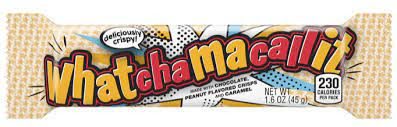
Yes, Hershey introduces the Whatchamacallit, a candy bar made with peanut butter crisps and chocolate (later to include caramel and whatnot inside to create the bar sold today, according to NEPA Scene). The Whatchamacallit was touted with the slogan, “It’s almost as much fun to say as it is to eat!”


Am I saying that the Whatchamacallit is what turned the misery of the seventies into the dynamism of the eighties? Well. not exactly, but it didn't hurt.

Let's bring the timeline up to date. Here we are in 2022. Everything looks like crap. The government is compromised and can't be trusted. The Chinese threaten war. The Russians are bumbling around with heavy ordnance and still have those nukes. Global warming has pretty much pushed the other world-ending disasters off the front pages, except that we all saw how a (likely Chinese engineered) virus spread quickly and probably accidentally -- maybe the next one will be a lot more fatal. Inflation is out of control; we have a labor shortage and high unemployment at the same time; the younger generation is hopeless and the older ones just want to hang on to what they have until the Grim Reaper comes. The music is terrible. The movies are worse. Incompetence by people convinced of their own value is the order of the day, and it shows. 

And now, into this bleached and burned landscape, Hershey brings us....


The Whozeewhatzit is a new candy bar, and it's great. It has a layer of peanut butter under the chocolate coating, not enough to dominate the flavor, and a thick brick of Krackel-type chocolate crisp below. The flavor balance and the texture are right on target. I say this one is a winner. 

Will it be enough to turn the tide? Who can say? We can't be cocky. Hershey introduced the Thingamajig bar in 2009, another bleak era, and discontinued it in 2012. Sometimes the problems are not done getting worse, and that was surely the case in the tremulous oughts and early teens. 

But like its ancestor, the Whatchamacallit, the Whozeewhatzit could be a harbinger of a prosperous age to come. And if the age doesn't arrive, at least we can eat good candy while we shiver in the dark. 

Monday, October 5, 2020

White chocolate supremacy?

Got a case of the Mondays? Tired of all the fighting and fussing in our society? Well, let's start the week off with some candy! And since we're in October, it's finally appropriate to delve into the Halloween loot. 


Mmm, Reese's White Chocolate and Peanut Butter. But wait! What's this "white créme" stuff? I'm sure I saw these on sale last year, but was nothing about white créme, whatever that is. 

Of course, there were lawyers involved. According to an article in Confectionary News from July 22, 2019, "Consumers filed a complaint in the Eastern District of New York last month alleging that the confectioner was knowingly deceiving consumers. The suit alleges that Hershey has engaged in deceptive trade practices, negligent misrepresentation, fraud and unjust enrichment, as well as breach of express and implied warranty." 

Whoa! Sounds serious! What's all the hubbub, bub?

It's all because "the ingredient deck omits cocoa butter -- the key ingredient in real white chocolate -- which the defendants [I think they mean plaintiffs] claim as misleading."

Well, I think we can all draw the same conclusion from this terrible circumstance -- that our country has too many goddamn lawyers with too much goddamn time on their hands. 

Hershey countered that its wrapper did not say White Chocolate; the regular candy was just called "White Reese's" and still is. However, in response to the lawsuit I suppose, they are now specifying that it is "White Créme" and peanut butter. According to Taste of Home magazine, "Even though it technically isn’t white chocolate, it sure does taste the same."

You ask me, the term "white créme" is a little suspicious on its own. Try not to think about it.

Really, who the hell cares? "Real white chocolate"? White chocolate isn't even real chocolate, so what's the issue? With all the things going on, even all the things that were going on a year ago, we had to waste the court's time on this? If the suit had gone forward, would we have seen commercials about it? "If you or a loved one has been exposed to fake white chocolate, you may be entitled to compensation." Then Spencer and Sheehan, the class-action weenies who brought the suit, would get fifty million bucks and the "injured parties" who signed on would each get a coupon good for one (1) Hershey bar. 

It must be said that the Eastern District of New York courts seem to have a lot of time on their hands as well, working on political hit jobs of the president among other stupid things. Might as well get into a candy imbroglio as anything else. 

But enough of that -- let's get to the important stuff. How does the White Reese's pumpkin taste?

I agree with Taste of Home; not one person in a hundred could tell that "white créme" is white chocolate. My wife, who doesn't like white chocolate, wouldn't like this much either. I did, but I have to say that peanut butter doesn't work as well with the white whatever-it-is than with milk chocolate or even dark chocolate. Peanut butter has a strong flavor, and aside from its sweetness, the white stuff has a mild flavor, so the PB overwhelms it. 

I don't care. It was good. So don't try to get me involved in your class-action lawsuits against Hershey's, you blasted ambulance-chasers. It's fine no matter what the company calls it. Happy Halloween.

Thursday, May 28, 2020

Break me off a piece of that birthday cake.

As you may know, I've become something of an expert on things that taste like birthday cake that are not actually birthday cake. A few of my investigations can be found here, here, here, and here.

This week brings a new one, in the guise of Kit Kat -- and I mean the candy bar, not the cabaret:


The cashier had not seen the display for this product in the store, and was very excited about it when she saw it in my order.

The Kit Kat bar has an interesting history, especially in the United States, as summed up nicely by the History of Candy site at Penn State. It was invented in 1935 by the British chocolatier Rowntree’s. Says the History site, "The name of this delicious candy comes from the Kit Kat club, which is named after  Christopher Catling. Catling would hold a famous political and literary club in his London pie shop in the 17th century." But the weird thing is that while Kit Kat is sold everywhere else as a Nestlé product, in the United States it is a Hershey product. Rowntree's licensed the trademarks for the U.S. market to Hershey beginning in 1970, a license that did not lapse when Nestlé bought Rowntree's in 1988, per our old pal Wikipedia. It's one reason that the primary Kit Kat bar is different in the United States than in other countries. Then again, Nestlé isn't even Nestlé anymore in the U.S., since the Swiss company sold its American candy business to Italian candy king Ferraro in 2018.

Also, Hershey gotta Hershey; anyone familiar with the history of the company and its founder, Milton Snavely Hershey, knows how he was so sore when the Swiss wouldn't show him how to make milk chocolate that he went and invented it all over again himself -- in a distinctive type and flavor. That said, the chocolate in a regular American Kit Kat has never tasted like Hershey's typical chocolate to me. But I do believe that the company fooled around with the Kit Kat formula to try to make it more appealing to the American palette.

Enough of this schlep down memory lane; how does the new limited edition Birthday Cake Kit Kat taste?

Pretty darn good!

Despite white chocolate replacing the milk chocolate, it is not insanely sweet. The cake-flavored wafers seem to keep it in check. It has more birthday-cake flavor (meaning yellow cake with vanilla frosting) than any of the other birthday products I've tried. And yet it has that nice, light Kit Kat candy mouthfeel and crunch. Really good job on this one, Hershey.

I see online that other countries have a ridiculous variety of Kit Kats; Japan has ten unique flavors ranging from must-try (Strawberry Cheesecake, Grape, Choco Banana) to crazy-rich-Asian (Apple Vinegar, Sweet Potato, Wasabi). I don't think Hershey is willing to push the brand that far, but you never know. We live in wacky times. Why not an American version of Japan's Sweet Corn Kit Kat?

Tuesday, December 26, 2017

Next up: Hershey's Myrrh.

Hello again! It is I, your post-Christmas pal, ten pounds heavier from the feast yesterday. By Jove, that goose must have been as large as a Victorian urchin! 

Which is why, if I'm going to write about Hershey's new candy bar, I think I'd better do it now rather than after my doctor's appointment later in the week, when he discovers that my blood test result reads 70% Dark Brown Sugar

Hershey's unleashed its first new Hershey's branded candy bar since the Cookies 'n' Creme in 1995, a sort of white chocolatey bar called Hershey's Gold. It was in all the papers. It's said to be made of "caramelized creme," which tells you very little, and includes "peanuts & pretzels." Here it is, clothed and naked. 


A few things you notice right off:

🍫 It's not chocolate. It's not, in fact, just colored white chocolate either. I don't know what it is if it isn't white chocolate. You'd think you would be able to tell by the taste, but it doesn't really taste like white chocolate.

🍫 It's very thin, like the original Hershey bar, so the peanut and pretzel bits are microscopic. I couldn't really tell they were in there, except for the very satisfying crunch. It gives the bar a nice texture, but the flavor, especially of pretzel, is barely detectable.

🍫 They played with the pieces. A normal Hershey bar is just a line of rectangles that can be snapped off for sharing (yeah, right) but the Gold bar has pieces of differing dimensions and is not lined up. Those Hershey rascals!

🍫 I liked the flavor quite a bit, and I knew it was familiar, a taste from long, long ago. It took me some time to realize what it was, and it was a surprising revelation:

Mary Janes.

I'm sure some Halloween along the line you had Mary Janes, the peanut butter chew from 1914 that Necco still makes. The distinctive taste of the Mary Jane comes from its combination of peanut butter and molasses. That's what I got from the Hershey's Gold.

Molasses is not listed as an ingredient on the label, but sugar is, and that could include sugar extracted from cane in the form of molasses. Or perhaps the caramelization of the "creme" made it molassesy. I happen to like the taste of it, and it's definitely nice here, not overpowering.

So my review is: If you liked Mary Jane candies but you didn't like the way they resulted in or yanked out fillings, you will probably like the Hershey's Gold. It has a lot in common with white chocolate, but not the flavor. Of course, your mileage etc. etc., and I welcome your thoughts, reviews, and general snide remarks.

Just remember to compare notes quickly; after New Year's, it's kale all day, every day. 😭

Thursday, September 7, 2017

I want... this candy?

Nestle and Hershey. Two of the greatest fighters in the chocolate wars. Two unstoppable titans of confection, rolling over the landscape with rich chocolaty goodness.

And yet, they still make some candy that makes me wonder what they were thinking.

Hershey has been promoting its Flavors of America products all summer. This campaign extends to various product lines and regions, such as Strawberry Kit-Kat (California), Key Lime Pie and Orange Cream Pop Twizzlers (Florida), Coconut Almond Kisses (Hawaii), and this:


Cherry Cheesecake white chocolate Hershey's bar for my home state of New York.

I liked the concept, cherries being a great New York crop and the city having its own style of cheesecake. In that way it combined the agriculture of upstate with the cuisine of the Big Apple. But this candy bar is pretty meh. Hershey's white chocolate doesn't usually taste like much but sugar, and this one has a weird almond flavor that overwhelms any cheesecake taste it might have. There's no almonds listed in the ingredients, so it had to be an artificial flavor added for no reason. The "crispy cookies," which presumably take the place of the crust, should have been sponge or vanilla or even graham, nothing almondy. You get some cherry flavor, but it's not too good. Got to give this one a D, Hershey.

On the higher end of the scale we have Damak, by Nestle.

Looks fancy, huh?

Damak has actually been around since 1933, but not in the United States, not until last year. When I saw it I asked myself, "Self, have you ever had a pistachio chocolate bar?" And I thought that while I might have had chocolate-covered pistachios in a boxed assortment, I could not say for sure. So, Damak was purchased.

And with this, too, I was disappointed, but for totally different reasons.

The chocolate was indeed very nice, a cut above Nestle's normal chocolate, which is quite good already. But to my surprise, the pistachios disappeared in it. I've always loved pistachio nuts, which have a flavor quite distinct from other nuts, but the chocolate was too much for it. And I got the milk chocolate, not the dark, which usually has a stronger flavor than milk. What would you taste then?

Of the two I'd say I liked the Hershey bar less, but it was cheap, so the investment was small. I just think that the Damak bar was missing something, but since Nestle's been at it since 1933, someone must love it, and Nestle's probably not going to mess with it because I said something.

As always, I'd love to get your opinion on these (or anything else) in comments, or at frederick_key AT yahoo.com. We need to improve our empty calories, and our only chance is if we pull together.

Sunday, June 18, 2017

What's for breakfast?

Father's Day! They're going to whip up a nice breakfast for the old man, right? Let's see what tasty confections await us down at the breakfast table! Boy, I can't -- 

What the hell is this?


Sure enough, it's what you think it is -- General Mills has released two breakfast cereals based on the most popular varieties of Girl Scout cookies, Thin Mints and Samoas (alias Caramel deLites). I spotted these in Walmart a few days ago. What kind of sad, sorry, cookie-inhaling fat bastard would be desperate enough to buy these?

So I bought the "Caramel Crunch" and tried it. Sure enough, the Internet's #1 cereal mentor, Mr. Breakfast, was already on the job, and I completely endorse his review:

The thing that makes Somoas cookies so good is coconut and gooey caramel lined with chocolate. By contrast, this cereal just looks like little cinnamon donuts. The flavor of caramel is there, but the coconut is so subtle that I'm still not sure if I just imagined it. There is no chocolate element to the cereal.... it still feels like General Mills is on their way to making a truly great caramel cereal one day, but this cereal is a stepping stone to get to that eventual product.
That was my feeling exactly. You really wouldn't know it was supposed to taste like a Samoa unless you saw the box. It doesn't mean that the cereal is bad, as it isn't -- crunchy, not preposterously sweet, caramelish -- but as a cereal version of the cookie it fails. (Mr. B says the Thin Mints cereal does a better job of approximating its cookie.)

Having had our cereal, what else is part of this complete breakfast, hmm? Waffles?


Almost two years ago to the day I investigated the Belgian Boys and found that they are a small outfit making these tasty Belgish treats. Tasty they are, especially the chocolate-covered liege wafel. The non-chocolate wafel has pearl sugar, which are delightful little droplets of hard sugar -- the chocolate ones have pearl sugar too, but it's kind of lost in the chocolate. These treats are like, if a standard waffle had a baby with a cookie. Like a pizzelle with a weight problem. As with the other Belgian Boys products, these are not quite really breakfast foods, though. Then again, neither are cookie-based cereals.

So all this sugar is getting to me; how about some nice healthy yogurt?


We've been following a lot of yogurt fads since Dannon stopped putting out its yogurt with those little cardboard lid discs. Mix-ins, Greek, Aussie, quark, lactose-free, whole milk... the yogurt aisle has grown to vast dimensions. But one thing Yoplait will keep doing is coming up with wacky flavors. Like root beer float.

This flavor is part of their Whips! line, which is yogurt whipped up to a creamy, almost whipped cream consistency. It looks like this:


You may note that that looks exactly like a scoop of ice cream does when it's been sitting in a glass of root beer for a while. Well played, Yoplait.

Here's the thing I find interesting: Hires, Barq's, Mug, and A&W root beer all use natural and artificial flavors, while Yoplait's root beer yogurt uses only natural flavors. Why is that? Why can't the guys who make actual root beer use all non-phony flavors? Are they scared of something? Is there some magic root beer ingredient that will degenerate after the shelf life of a cup of yogurt but shorten the shelf life of bottled soda? We want the truth, soda people. I suggest appointing a special prosecutor.

Well, after that meal you really ought to brush your teeth -- but if you can't for some reason, like you're at a funeral, maybe you could pop one of these:


I was surprised to see the labeling change in Breath Savers, a line of mints by Hershey that has always tried to get its packaging to make you think of whooshing through a frosty landscape, like you're on skis.

Whoosh!
The new font is attractive and completely counter to what has gone before. Looks like Century Schoolbook, or a reasonable facsimile. It caught my eye, which the old packaging never did. I suppose that's the point -- that, and as a means of focusing on the "breath" part, the way Certs (by Mondelēz) always has.

The problem for me is that Certs always tasted good and Breath Savers always tasted lame. Why? Sugar. Nowhere does fake sugar taste more fake than in candy. Breath Savers and other sugarless candies have always tasted like plastic to me. Some are better than others; the sugarless Werther's are not quite as obviously artificial. But they don't freshen your breath. And if you're going to freshen your breath after eating, why use a sugary candy and rot your teeth?

Well, that's enough Father's Day breakfast for me; back to bed! See you Monday!

Monday, May 1, 2017

The music of chocolate.

Writing about the new caramel M&M's the other day got me thinking about American chocolate in general, and about the quality issue in particular. A lot of people will be happy to tell you that American chocolate is lousy, unless it's small artisanal batch stuff -- and I'm not even going to link to any of the online stories, because these people can't seem to make a point without using foul language, as if it proves their superior taste. 

Most of them object to Hershey's famous milk chocolate, which many Americans don't realize is kind of strange. There's a reason for that, which I'll get to shortly, but I wonder if American chocolate haters have tried this:
It seems that over the years our major chocolatiers have striven to make some quality stuff, while not giving up on your everyday street chocolate. (Whitman's Sampler; too legit to quit.) Mars makes Dove chocolate; Hershey's has products like its Pot of Gold line, featuring more expensive chocolate. And the Symphony bar, above, is just what America haters supposedly want in a chocolate bar--a creamier, richer flavor with more cocoa butter. Wikipedia says that when it was introduced in 1989 it "marked the first departure from Hershey's original milk chocolate recipe in 1894". I've had plenty (i.e.: whole great big lot) of European chocolate and I find that U.S. companies, when they make the effort, can stand with anyone.

And if it helps the America haters, Godiva has been headquartered in America since the 60's.

What got me thinking about the Symphony bar and Hershey's in general was in fact the caramel now found in some M&M's. I worked on a book about Milton Hershey some years ago, and to me, he was the most amazing of America's rags-to-riches tycoons, with the possible exception of Thomas Edison. It's a topic I've touched on before but it's fascinating.

In the 1800s, chocolate was almost unknown in the U.S., because it was dark and hard and... basically the stuff we're supposed to endure for its health benefits now. Caramels were the main candy. Milton set his sights on becoming a candy manufacturer, a goal hindered in many regards by his semi-estranged father, who "helped" his Manhattan store fail miserably. He failed twice at the game, in fact. If the senior Hershey had helped any more, we'd have never heard of Milton Hershey.

Milton did ultimately become a huge success -- as a manufacturer of caramels. Then the Swiss came out with milk chocolate, a complete game changer. Milton went to Europe to find out the secret, because inventing milk chocolate from cocoa beans is extremely difficult, as it turns out. But those Swiss fellows---guys named Nestlé---jealously guarded their secret (a dehydrated "milk flour"), and Milton returned home empty-handed. Then he did the crazy thing.

Without knowing how to make milk chocolate, Hershey sold his successful caramel business, the business that he'd worked his tail off to build, and poured his money into inventing milk chocolate all over again. Obviously he succeeded. And this is why Hershey's milk chocolate has a strange tang that no other milk chocolate does -- because he created a different method for making milk chocolate from the one that was in use by Europeans at the time.

At the end of his career, when he was one of the most wealthy and famous men in America, he got a little bored and the inventing bug bit again. He tried to create cocoa butter soap, and wound up peddling it in person on the Atlantic City boardwalk. Of course he was recognized. The soap was a failure, but I think he was just having a grand time.

If you want to know more about Hershey, one terrific book I used for reference was Michael D'Antonio's Milton S. Hershey's Extraordinary Life of Wealth, Empire, and Utopian Dreams. If you want to know something good about Hershey chocolate, try a Symphony bar.

Wednesday, March 25, 2015

On the Avenue... Fifth Avenue...

What I don't eat for you.


Hershey makes the 5th Avenue bar, but you'd hardly know it. You don't see the Hershey logo on the wrapper. Heck, you almost never see the wrapper. I know only one store in town that sells these.

The history of the 5th Avenue bar is shrouded in mystery, and possibly conspiracy. I'm serious. The Wikipedia page says it may have been introduced by the Luden's company in 1936, but "This date is uncertain because information about this product has been subject to misinformation from The Hershey Company for marketing and perhaps legal reasons."

What the hey? Hershey has sent the history of this thing down the memory hole? What is this, chocolate bar or commissar?

Indeed, Hershey's page has almost nothing to say about their own candy bar. "First introduced in 1936, this chocolate peanut butter bar contributed to the war effort—and is still enjoyed today." Which 1936 war would that be? Was the 5th Avenue bar a major player in the Spanish Revolution? WHAT ARE YOU HIDING, HERSHEY?

As for the bar itself, it's virtually identical to a Butterfinger, which is of course a Nestle candy.

The tragic thing is, the 5th Avenue bar used to have a couple of almond halves on top, which would have differentiated it from the Butterfinger. They removed the almonds in 1988. In John Homans's Wilber Winkle Has a Complaint!, the fictitious Winkle wrote a genuine letter to the actual Hershey's company to complain about the almond situation (this was in 1993). Hershey's claimed that the change was part of a revamping to improve the quality of the bar, and customers liked it better (it's virtual demise on candy shelves by 2015 would seem to expose that as a misrepresentation). Winkle did not let it go, pursuing the matter in letter after letter through most of 1994. They should have listened to Winkle.

Hershey bought the candy from Luden's parent in 1986, says the Wiki article; the better-known Luden's cough drops are now sold by Prestige Brands, which also has Goody's headache powder, Clear Eyes, Dramamine, and a whole potpourri of other OTC medical stuff. Hard to believe that Luden's started out as a candy company.

1965 Life magazine ad. This girl is probably 68 today. Just sayin'.

On the whole I liked the 5th Avenue bar, even though it originated in Pennsylvania. It didn't really make me think of the street.


Hey, I wonder if Hershey's bought Almond Royal too...? Mmmm...


Monday, June 30, 2014

Unholy marriage...

...of Nabisco and Hershey:

Evil.

This is just cruel.

Unless you're one of the unfortunate souls that is allergic to peanuts or, even more tragic, chocolate, you're aware that Reese's Peanut Butter Cups (made by Hershey) are among the world's great candies. And Nabisco's Oreo is one of the world's great cookies. But we thought they were safely tucked away in their respective universes, like Loki and Set, Doctor Doom and Lex Luthor, Darth Vader and the Daleks. But something happened, and now this temptation to fat has been fired at us, and right at the start of swimsuit season. What will it do to my girlish figure?

I saw them in the store and desperately wanted to try them, but couldn't justify smuggling the calories into the house. So I texted this picture to the lovely Mrs. Key in a "Can you believe this?" manner and she texted back "BUY!"

I love her!

Her review was similar to others on the Net, as it turned out---too sweet, for one thing. "Too sweet" is a concept with which I am not overly familiar, but the point is taken. The Oreo doughnuts that have just made their annual reappearance at Dunkin' Donuts are really, really sweet, so it seems to be a Nabisco risk they run, a fine knife's edge trod by the Oreo people as they skate where angels fear to tread.

Eviller.
But I liked the Oreo Reese's. I've always been one to walk on the dark side. Or at least the oversweet chocolaty side.