Showing posts with label library. Show all posts

Tuesday, December 17, 2024

Librarians eaten.

I hate this stuff.


What they think they're doing: Showing that "different" things aren't scary.

What they're actually doing: Showing that heroic men are idiots.

Here's the deal: Dragons are mythical creatures intended to be scary, even if they are good, as in Chinese mythology. A cuddly dragon is a non-dragon creature of some other kind. That's the point of dragons. 

I'm sick to death of dragons being the good guys. Dragons want to eat us. Dragons are no good for human companionship. Dragons suck. Boo dragons. Leave them alone.

Where did it start? Ogden Nash's "The Tale of Custard the Dragon," about a cowardly dragon (who does in fact eat a human)? Anne McCafferty's Dragonriders of Pern series? Wherever it did, we find now that the world is on its head, that the dragons are always (surprise!) good and the guys who want to take them out bad. Whether it's Dragonslayer, Dragonheart, How to Train Your Dragon, it's hard to find a dragon in fiction that's not the good guy. It's like finding a police office or priest in fiction who is the good guy, especially if he's white and male -- like finding hen's teeth.

It's all part of the crap that gave us Wicked and all the new Disney pictures that root for the bad guy. (As long as the bad guy is, you know, a girl -- Captain Hook and Gaston remain bad.) The ladies are just misunderstood, you know. Men were mean to them, probably. That's why they're bad. 

Or maybe they're just power-hungry crapweasels. I don't care what made the green babe mad in Oz; if she sends a pack of wolves to rip up a little kid, kidnaps her with terrifying flying monkeys, and threatens to slaughter the little girl when the sand runs out of the hourglass, to hell with her. Drop a freaking house on her. SHE'S THE BADDIE. How she got that way is irrelevant; she chose her path. 

As Germán Saucedo wrote recently in First Things:
The clear images of true evil present in the best fairy tales, ballads, myths, and legends offer both a vision of what is to be avoided at all costs, as well as a vision of virtue. As such, the “sympathetic villain” genre is a symptom of a society that disagrees on what is good and what is evil, or that tries to explain evil away as trauma, psychopathy, or pathology. But to identify and avoid evil, we must first learn to recognize the good. The insistence on subverting villains is a sign we have lost confidence in our belief that we can know what heroism looks like, a heroism that displays the good that would oppose their unrighteousness. In a world without any moral certitude or any agreed upon system to define true virtue, what is wickedness anyhow? It would be just a matter of perspective.
In this light, we see that stories like this tell us a lot more about the storyteller than they actually do about good or evil. 

One dragon story that takes a more serious approach to the topic was based on Fred Saberhagen's Swords books, which I discussed here last year. An Armory of Swords features stories by other writers about what happened to various normal people whose lives were touched by the mighty god-forged Swords that were circulating the world. In "Dragon Debt" by Robert E. Vardeman, my favorite story in the collection, a young man comes into possession of Dragonslicer, the Sword of Heroes... and also a small, helpless baby dragon. A moral dilemma ensues in which the stakes are not small. 

The point of dragons is that they're dangerous, and dealing with them requires valor, not tea and cookies. Pretending they are all nice and lovely is just pretending that there is nothing really dangerous in the world, which we know is false. As C.S. Lewis wrote in the essay "On Three Ways of Writing for Children," "Since it is so likely that they will meet cruel enemies, let them at least have heard of brave knights and heroic courage. Otherwise you are making their destiny not brighter but darker."

Meanwhile, the librarian type in the meme above are the sort who expect their native goodness to make everyone but the genuinely evil side with them -- and when people don't, they go on TikTok demanding the ruin of their lives. 

I've had it with dragons, but when the one pictured above turns on his bookworm buddies and eats them, I will offer him a mild nod. Not that I want the wicked dragon to win, but smugness and stupidity must be punished if we're to understand why these are bad things. 

Sunday, December 8, 2024

Book thief!

Voltaire is supposed to have said, "Only your friends steal your books." I have not been able to find the quote to verify it, although it sounds like him. I have also heard a version as "Enemies steal your money; friends steal your books."

Nevertheless, there is truth to it. 

A friend of mine has recently found himself with time on his hands, and mentioned that for the first time in many years he is looking for books to read. I happily loaned a few from my library, most of which he enjoyed. 

Then he gave them away to other people. 

This is one reason why friends steal books -- if they are not true book lovers, they don't see the value in keeping a book at hand. Then they pass them along, figuring everyone should enjoy this nice book. I honestly had not anticipated this, but when he told me that he gave one of my books to his son and another to a friend, I knew I'd never see them again. 


"That's my book in your pocket, isn't it?"
“No, I’m just happy to see you. And
I have a rectangular schmeckele.”

I can sort of understand it, and yet at the same time I don't. No one does this with anything else. If I leant him a coat or my car or some tools, I know I'd get them back. He is very honest. I'm pretty sure if I'd leant him a DVD, he would not send it along downstream for someone else to watch. And yet hardcover books and many paperbacks are more expensive than CDs and DVDs. Maybe they expect you’ll watch a movie over and over, but no one ever rereads a book.

When I've stolen a book from a friend, I did it the old-fashioned way -- forgot to return it. Sometimes the book didn't grab me, or I had no time, and was determined to get back to it, only to find years later that it had been in my possession far longer than it ever had been in his. That's not larceny, which requires intent, but I still didn't give the book back.

Well, my pal still is looking for things to read, so you can figure what I have done -- I've bought him some as a Christmas present. I hope he enjoys them, and the same to whomever he sends them to next. I will not have to worry about those books. 

Monday, January 15, 2024

Bad words.

As usual, those on the Left are portraying themselves as champions of banned books, but not giving the facts behind the books the Right want banned -- which are only and specifically graphic sex books from kids' libraries. Seems like a reasonable ask.

On the other hand, conservatives are not the ones who subject books to diversity and sensitivity readers. These new drugs on the market are paid by publishers to read books before they go to press and flag things that might be offensive or triggering to readers. But only certain readers, as we shall see. 


Obvious ones are, of course, words insulting to ethnicities, but there's definitely a hierarchy in place. Words that have been used to insult blacks are out entirely (unless maybe if used by a black author). Even if an evil character uses the word, it cannot be allowed in print. Words offensive to Latinos face automatic ejection as well, but may not bring the ban hammer down on the author. I'm told it's all about context.) Words that insult Asians of any type may be used if important to the story. Jews and other whites (all Jews are now whites even if they aren't) are fair game. 

Wops, Micks, Dagoes, Krauts, Squareheads, Hebes, Polacks, Rednecks, Crackers, and so on -- use them all you want. And as a white guy I have no problem with that. Here's a little white secret: We use those terms on one another, even within our own families.

Some ethnic words have to go, we are told. But there are many words that you might not know are ethnically insulting that are also banned. Cakewalk, for one, has a historical background that makes it (all together now!) problematic. Master bedrooms are no more, as you may have heard. And don't talk about slaving away on a project, even for comic exaggeration, even if you had a Castilian ancestor sold into slavery by the Barbary pirates. 

Of course, insulting words about sexual orientation are right out. So is misgendering -- and this can be a bear trap for the unwary, as there are now more genders than Baskin-Robbins flavors. This also means you can't use any collective noun that implies gender -- not just the long-despised mankind but also guys as in Hey, you guys! Even ladies and gentlemen, which used to cover everyone, is insulting because it leaves out those who do not conform to either or who choose multiple genders. 

Let us not forget the words that are banned because they might offend the differently abled. Bruce Springsteen can no longer be blinded by the light; he may be dazzled or find it difficult to see but not blinded. Never mind that the light actually caused a brief loss of vision; the verb is no longer allowed. Similarly, deafening is out. Dummy is no good anymore, not because it offends the mannequin-American community, but because it was used to make fun of deaf-mutes. 

Crippled? Are you kidding? Banned for life.

What about the crazy people, you ask? Well, you are now banned for using the word crazy. Mental illness isn't funny, buster! Wacko, looney, nuts, ga-ga, all those words are problematic because insane people need love too, right up until the moment they shoot up a school. (Then it's the gun's fault, anyway.) 

Don't expect to get away on technicalities. Words that sound like banned words are also banned, even if there's no connection. A guy lost his job for using the word niggardly, which comes from Middle English and Norse (hnøggr, meaning stingy). Merriam-Webster even warns against its use -- not that it can bring itself to use the word that it sounds like. As for spick-and-span, its origin is "short for spick-and-span-new, from obsolete English spick spike + English and + span-new" -- but you'd best drop it anyway. I'm surprised KIK Consumer Products still uses the brand name Spic and Span.

🔨🔨🔨🔨🔨

Most of you know I'm a pretty nice guy, and I genuinely try to be respectful to everyone. But I'm also respectful of the idea that speech must be free, and not restricted among adults for any trivial reason, least of all because someone might get annoyed. (Christians have been getting annoyed for 2,000 years and no one worries about our feelings.) Adults have the freedom to not listen to or read something we don't like. If its very existence bothers us, we need to grow up.

I have one simple message, and if you never remember anything else I've written, I would ask you to remember this: 

Do not take seriously the claims about banning books by people who are set on banning words.

Thank you and good day!

Friday, October 20, 2023

Before the bomb dropped.

Soon after September 11, 2001, I was in a supermarket checkout line. I was looking at the cheerful covers of the magazines on display near the register, magazines written and printed and distributed before the attack. I was thinking that they were each a window to a more innocent world we had just left behind forever. 

Here's something funny. 

I got a couple of books out of the library, doing fact-finding research. One of the books hadn't been checked out in some time, I guess, and it looks like the last person to take it out didn't throw away the checkout slip. Maybe the reader had been using it as a bookmark, but if so, he or she got less than halfway through the book. 

There's some hard-core irony at play here. 


Due date: February 21, 2020. Ten days earlier the World Health Organization named the Wu Flu COVID-19, a name that would swiftly become burned in our minds for the rest of our lives -- lives that would also be shortened, in a great many cases. 

A couple of weeks after that due date, Italy would be the first country to initiate a national quarantine. Two days later the WHO would declare COVID-19 a pandemic. By March 21, ten thousand would be dead and the total number of cases about 250,000. And you know the rest. 

"Stuck indoors because of the cold?" Lady, you don't know the half of it. 

This definitely has a little frisson of seeing, say, a "Visit Lovely Pearl Harbor" postcard mailed December 5, 1941, or an "I 💖 NY" postcard mailed September 10, 2001 -- or a poster for the Supernova music festival put up October 1 of this year. A little less so because COVID was a slow-growing catastrophe, but similar in that government intelligence was ineffective prior to the event. Also, in the case of the vicious surprise attacks, the evil was front-loaded. In COVID's case, while I believe the virus was man-made with American funding (using shenanigans to contravene US law about gain-of-function research), I think the release of the virus was accidental. In that case, the evil was back-loaded, with the purposeful wickedness coming later. 

All this leads to a lot of finger-pointing, because there are always people who could have prevented or prepared but were stupid or evil about it. But it also leads to "if only they had known" thinking -- If only you, innocent library patron, had known in February 2020 what was coming your way! And that leads to What's coming our way now that we don't know about? thinking. And that's the worst.

Friday, March 3, 2023

Naughty, naughty words.

The silliest words are completely taboo now. Including taboo, because it might offend some Tongan people out there. 

Censorship has been in the news again, although the proponents aren't calling it that. Roald Dahl's books are getting the workover to remove offensive words like "fat" and "ugly" that might offend people who are... well, fat and/or ugly, I guess. I never liked Dahl's children's books -- he was not a lover of humanity, and his writing for adults has a high enough body count to back me up on that. But you don't even have to read those stories. Spoiler alert: In Charlie and the Chocolate Factory we have children being blown up and squashed, permanently discolored, thrown in the garbage, shrunk and stretched out, and all kinds of things I found traumatizing when we covered the book in second grade. That stuff's fine, but we can't use words like "fat"? 

If they think that taking insulting words out of the discourse will make children be nicer to one another, they have never met any children.


Even dumber of course (ooooh, dumb is a taboo word too!) is that Fleming's James Bond books are getting the treatment. For the love of all that is good, if you're an adult and you can't handle a seventy-year-old spy novel, you ought to go back to singing "Baby Shark" and let the adults talk. 

The American Library Association is useless, as always. They love to prance around with their so-called Banned Books Week in the fall. Altered Books Week is never going to happen, though. They're all for it. You might hope that the dead authors' estates would fight against this nonsense, but they couldn't care less, as long as the money keeps rolling in. 

Lately I find more of the companies I work for employ sensitivity readers, people whose entire job is to go off like a smoke detector if a bad word comes up. Not bad as in obscene, blasphemous, or grotesque, but bad as in possibly offensive to one of the many grievance farmers out there working the fields. Words like dumb (insults the deaf), insane (insults the crazy), handicapped (insults the handicapped), fat (covered above), hooker (insults sex workers), mumbo-jumbo (I think this is cultural appropriation), addict (insults bums), grandfather (as verb, from its relation to Jim Crow laws), master bedroom (because only plantations had master bedrooms?), and anything that might suggest masculinity, like fireman or congressman. Also any possible use of black in a negative sense (as in a black mood), or any use of white in a positive one (which will be a bummer to the saints in Revelation 7, who "came out of great tribulation, and have washed their robes, and made them white in the blood of the Lamb"). And you'd better not have a character wear moccasins. Although they have been a style in the shoe industry for more than a hundred years, now they're culturally insensitive.

Sensitivity readers have to keep coming up with new words to ban, if they're to justify their phony-baloney jobs.

We need more insensitivity readers. Speech is supposed to be free in this country, and we need to toughen the hell up. I was rereading a 98-year-old book by an Englishman and was surprised to find an incidental use of the old N-word. I'm an adult; I can that the author was using the term in a reflection of the attitudes of colonialists, whom he firmly opposed. But I dare not tell you what book or author it was, lest the Kancel Kops come for him next.   

One word that the sensitivity Nazis ignore, of course, is Jesus in a perjorative sense. It's peachy with them that some readers will be offended over that. It's ducky. No problemo. I've heard it said that Christians are the only religious people who consistently use the name of their Lord in vain, and that's probably true. But not all of us. However, that's not something a sensitivity reader worries about. 

After all, it's not like saying a simple scientific sentence like "Flowers contain male sex organs called stamens and female sex organs called pistils." That could get you fired. Who are you to assume that flower's gender?

Tuesday, February 28, 2023

Cull the herd.

I know the time has come to get rid of some books. 

I've talked about this before, maybe on this blog, but I've done nothing about it. In my heart of hearts, I do not want to. As a boy and as an apartment-dwelling young man, I dreamed of one day having a home with a dedicated library. You know -- all wood and leather and comfortable chairs and reading lamps and peace and quiet and books as far as the eye could see. I didn't care what the rest of the house looked like. I never got that far.

None of that worked out -- we have two rooms with large bookcases and a desk with bookshelves and a small shelf downstairs with cookbooks and home books and stacks of books around and a box of books in the cellar that I had stored in my in-laws' cellar and had to retrieve when they passed on. 

And random piles.


Thank God I don't live in an earthquake zone, because I am sure I'd be buried in them one day. People would say "He died doing what he loved" and my wife would say "What, gasping for air under half a ton of old paperbacks?"

If I'm to avoid that fate, I figure I should sort the books first into sets:

1) Books I need to have about me and would take into the grave with me for the afterlife like a Pharaoh

2) Books I treasure 

3) Books I like and would like to read again

4) Books I think I liked and pretend that one day I will give them another shot

5) Books I read but didn't like and won't read again

6) Books I bought new but will never read

7) Books I bought used but will never read

Seems like a pretty easy go from there, right? Just eliminate piles four through seven and I'm done! 

But of course it's never that easy. Deep inside I hate to get rid of books. Worse, no one wants them. I have perhaps three or four valuable enough to sell online, but people don't collect books anymore -- not like they collect really valuable things, like Star Wars figurines. The library doesn't want them -- they certainly don't want paperbacks, although I might convince them to take a stack of new hardcovers that I bought in a moment of madness and now regret. Stores that sell used books, once thick on the ground in any city, are now barely extant. Recycling is the fate of these books, and it'd be sad even if I had not spent actual money on them. 

Well, if I don't do it, one day my wife will be stuck with the job, and that's a sad thought. (Women tend to outlive men by about seven years.) Looks like my dream library remains as far-off as thoughts of being interred in a book-lined pyramid. But I can dream, can't I? Call me Nectanebook, last of the book-obsessed mummies.

Thursday, October 22, 2020

Making a spooktacle.

When a major decorative holiday approaches, I like to canvass the area and see who's doing what. I have to say that my friends and neighbors have mostly not thrown in the towel, or the hole-covered sheet, on Halloween just because trick-or-treating may be cancelled and there's no Great Pumpkin special on TV for the first time in 54 years. 

So here's what I've seen in my jaunts about town, often accompanied by my Canine Praetorian Guard. We'll start with a music number: 


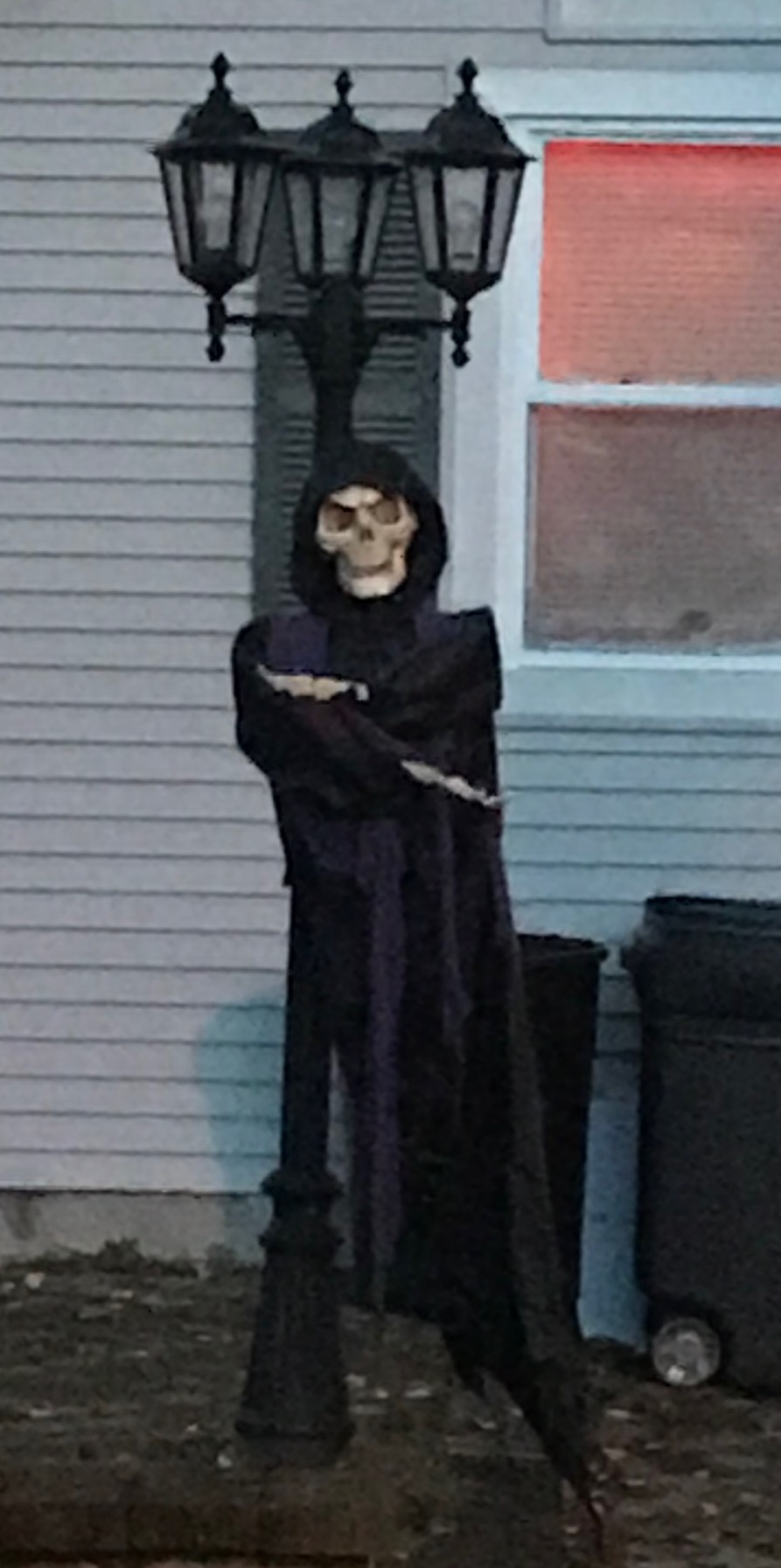
Leaning on a lamp
You think I look a tramp
Or maybe I'm just 'round to steal a soul
But no, I'm not a schnook
You think that's what I look
I'll tell you why I'm on this bloody pole

I'm leaning on a lamppost at the corner of the street 
In case a certain walking dead man comes by
My, oh my
I hope that walking dead man comes by
You see he's doomed
His death has loomed
And by the tomb he'll be consumed
So anyone can understand why
I'm leaning on a lamppost at the corner of the street
In case a certain walking dead man comes by


And here we have good old Jolly Jack. He's two-dimensional but full of cheer.


The maiden aunt of Death, above.


This family's home always seems quite proper. So, no fun decorations. I have no idea where they got the classy Halloween bow. Who does classy Halloween decorations?


Now, that's more like it! Big, fat, inflatable pumpkin fun. The brim is even up at a rakish angle.


The local kids painted the windows of our public library. Frankie and Drac are by far the best work. Unless these are decals. They are good enough to be decals. Now I think they're decals. 


Half upright with bloodshot eyes. This scarecrow is just missing a bottle of MD 20/20. Which would be perfect for this stupid Halloween, as I think about it. Sober up and get a job, scarecrow.


This is not a house that goes in for Halloween stuff, but this year they went game. Made a good job of the big web by the front door. That could actually deter little kids.


Okay, this is sad. Mistakes were made, clearly.


A common problem this year. People think putting out pumpkins is a nice, decorative touch. Sure, if you don't mind feeing the squirrels and chipmunks. So, these migrated from the home's porch to the curb to await the garbage man.


I dig this one. A haunted tree with a churning green light inside! Never seen that before. I even took the two-second video below so you could see it in action.


I was surprised to find out it's an inflatable. When I passed by later that day with the other dog, it was collapsed on the ground like a teenager's sock.


Aaaaand here are the pumpkins by the curb a couple of nights later, when the deer have gotten into the act. 

So that's what's going on around here. How are things where you are?

Wednesday, January 29, 2020

Fred's Book Club: Everything, Useless.

Last week we had my smallest book; this week, the biggest series.

This Wednesday's episode of the Humpback Writers (named for the fact that it runs on Wednesday, not because of the condition kyphosis, "the third basic type of spinal curvature... In its most severe form, kyphosis becomes a sharp angular deformity known as hunchback") features thousands of writers, because of the nature of the book, or really books. Thirty books. Maybe some of the writers did suffer from kyphosis. How should I know?

Here is the set in question:


Yes, fellow kids, it is the thirty-volume set of the Encyclopedia Americana! No, not the one moms bought one volume a week from the A&P; I think that was the World Book (still around) or Funk & Wagnalls (not). I don't wish to put down those encyclopedias, but the Americana (first published in 1829) was a serious general reference set, the kind of thing found in colleges, high schools, libraries, and the offices of educational publishers.


Alas, here's the rub:


This is the 1985 edition. I have a thirty-volume library-bound encyclopedia that is thirty-five years old, and thus terribly out of date.

What the heck am I doing with an encyclopedia, let alone one this old? Did Fred's mommy, sensing the genius of her boy, buy it in installments to help his advanced learning? Did she buy it as a Hail Mary to try to get some information through his thick skull? Did I win it on The Price Is Right? Did I shoplift it from Walden Books using unusually large pants?

No -- what happened was, one of my first jobs when I was a little baby editor Fred, was as a clerk/mail reader/Dude Friday/dogsbody/research assistant/flunky/water cooler refiller/occasional proofreader for a publisher of nonfiction books for youths. The Internet was little more than a twinkle in DARPA's eye at the time, so it was helpful to have things like a big, serious, unabridged dictionary and a big, serious encyclopedia. I worked at this place for a year or so, and then we heard that the company had been bought and the office was moving out of the city. So, everything had to go, including us. We had jobs for a while, mainly packing down decades of stuff, resolving author and production contracts, all that kind of thing. And no one wanted the encyclopedia. It was just going to be tossed. So, although it was dated even then, I decided to bring it home to my apartment, one volume at a time. There's a lot of information in 23,000 pages of six-point type. At the time, I don't think it could have all fit on a CD-ROM; Microsoft's Encarta had been around a bit, but was not nearly as extensive an encyclopedia. I didn't have a computer at the time, anyway.

The Americana was useful for a while, especially when I was unemployed and scrambling for publishing work. I didn't get many fact-checking assignments then, but I did have some copyedit jobs, and sometimes you want to look things up to make sure they're right. Well, we still had no Internet, children, although that was coming soon. And then we did, and I stopped using the books.

(Remember, wee tots, the Internet is only a source, and as a whole not a reliable source, of information; we all need to learn how to pick out the good stuff from the mountains of crap and fake news. And just because I've linked to Wikipedia in this article doesn't mean I endorse it; it's free and I'm lazy.)

These last few years, the main use of the volumes has been propping up electric candles in the window for Christmas. And, as I have tons of other books that can be used for that, I have to let them go. They take up a lot of space.

And they are out of date. In these tomes, Burma is still Burma, not Myanmar, and George Herbert Walker Bush is still alive, and is known as the vice president of the United States (Volume 5, BURMA to CATHAY). Not only is Yugoslavia still intact (Volume 29, WILMOT PROVISO to ZYGOTE) but so is the Union of Soviet Socialist Republics (Volume 27, TRANCE to VENIAL SIN). Persons who have become awfully important in the decades since, like Bill Clinton, Bill Gates, George Walker Bush, Steve Jobs, Barack Obama, Donald Trump, Angela Merkel, Osama Bin Laden, Benjamin Netanyahu, Vladimir Putin, Xi Jinping, all of them were alive in 1985, but none of them rated an entry back then.

You can imagine how antiquated the entries on science and technology are. Just a quick example, about Saturn, quoted from Volume 24 (RUSSIA to SKIMMER): "A total of 21-23 moons are known to be in orbit around Saturn." We now know that Saturn has more moons than any other planet in our Solar System: "A team discovered a haul of 20 new moons orbiting the ringed planet, bringing its total to 82; Jupiter, by contrast, has 79 natural satellites," the BBC reported last October.

It's true that some things don't go out of date like that. The quote on kyphosis at the top of this entry is still accurate, and its brief section on treatment for the condition hasn't aged significantly. But even historic information is liable to change. For example, when these books came out, no one knew where Richard III was buried; his body was located in 2012.

The publisher, Grolier (since become a division of Scholastic), only publishes online editions of its encyclopedias now. I'm sure if you've been in a library in the last decade or so you've seen how much of its information services have been relegated to computers. The last print edition of the Americana was published in 2006. Even the Encyclopedia Britannica no longer makes a hard copy version of its encyclopedia. A full set of a hardcover encyclopedia is pretty rare these days.

And I have to get rid of it.

You can't sell these things. I've seen people try online, but shipping would cost more than you could get. Each book weighs about 3.3 pounds; it's close to 100 pounds altogether. It could go book rate, or what the post office now calls Media Mail, for $2.80 a pound, but who wants it that much, that they'd pay $280 just for the shipping?

Libraries don't want 35-year-old reference books. Nobody wants research that will lead them wrong -- well, I guess some of us do, judging by the misinformation online, but they won't bother to haul out the hundred pounds of books just to confirm their biases. No, old encyclopedias are of interest only to historians, and mainly important encyclopedias like the famous 1911 edition of the Encyclopedia Britannica.

You can't recycle hardcover books here (not that our recycling program is anything but a state-law-mandated charade anyway).

I despise sending good books to the trash heap, but I have to start reducing clutter. So, I've started throwing the Americana out, three volumes at a time, six books a week, for an extra ten concentrated pointy-cornered pounds in each load. Surely throwing the very books I'm writing about into the landfill makes this is the saddest entry in the Humpback Writers series.

Also, one reason why I tip the garbage men at Christmas.

Farewell, encyclopedia! Your scholarly words are too good, or just too old, for this world.

Friday, October 6, 2017

Bad Books Week.

Well, I missed all the fun of Banned Books Week again. I am so completely upset that once again no one has tried to ban one of my freaking books. I'd be on the best-seller lists and making a fortune.


I guess I've read a lot of the books that those self-righteous types celebrate on the Banned Books List, but I would never read one just because it's on the list. It may be striking a blow for freedom, but we don't ban a lot of books in this country (although we're starting to). When we used to think of banned books we thought of pecksniffian town elders getting so upset that a book contained a reference to a woman's ankle that their faces would pinch up like a dead man's anus. Now such old folks are desperately trying to be "down with the people" while banning is beginning to come from the same kinds of folks that celebrate banned books. So there's a good deal of insanity in the ranks.

Typically, though, it was really parents who wanted books to be banned, because they thought such books were inappropriate for young readers. For some reason it is reasonable to say that certain movies are not appropriate for youngsters, but you can no longer say that about books. And publishers seem to be thrilled about it, because when it comes to sex, depravity, and violence for the teen market, they are all in. (I should warn you that the link itself leads to naughty language because it's Cracked, but that should be obvious. Because Cracked.)

Personally I would like to lead a movement for Banned Bad Books Week. We're not going to get rid of books for young readers because they have sex, we're going to get rid of books because the sex in them is stupid and consequence-free. We're not going to get rid of them because they have violence, we're going to get rid of them because the violence is so ridiculous it makes your average superhero movie look like Saving Private Ryan. Above all, we want to ban books that are just bad. Publishers will say they print the books that teenagers want to read, but somehow if Nestle used that argument about Hot Pockets I don't think the nutrition watchdogs would buy it.

I've worked on a number of books for teen girls -- there are no books for teen boys, because boys don't buy books directed at teens when they buy books at all, which they don't -- and most of them end the same way. The heroine is someplace alone, bleeding profusely, but is such a badass she never quits. Here's my take -- and again, language warning, since I want to be accurate:

📗📘📙📕

Kaszandra got up out of the pool of her own blood that was quickly starting to ice over. It had to be minus forty in this warehouse. Wasn't that the same in Celsius and Fahrenheit? Damn, wish I'd paid more attention in Ms. Horkdork's class, she thought. 

But this was no time to review math homework. She ripped the scrunchie from her hair and made a quick tourniquet for the bullet wound on her leg. Devlin DeVille was somewhere in this building, and none of his evil demonic power, none of his obscene wealth, would stop her from destroying him. 

She hopped forward, stifling the scream from the stab wound in her gut. It hurt. She wouldn't have believed there was that much pain in the world. It hurt more than any hurt ever hurt. But all Kaszandra wanted was to stop bleeding so she wouldn't leave a trail for DeVille to follow if he was coming up behind her. 

It was dark as coal in this warehouse, dark as DeVille's heart. Who would have guessed that the richest man in town, head of the local Republican committee, was also a vicious bastard who raped the entire fourth grade? Fucking asshole. She had to destroy him. 

But where was he? She listened carefully, but her ears were still ringing from when DeVille shot her in the head with a potato gun. 

Fucking asshole. 

If only Jassper were here to help, but for all she knew he was--- God, she hated to think of it. She'd hated to leave him under that pile of excelsior, but there was no way she could dig him out. DeVille had planned that trap for Kaszandra, and Jassper had walked right into it, damn his stupid beautiful head, his 24-inch python arms, his rock-hard washboard abs, his---

Whoa, girl, better cool it. Work to do. 

Kaszandra shifted into the shadows, quiet as a mouse in fuzzy slippers. With the fracture in her femur it was tricky, but those three years of ballet finally came in handy. Suddenly she heard a click, or a clack -- was DeVille here, behind those stacks of boxes marked High Explosives? Or was that an echo... an echo from the---

"Catwalk," said a voice, and a bucket of gasoline poured onto Kaszandra's head. 

"You son of a bitch!" shouted Kaszandra. That was the end of this blouse. She staggered back into the center of the warehouse room. Dimly lit above her was the catwalk that ran around the interior of the building, and on that, cinematically lit from above, was Devlin DeVille. 

"Feeling warm, Kas?" said DeVille. He struck a wooden match on his thumbnail and tossed it toward her. Kaszandra gasped and stepped back out of the way of the flaming stick of horrible death just in time. "Things are just starting to heat up around here."

"I'm going to destroy you, DeVille!" yelled Kaszandra, her gasoline-soaked hair billowing around her like a bronze cloud. "You've hosted your last Trump fund-raiser!"

DeVille chuckled. "You're difficult to kill, Miss Hendreson, but we're getting there. Fortunately you are unarmed and a sitting duck. A duck coated in gasoline, I might add."

He was right about the gasoline. But wrong about the duck. And wrong about her being unarmed. Carefully, slowly, never taking her eyes from DeVille, Kaszandra reached up to her sternum where his throwing knife had stuck in her ribs. This was going to hurt....


📗📘📙📕

Oh, to hell with it. This is too easy. I'm going to start writing one of these today. I just have to sign my books F. P. Key and use my wife's photo for my author picture. See ya on the best-seller lists!

Monday, October 20, 2014

Bless me, librarians, for I have sinned.


I have long reached the age where my courage has failed, my awareness of mortality become more acute, and my patience shortened---in other words, when I turned 35---and decided I was not going to finish every book I started. There, I've admitted it.

For years it was a point of honor for me that if I picked up a book voluntarily I would see it through to the end. I took it quite seriously. Now, not so much.

It's not that some books start off dragging. I know that not every book begins with the hero being thrown out of an airplane; some take quite a while to get going, and that's how they should be. They reward patience. I know that some books are going to have unique styles or odd word usage or other methods of storytelling that make it rough sledding until you get into the lingo, and they too are as they should be, and usually reward persistence. So I don't just chuck a book to the side if no one's bleeding or naked by page 5, as I fear many of our modern readers do. Some books, like some works of music, unfold in their own time and their own way, and must be seen through.

And some just stink on ice.

Sometimes books are just not to one's taste. Nothing wrong with that. Mrs. Key had a college English professor who stressed the difference between appreciation and opinion, which was very wise; you can appreciate a book and the author's achievement without necessarily enjoying it. The ability to discern that is one of the things that distinguishes the casual reader from the book lover.

Here are some classics I started but could not get through*, and probably never will unless I am stranded with them on the proverbial desert island:

Crime and Punishment
Doctor Zhivago**
Pilgrim's Progress
Memento Mori
This Side of Paradise
Unfinished Tales (Tolkien---remained unfinished here)
Varieties of Religious Experience
The Works of Charles and Mary Lamb
At the Back of the North Wind
Le Morte D'Arthur
Don Quixote

It's not that I don't think they're worth another shot; it's just that there are so many other books I want to read. I can only hope you, fair librarians, will forgive my sins of omission in lights of the thousands of books I have read and enjoyed.*** Thank you for your mercy.


*I'm not counting assigned reading for school, like Fenimore Cooper's The Pioneers, which I would have been unlikely to start on my own anyhow.

**I'm not anti-Russian; I loved The Brothers Karamazov, but my edition may have had a superior translator.

***Of course, there were many books I got through only by the skin of my teeth, like The Turn of the Screw, but that's another confession. Anyway, I made it. 

Tuesday, July 8, 2014

Pull the trigger warning.

An online writing group recently debated the merits of trigger warnings in literature. For the most part the writers were against the idea, as being craven and foolish, dangerous and disturbing. A few were more sympathetic to the triggerbes, saying that movies are rated according to their content in the U.S., so you know what you're getting when you go to see one -- why not books?

Personally, I think the whole thing is a bright blue box of foolishness in a big brilliant bow of stupidity.

The latter argument comes from a place of niceness and a desire to protect children, but seems to come from a place too where no one has seen a book in a hundred years. If I flinch at violence or am looking for a book for my second grader, and I am offered a book with a bloody hatchet and an eyeball and a human spleen on the cover and a title like Kill Them Slowly and Eat Them, should I be surprised if it's not what I'm looking for?

I've heard it argued that trigger warnings show respect for victims of terrible things. Conversely, that this is political correctness run wild. I think it's censorship in the most insidious form I have ever encountered, and I look to the American Library Association to slap down this ridiculous idea, champions as they are of banned books and the First Amendment.

[insert crickets]

Most of this talk is on college campuses, where we're supposedly trusting adults to become educated. These young men and women would love to tell you that they're strong enough and mature enough to make all the choices they need to, without interference from Mom and Dad or faculty advisers or chaperones or anyone... and they can't face Huck Finn or The Merchant of Venice?

How many of these students have been traumatized, really?

I guess PTSD makes people shy away from the things that traumatized them, huh? That's why veterans refuse to join the American Legion or the VFW.

Look, I dislike meaningless violence in literature and movies, so I avoid those books and movies as a matter of taste, but when I was a student I had to read books that offended me in every possible way. So what? Maybe I even learned something.

I don't want to be mean, but come on. If you're unable to function because you have to read Mrs. Dalloway, you need more therapy.

Sorry, cupcakes: Life is hard and hiding from certain books won't change that. Stop whining. If you can't face the books, change your major to accounting. Much better chance of finding work that way after you graduate, anyhow.

Tuesday, June 17, 2014

Dewey Dewey want my love?

Fred as Dewey Decimal Code, courtesy of Spacefem.com:


Frederick Key's Dewey Decimal Section:

229 Apocrypha & pseudepigrapha

Frederick Key = 685458931155 = 685+458+931+155 = 2229


Class:
200 Religion


Contains:
The Bible and other religious texts, books about the general philosophy and theory of religion.


What it says about you:
You don't mind thinking about the unknown or other very big ideas. You will never feel like your work is finished. The 200-series is dominated by Christian topics, so you may feel like you're constantly surrounded by Christians.
Find your Dewey Decimal Section at Spacefem.com

Very interesting, given my longstanding interest in pseudepigrapha and all things pseudepigraphic.

It's one thing to write a book and have Mr. Dewey and His Crewey reduce it to a number; it's another to have your own data plugged in that way. I think they generate the entry based on the letters of your name; you're not asked to give any data about past studies or other interests. And yet they plugged my personality and interests better than any online astrological profile or BuzzFeed quiz I ever took.


I do think about the unknown a lot, and other very big ideas*, my work is never finished, and as soon as I looked up pseudepigrapha** I realized it did mean something of interest to me. I am not, however, a follower of any gnostic gnospels or the like. I've looked into it, and the books of Gnosticism appear to have no basis in early texts of the church. I do not wish to offend, but if you are a devout follower of the Gospel According to Louie (Apostle #42), I'm going to have to call you out on it.

And yes, I often feel like I am surrounded by Christians. Especially at church.

* People often ask me, "Hey, dummy, what's the big idea?"

** Basically means "pen names" but is essentially the same as apocrypha in this use---non-canonical writing. Like the Batman TV show is to the Batman comic book, for instance.