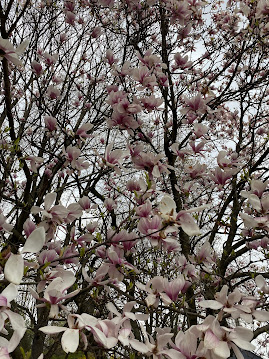
Ah, spring! What joy! How well the great poet Chaucer put it:
You forget the bulb is there and suddenly: Bing! I'm back!
Fred talks about writing, food, dogs, and whatever else deserves the treatment.
Ah, spring! What joy! How well the great poet Chaucer put it:
Five years ago, this blog joshed about California outlawing gender-reveal parties as part of a "Gender Prenatal Nonassumption Act." Well, we're not there yet, but we're getting closer.
No less a popular authority on medicine than the Cleveland Clinic is tying itself in knots over having to use terms like "man" or "woman," lest they offend women who think they are men and vice versa. The problem is, they're trying to write about health concerns that may only affect one gender or the other, and it's making them crazy. Pity them: Here they are trying to educate the public for its own good about, say, prostate cancer, but they can't say this affects men (although women have no prostates) because men who call themselves women will be offended and -- I'm not sure what. Ignore the advice? Be angry because it applies to them (they, having prostates)?
One way out of this inability to tell the truth is the "assigned" gambit. Instead of calling human beings men and women, which has worked pretty darn well through history, we now can say "assigned male at birth" and "assigned female at birth." As if the obstetrician just made some arbitrary decision when yanking the baby from the mother (or "birthing person"). Even the baby has to be covered by gender newspeak. As the Cleveland Clinic writes:
"The fetus gets its assigned sex around nine weeks of pregnancy, although your healthcare provider can’t detect it on ultrasound yet."
In other words, the growing baby's sex organs are showing at nine weeks of pregnancy, but they cannot be seen yet on ultrasound. Does the Clinic have any idea how weird their phrasing sounds?
If these geniuses have their way, we'll all be known as AFABs and AMABs -- Assigned Female At Birth and Assigned Male At Birth. Of course, it won't stay there -- it never does. Remember, terms like "handicapped" and "colored person" were once the polite terms, but once they became common they became insulting, and new terms had to be put into use. I suspect AF/MAB's days are numbered already.
In the meanwhile, though, we can still celebrate true love in a modern way. Instead of Boy Meets Girl, of course, we will have:
"AMAB Meets AFAB"
A Poem
An AMAB a-wandering near the windmills by the bay
Distressed by the eagles, chopped up below them lay
Was suddenly, like chance, taken at the flood
By a lovely young AFAB, xer eyes as dark as mud.
"That's my kinda AFAB," the youthful AMAB cried
"I must go and meet xer; I'll not be denied!"
The AFAB, quite lightly, trotted down the road
Xer coveralls, quite tightly, xer tuchus they showed.
"Hello there!" said AMAB, "And please pardon me!
I hope you have interest in an A. M. A. B."
"Why, yes," said the AFAB, "and you seem okay.
It's just about lunchtime; what do you say?"
AMAB and xe went to dine at McKlaus's
On hot roasted mealworms and crickets with louses
They toasted each other with beetle juice soda
And strolled to the lake by the People's Pagoda.
"You're just right for me," said the AMAB with heat
"What a great fortune we happened to meet!
What a great future we'd have! Can you see?
You, me, and unassigned baby makes three!"
"Cool your electrons," the AFAB said ruthlessly.
"I like you, but thus far I have acted truthlessly.
In fact, I'm an AMAB, but wished to be other,
So my assignment was changed by birth parent (mother)."
"Worry no more," said AMAB with a cry,
"For no more truthless has one been than I!
For I am an AFAB but lied on the form.
I'd say I was anything for your love so warm!"
They were bonded together in ceremony
No one was sure who was he or was she
But they vowed to be one if their hearts still were in it
And truth never entered their lives for a minute.
In 1821, Percy Bysshe Shelley wrote that "poets are the unacknowledged legislators of the world," then presumably coughed a little and raised his eyebrows, looking around with a smile.
I'm not sure that poets have the clout anymore to make statements like that. But that's just fine -- there are plenty of other vocations in which the practitioners have a self-regard that would make Caligula seem like a shy, modest type.
![]() |
| "Little ol' me? I'm just a kindly emperor, trying to help the people." |
Journalists seem to have an enormous self-regard. Maybe they always did, feeling that with the power of their words they were able to assume an authority that required neither education nor invention, just the vote of the public when it purchased the newspaper. Since Watergate, their self-regard as truthtellers in a corrupt world has inflated as respect for the profession and evidence of its independence has cratered. Reporters on the whole seem to be happy lapdogs for the people they like, covering up things here and attacking on command there, whose mistrust by the public grows daily. (Was anyone surprised when the Newseum closed?) And yet if you read a book by a reporter on reporting, he'll tell you that he's not important, the story is, and also, ME ME ME. It's a tour de force of the author's humblebrag, with a few lectures on his Journalistic Ethics tossed in.
Saints never tell you they're saints.
Perhaps this egotism is purposeful puffery for journalists, designed to dispel the creeping fear that they really are useless loudmouths. Could be.
Teachers have really gotten out in front of their skis on this one as well. Yes, they are important for the education of our children (when they do it), and most teachers I know are great people who love what they do. But when did some of them begin to think they were more important than the children's own families? While it's true that a bad family can turn out a bad kid, one bad teacher can corrupt a whole passel of them. Ironically, a little humility goes a long way to earning respect and trust.
Sometimes I get the feeling too many of them took Plato's Republic seriously, thinking that philosophers ought to be the monarchs and children should be taken from their parents for education. They ought to remember that it might be a nice place to visit, but they wouldn't want to live there.
Money handlers as a class do not consider their large sums of money adequate recompense for their work. They also demand the respect of the public for the genius that they possess. If you were smart, you'd be rich too! seems to be the thought. They needn't worry -- rich people will always get their tuchuses polished by those who want to know their secrets. They never have to see the disdain of those who find their egoism tiresome, their methods dubious, their gospel damaging. They never have to hear the moans of those who despise how they use their cash for charitable purposes and have to live with the consequences.
Politicians are and have always been the worst of the lot, able to convince themselves of the good they are doing while stuffing their pockets and crushing the lives of citizens they are meant to serve. I'll give them this -- if people were always coming to my door and begging me for special favors, I'd begin to think less of humanity as a whole. Perhaps that's the best argument for term limits -- as a means of preventing cynicism and hatred among the ruling class.
Successful actors and other performers are perhaps the most revolting of them all. The love of the fans ought to be enough, but the appetite of the ego grows with the feeding. They must be world-changers as well and loved for it. It usually makes them pretty tools for the faddish fanatism of the day. This would be harmless, but it inevitably requires telling us little people what we ought to be doing. Yeah, we all just love that.
And what of the humble novelist, who sweats away in his little garret, chipping away at his stories like a sculptor trying to draw the angel from the coarse stone? Like moi, in other words? Do we not think that we are hot stuff, and expect to be respected for it?
Meh -- not me. As with poets, maybe there was a time when the novelist was a person of some societal rank. A million lousy novels and a million good but forgotten books since, those days are gone. Now only a pinpoint of wildly successful and wealthy authors would expect that kind of obsequiousness, and they fall into the money handlers category. The rest of us prefer love to respect. (Although a little money is nice, too.)
Saga of the Homophones
Or, Long Knight's Journey into Daze
By Fred Key, Righter
Knight fell slowly on the town
And it hurt him on his knee.
A boulder knight no one could know
It tripped him up, you see.
“This rock has merely hurt my pride;
My hart is much more pained.”
Indeed the dear looked shaken as
He wobbled off, half sprained.
“Sad knight,” his squire said to him,
“Despair misaimed your boot.
I’m saddened to my sole for you!
How sorry is my foot!”
“Alas, the pain is all too reel,
A fishhook in my heart.
It lands my fate I know not wear!
I rend my clothes apart.
I love the Princess Jezebel
If I may bear my sorrow.
The sorrow growls, shows its teeth,
And haunts me for the morrow.
Ah, Jezebel! Beloved one!
Such a gorgeous site!
Yes, her castle is quite nice,
And she’s a bit all right.
I sought to woo her to be mine
I brought a bunch of flours.
The sacks all busted on the way!
Was sweeping up for hours.
Covered as I was I thought
To play a dashing roll.
Alas, she’s gluten-free these days!
She shunned me, on the hole.
When I climbed out I wrote a note
With finest stationary
The note, I fear, I could not send!
Stuck to my reliquary!
I made a book of poems for her;
Enclosed it in a phial.
But all the pages jammed in there
So it was not worthwhile.
Once more I leapt upon my horse
And took him by the rain
Which meant I had to shower off
That horse is such a pain.
At last I rode once more to her
And to her castle peek
I found my interest peaked in her
As in her bath I sneak.
Once more disaster struck, for she
Whose love I tried to steel
Had me tossed out upon the tush
And that raised quite a wheel.
I rolled back home and now I sob
Thwarted in love thrice.
What a scandal! What a waist!
And the rest of her was nice!
You clearly see me in such pane
All riven by love’s wars!
And thus my tail is at its end.”
He pointed to his drawers.
“Such a poem of -- whoa!” the knight
Herd from his faithful flunky
While chasing off a pesky flock
Of sheep who all smelled funky.
The squire said, “A lesson, lord,
Is learned by eye or ear.
And yet ignored, for it is said,
You can’t get there from hear.”
✍🏰🐑
| "This'll wow 'em!" |
Arnold, we love yaYour friends are all hereWe’re happy to toast yaWith whiskey and beerRemember those daysGrowing up in the HeightsBlock parties and girlsA few switchblade fightsWe had so much funIn the high school you knowYou won your diplomaWhen you promised to goOne day you met JoanieHer hair then was redYour first gal who didn’t haveTo put a bag over her headAnd soon came the little onesJill, Pete, and JoePete’s up for parole nowIn six months or soThe family was growingAnd you said what the hellsI guess we’ll get hitchedOut rang wedding bellsYou worked for the cityThe union’s great prideDoing God only knowsRunning bets on the sideYou’re old and your fat nowAnd so you’re retiredYou’re leaving for FloridaOn account it’s requiredSo we say happy birthdayAnd we raise up a toastTo Arnold, our brotherWho we love the utmost(Drunken cheers)
The Guardian (because we have to go outside New York for important news about New York) reports that New York City has banned students from using artificial intelligence for schoolwork:
New York City schools have banned ChatGPT, the artificial intelligence chatbot that generates human-like writing including essays, amid fears that students could use it to cheat.
According to the city’s education department, the tool will be forbidden across all devices and networks in New York’s public schools. Jenna Lyle, a department spokesperson, said the decision stems from “concerns about negative impacts on student learning, and concerns regarding the safety and accuracy of contents”.
The first indication that artificial intelligence was being used was that some actual intelligence was being shown by the students.
The barometric pressure fell like lightning
While the pressure mounting everywhere else tightening
The grimaces on faces far too cold
"For this stinkin' weather I'm too old!"
Cried frozen folks from ages 8 to 90s
As north and south alike all froze their hienies
The weatherman said bombogenesis
Not one on many bingo cards, I guess
![]() |
| Winter weather report bingo |
The airports were all clogged with canceled flights
Delays and strays and families spend a night's
Disgruntled misery at the flyways
Still better than disasters on the highways
Snow and ice and tires uninflation
Can make a catastrophic situation
Be careful as you travel friends, and I pray
God see you safe on Christmas all the way.
Thomas Edison gets a lot of flak these days, mostly I think from people who identify with Nikola Tesla. It's true that Tesla got the high hat from Edison when he worked for the man, but most people did. Most people did from anyone they worked for back then. Edison was also mostly deaf (probably due to scarlet fever) and so would have been a lousy communicator anyway. Plus, Tesla was a very strange man, and put off a lot of people.
In a way, Tesla won, with the help of George Westinghouse. Both of them believed in the utility of alternating current over direct current -- Edison's direct current generators would have required far more and smaller generating stations than alternating current, which made A/C perfect for Westinghouse's Niagara generator and for electrifying the White City, the Chicago World's Fair of 1893, as well as for major metropolitan installations.
Well, Edison just had to resign himself to his million other inventions -- and dollars.
But I'm not looking to criticize Edison today. I want to give him the ho-ho-holiday thumb's-up for his work with that other bulky gray-haired legend, Santa Claus.
First, Edison's workable lightbulb was a wonder, and with it and his partner and friend Edward H. Johnson he created the first string of electrical Christmas lights in 1880. At first these lights were not practical for home use, requiring professional installation, and the public was understandably nervous about electricity. But Edison's company General Electric was first out with a Christmas light set in 1903, and over time they became more popular.
They certainly are pretty. I always am especially saddened, of course, when I hear about dangerous mishaps with these Christmas lights -- people lose homes and even lives when electric decorations are misused or faulty, but imagine what was happening when people put actual candles on their trees. (I always refer people to the Consumer Product Safety Commission's safety tips on how not to electrocute or burn anyone or anything with electrical decorations. I assume their advice for putting lit candles on trees is: Don't.)
Edison also helped Jolly Old St. Nick more personally when his movie studio released a short film called "The Night Before Christmas" in 1905:
It was the first film version of the famous poem "A Visit from Saint Nicholas," but not the first live-action film of Santa; that was done in Britain in 1898. (An interesting run-down of the first 10 Christmas films ever can be found at the Reel Rundown site here.)
Of course sound film had not yet been invented, but Joseph Miller, who posted the Edison film on YouTube, says that the music heard on this reel was "added some time later which appears to be cylinder recordings from about the same time period, with the exception of 'It Came Upon A Midnight Clear.'"
I like all the business about Santa getting the team ready to ride.
Edison himself may not have been very jolly, but he helped make the celebration of Christmas an expression of civic joy as we know it today. As we wait for the capital-L Light in the Darkness to shine, we can have some cheer from the small-l lights at Christmastime.
So, this was making the rounds.
And . . . yeah. It's hard to argue with it, actually. For such a popular holiday as Thanksgiving we ought to have some popular songs to celebrate it. Instead, what do we have? What comes to mind for you?
"Over the River and Through the Woods" -- I think this old wheezer got its second legs by being sung at the end of A Charlie Brown Thanksgiving by the gang riding -- in what now would be ILLEGALLY! -- in the back of the Browns' station wagon. And what is that song all about? Going to Grandma's house for a celebration in a snowy season. Sounds more like Christmas than Thanksgiving to me, unless you live in Buffalo, God help you. But indeed the poem was published under the title "The New-England Boy's Song about Thanksgiving Day" in 1844, according to Dr. Wikipedia. No one knows who set it to music.
So that's one, but I guess it doesn't count as a "banger." Neither do a lot of our popular Christmas songs, though, and I'm not sure I'd like to see a lot of them done in a modern style, let alone as Thanksgiving songs. "All I Want Stuffed for Thanksgiving Is You" may seem to have a kind of charm, but -- nah.
It's easy to say that Thanksgiving's theme of gratitude is too solemn for ribaldry, but come on. It certainly can't top the night of the birth of Christ for solemnity, and we've been celebrating that in every degree from contemplation to drunken spree for two thousand years. So let's try digging a little harder in the hit holiday mine shall we?
I have to say, it doesn't get much easier. Even Mark Steyn, the radio deejay turned political commenter, wrestled with it in his book A Song for the Season. For Thanksgiving, he chose the utterly unexpected song "Jingle Bells" -- unexpected, that is, unless you'd read his essay about it when it originally appeared on his blog.
Just in time for Thanksgiving, here comes, er, "Jingle Bells" - which was written not for the Yuletide season but, allegedly, for Thanksgiving. In Boston, in the fall of 1857, the city's leading music publisher, Oliver Ditson, introduced the world to a new song called "The One-Horse Open Sleigh".
Steyn notes that racing about fast as possible in unprotected sleighs pulled by speedy nags -- and maybe with speedy nags, IFYKWIM(AITYD) -- was quite the pre-Civil War craze. New England certainly can get cold enough by Thanksgiving to let loose the horses. (It's 36 degrees in New York City as I write this, and you can usually subtract a few degrees and add a couple of inches of ice and snow to estimate the weather in Boston.) Steyn writes:
...what I find oddest are the claims of Christmas Songs Made In America and many similar books that the song was written for "his father's Sunday School class on Thanksgiving 1857". I'm willing to believe that at Thanksgiving a young man's fancy turns to snow, at least in those distant days before Al Gore's global warming project sent the mercury rising. But no Massachusetts Sunday School is going to teach its charges a song whose lyrical preoccupations are racing, gambling and courting:
A day or two ago
I thought I'd take a ride
And soon Miss Fannie Bright
Was seated by my side...
Now the ground is white
Go it while you're young
Take the girls tonight...
Hmm. He's got a point.
But it's no good; all songs about snow activities are eventually sucked into the Christmas oeuvre, and "Jingle Bells" got there a long time ago.
What are the other choices, then? "Turkey Lurkey Time" from the 1969 Broadway show Promises, Promises sounds promising, but it's A) all about Christmas and B) got a title that makes me want to Hurly Wurly. Adam Sandler did a comedy song on Thanksgiving almost 30 years ago, but we're not looking for parodies here, and if we were, we'd look for better ones. (It's no "Chanukah Song," is what I'm saying.) I applaud Ben Rector for giving it 100% on a country song:
A couple of years ago I noted that Irving Berlin took a crack at Thanksgiving for the film Holiday Inn, in which all the songs are pegged to different holidays with mixed results. The number "I've Got Plenty to Be Thankful For," is one of the better ones, but it's never become a standard -- maybe because Christmas does shove aside all Thanksgiving numbers, or maybe because it's a love song, and in the movie Bing does a rueful duet with his own recording, having a lonely Thanksgiving after his girlfriend has been stolen by Fred Astaire. As far as I can tell the song has never had a successful cover version.
Surely the old-timers 100+ years ago in Tin Pan Alley coughed up a Thanksgiving song or two, right? Well, probably -- God knows they churned out songs on all kinds of topics, all day, every day, hoping one or two would stick in the public consciousness. I note there was a number called "A Thanksgiving Song" in a book of Tin Pan Alley tunes, but I can't track down whose it was and who may have recorded it.
I admit I'm no musicologist, though.
A search through the AllMusic site brings us many songs with Thanksgiving in the title, and I hope you'll enlighten me if any others have really made it to the big time.
However, I do have a suggestion for an older number that really does suit the day. It's from a Broadway show, almost as old as Promises, Promises, but like that show also had a breakout hit (in the case of the former, "I'll Never Fall in Love Again"; in the latter, "Day By Day"). I'm referring to Godspell's "All Good Gifts," which hits every note in the purpose of the holiday of Thanksgiving. Yes, it's hippie music, but it's grateful hippie music.
A small ship battered close to shore
No harbor finds it to secure
Left its sails up far too late
In drowned hope to escape this fate
Now too close, and keel to pole
Twisted, tossed against the shoal
The wind too strong to pray escape
The stones that grind and shred and scrape
As lashed and racked with wind so full
Sails rounder, tauter than the hull
Now chewed upon by teeth of stone--
The able-bodied, fate unknown.
The ship appears to bob but not
The ruinous wind pins to the spot--
And when the wind its whim will change
And tide is turned, and disarrange
The sails and shrouds, no more near break,
Drop dead, and low tide moved to wake
And drag the ghost ship toward the deep
The water full enough to sleep.
And so then down, into the sea
With no more mighty blast to be
Ground above as teeth on bone
Illusive life, no more is shown.
Summer sands and skies
Just you and me and the sun
And eight million more
Balloon floats over
The ocean in perfect peace
Kid lost another
Mighty sun above!
Bringer of summer's bounty!
Burns me like bacon
Sausage and peppers
Zeppoli and soft-serve too
Indigestion calls
Dark eyes upon me
My movements, grace and fluid
Stupid ring toss game
It occurred to me that the word poem does not actually have a rhyme. Ironic, isn't it?
2 syllables:bro hymn, ho hum, know him, loham, low hum, pro-am, show him, spoem, throw him
3 syllables:below him, roboam
4 syllables:jeroboam, rehoboam
Where all goes wrong, and nothing as it ought?Old age, the graybeard! Well, indeed, I know him,--Shrunk, tottering, bent, of aches and ills the prey;In sermon, story, fable, picture, poem,
ABCCDDEFGGEBFAII
Surely, not since the time of RoboamHath been such a wackadoodle poem
| Roboam: "You can say that again!" |
Snow falls on the path
One flake, two flake, three flake, and
Oh my achin' back
Dog sits on the ice
Rejoicing in nature's bliss
He got a fur coat
My friend has moved south
Shows me pictures of beaches
He can go cram it
Some ski in winter
Some sled, some skate, and some board
I pay the gas bill
Snow is the only
Weather with which you can play
Gimme a yo-yo
I hate summer's heat
But I won't die picking it
Up with a shovel
I met a traveller from a muddy place,
Who said—"One small and footless step of thin ice
Rests in the yard. . . . Near it lies the face,
Of mud reversed from snow a visage lies, whose grimace,
And icy lip, and sneer of cold command,
Tell that its sculptor well those passions read
Which lasted, stamped once on a snowman's noggin,
The hand that crafted, on the snowman's head;
Within the mire, these words appear:
My name is Snowzymandias, King of Toboggan!;
Look on my Works, ye Frozen, and despair!
Nothing beside remains. Round the decay
Of that minuscule print, alone and bare
The lone and yellow grass stretch far away."