Showing posts with label space. Show all posts

Monday, April 8, 2024

Super eclipse!

Today, of course, is the total eclipse of the sun in the United States and elsewhere in this hemisphere, the first one here since 2017. Where I am in New York we won't get the whole magilla, but it will be a nearly total eclipse, hitting around 3:30 this afternoon. 

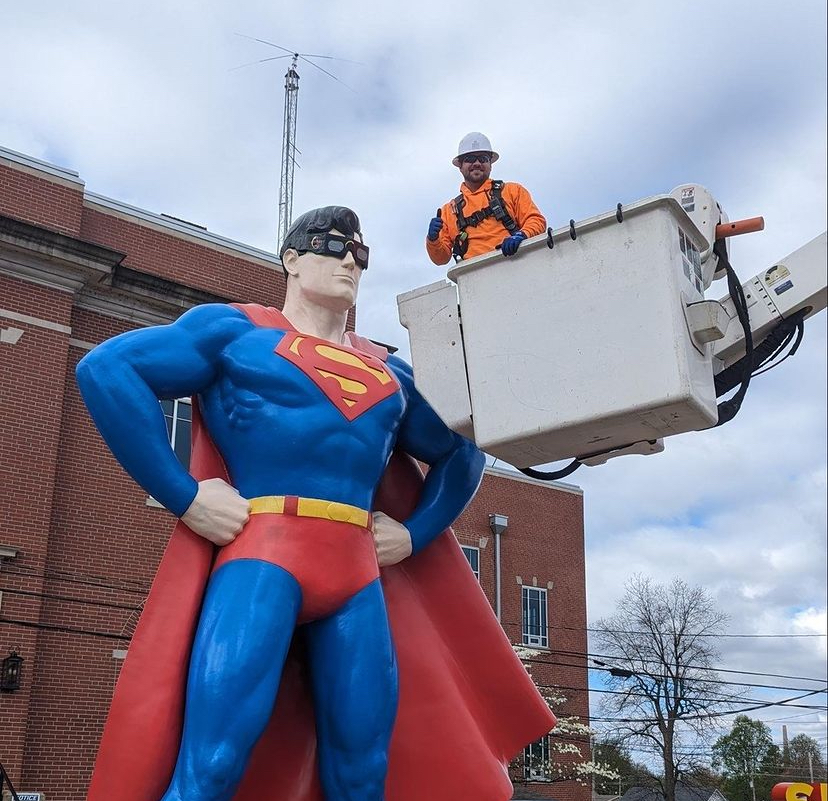
Meanwhile, at the Super Museum in Metropolis, Illinois, Superman has made preparations. 


It seems kind of silly for the one guy who could always look straight at the sun to wear eclipse glasses, especially since they could compromise his secret identity. (Clark Kent -- shhh.) However, it's possible there is a villainous plan by the evil Eclipso, a DC Comics villain since 1963.


Eclipso is a scary evil dude, with a variety of superpowers, but in his early stories he was mostly a menace to ordinary people. He was the alter ego of the magically cursed solar scientist Bruce Gordon; in the event of an eclipse, Eclipso would arise from Gordon and wreak havoc. In more recent years Eclipso has become a worldbeater, a menace to millions, capable of taking on DC's mightiest heroes. So maybe Superman's eclipse specs are part of a plan to save us from Eclipso today.

Elsewhere in the funny pages, others have also had a bad time with eclipses. 

Let it be noted that Charlie Brown is not the only hard-luck character in Peanuts.

Friday, July 22, 2022

Dominant species.

I hate to keep krexing about nature, but I've come to think that the dominant species on Earth ultimately will not be humans nor cockroaches nor mosquitoes nor bacteria. I think it's going to turn out to be crabgrass. 


As far as grass goes, this stuff is mean. You try to pull it, you can't get it all. You try to poison it, and half of it stays green. You put down all kinds of chemicals, and back it comes next year. 

When all of us are gone, and our Kentucky bluegrass, our fescue, our Bahia, our buffalo and Bermuda and creeping bentgrass are toast, the crabgrass will still be here, annoying whatever mammal still lives. 

I can see it becoming an evil species, like the giant carrot man from the vegetable uprising episode of Lost in Space. 

Yeah, that guy.


While retaining its evil crabgrassy ways, it will leave Earth to go pester other life forms throughout the galaxy, impossible to ignore, get rid of, or isolate. It won't take over planets or displace other sentient life; it will just move in and not leave, like the galaxy's unemployed brother-in-law. 

At least that's how it looks to me today. Is there no hope? Why, yes, there might be, thanks to our friend BG Bear, who posted this: 


Kill it with fire! I'm not sure if this little number is available anymore, but flaming weed killers can be bought at large hardware and yard outlets. 

It's either that or we nuke the crabgrass from orbit. Easy choice, you ask me. 

Monday, July 11, 2022

Space make deaf.

A friend of mine posted this from Beyond Fest, and it really is a gem. 


If the Academy of Motion Picture Arts and Sciences had any real sense or taste, they would indeed enshrine this film depiction in their Academy Museum.

I showed it to my wife, and she said, "Google Translate would do a better job than this!"

That, of course, got me to thinking: Would it? Let's find out! 

Here in the depiction of the 1979 horror-SF classic Alien from IMDb, with tagline added: 

In the distant future, the crew of the commercial spaceship Nostromo are on their way home when they pick up a distress call from a distant moon. The crew are under obligation to investigate and the spaceship descends on the moon afterwards. After a rough landing, three crew members leave the spaceship to explore the area on the moon. At the same time as they discover a hive colony of some unknown creature, the ship's computer deciphers the message to be a warning, not a distress call. When one of the eggs is disturbed, the crew realizes that they are not alone on the spaceship and they must deal with the consequences. In space, no one can hear you scream.

 Now we'll put it into Google Translate and turn it into Chinese.

在遙遠的未來,商業宇宙飛船 Nostromo 的船員們在回家的路上接到了來自遙遠月球的求救信號。機組人員有義務進行調查,隨後飛船降落在月球上。粗略著陸後,三名機組人員離開宇宙飛船去探索月球區域。在他們發現一些未知生物的蜂巢群的同時,船上的計算機將消息解讀為警告,而不是求救信號。當其中一個蛋受到干擾時,機組人員意識到他們在宇宙飛船上並不孤單,他們必須處理後果。在太空中,沒有人能聽到你的尖叫聲。

So far, so good. Now we'll turn it back into English and see how it looks. 

In the distant future, the crew of the commercial spacecraft Nostromo receives a distress call from the distant moon on their way home. The crew was obliged to investigate, and the spacecraft landed on the moon. After a rough landing, the three crew members left the spacecraft to explore the lunar region. While they spot a hive of unknown creatures, the ship's computer interprets the message as a warning, not a distress signal. When one of the eggs is disturbed, the crew realizes they are not alone on the spacecraft and they have to deal with the consequences. In space, no one can hear your scream.

That's terrific. A couple of small changes but no problem at all understanding it. Nothing laughable. Is Google really that good? Or is it just really deeply in love with China? 

Let's try the translation with another language, like say Kurdish. 

Di paşerojeke dûr de, ekîba keştiya fezayê ya bazirganî Nostromo li ser rêya malê ne dema ku ji heyvek dûr bangek tengahiyê digirin. Ekîb mecbûr in ku lêkolîn bikin û keştiya fezayê paşê dakeve ser heyvê. Piştî daketineke dijwar, sê endamên ekîban ji keştiya fezayê derdikevin da ku li herêmê li ser heyvê bigerin. Di heman demê de gava ku ew koloniyek hingiv a hin mexlûqên nenas kifş dikin, komputera keştiyê peyamê deşîfre dike ku bibe hişyariyek, ne banga tengahiyê. Dema ku yek ji hêkan teng dibe, ekîb fam dike ku ew li keştiya fezayê ne bi tenê ne û divê ew bi encaman re mijûl bibin. Li fezayê, kes nikare qîrîna te bibihîze.

And back into English: 

In the distant future, the crew of the commercial spaceship Nostromo are on their way home when they receive a distress call from a distant moon. The crew has to investigate and the spacecraft will then land on the moon. After a rough landing, three crew members leave the spaceship to explore the area on the moon. Also when they discover a bee colony of some unknown creature, the ship's computer decodes the message to be a warning, not a distress call. When one of the eggs goes awry, the crew realizes they are not alone on the spaceship and must deal with the consequences. In space, no one can hear you scream.

Looks darn good! What if we try it in Chinese with a slightly lesser known work, say the description of my book, Larry and the Mascots?

When Larry gets thrown from the roof of his dormitory, little does he realize that his troubles are just beginning. Surviving this encounter due to the help of an advertising character—Whitewall, a pitchman for tires who is actually made of tires—Larry discovers that a group of advertising mascots have come to life. There’s Mitts, a flying oven mitt; Captain Freshy, a homicidal pirate who sells canned tuna; Sweety the Sugar Fairy, who glazes children’s cereal; Mushy MacClown, a sad clown on packages of marshmallows; and others—some of whom are up to something sinister. Who are they? What do they want? And why did one of them steal his crummy laptop? What Larry discovers is a conspiracy that springs from the actions of one of the school’s greatest patrons—one that ultimately threatens the lives of the students on campus, and perhaps even the entire nation. Larry and the Mascots is an intriguing adventure, full of action, heart, interesting characters, and cartoon characters, and is part of a complete breakfast.

We'll run it back and forth through the Chinese translation and then:

Little did he realize that his troubles had only just begun when Larry was thrown from the dormitory roof. Surviving with the help of advertising character Whitewall, a salesman for tires that are actually made of tires, Larry discovers a group of advertising mascots have come to life. There are gloves, flying oven mitts; Captain Freshy, a murderous pirate who sells canned tuna; Sugar Fairy Sweetheart glazed on children's cereal; Mushy MacClown, the sad clown on marshmallow wrappers; and others -- some of whom are making some sinister things. who are they? What do they want? Why did one of them steal his tattered laptop? The conspiracy uncovered by Larry stems from the actions of one of the school's biggest patrons -- ultimately threatening the lives of students on campus, and possibly an entire nation. Larry and the Mascot is a fun adventure full of action, heart, funny characters and cartoon characters that is part of a complete breakfast.

I mean, it's not awful. A little confusing, but roughly understandable. "Tattered laptop" is amusing. But a far cry from that Hong Kong description of Alien.

So what have we learned? That Google Translate has gotten scary good, and that movie pirates ought to use it rather than rely on their cousin who claims he speaks English unto like native total. 

Thursday, June 30, 2022

Return of the UFOs.

I'm starting to get a sense that it's time for the UFOs to come back. They have a cultural moment every twenty to twenty-five years, and I think they're due. 

Why do I think so? Oh, they radioed me through my tinfoil hat. You should get one. It blocks the CIA but lets in the aliens alerts. Kind of a police radio for ETs. 

No, it's actually a couple of real things. For one, in the last twelve months I've had assignments for various books centering on space creatures, either nonfiction (such as, about Roswell or Area 51) or fiction (aliens-among-us stuff). Book publishers have their faults -- their many, many, many faults -- but they often are right up front with this stuff. Our cultural vampire phase and zombie phase came out of book series; the apocalypse phase too, and whenever we're in a mood for swashbuckling or historical drama you can bet it started on the bookshelves and went into movies and TV after. And I am seeing a ton of BEMs and LGMs and ETs and UFOs (or UAPs, as the navy calls them now) coming down the cultural chute. 
Don't count me among
the Little Green Men.

Usually there is a real-world prompt that gets things moving. I think the main one now is the Webb Space Telescope, which is getting people who like space stuff excited enough for it to spill over to the rest of us. Less so the talk of Mars missions and new missions to the moon. They are boosted by nationalism again with China and Europe and the US and others wanting a taste of space glory -- and nationalism is the only thing that got humans into space and on the moon, by the way -- but those goals keep being pushed off and seem less concrete. Webb goes live in July and we expect some amazing things.

Culturally, this means more X-Files type shows, maybe some ALFs or Mork and Mindys or My Favorite Martians, although undoubtedly the darker, grittier, versions. Our fictional aliens have been with us for decades, but I predict a strong resurgence of alien-themed cultural artifacts. I think a lot of it died down because the ubiquity of personal cameras in phones meant far fewer UFO sightings for a while, because tales of things that happened would have inevitably meant lots of pictures from various people. However, they're coming back. 

Here's where I would say "Keep watching the skies." Honestly, though, I am not convinced that there's ever going to be a useful workaround to the universal speed limit of light speed, so I think it's very unlikely we'll ever be visited by aliens. So instead I'll say "Keep watching the TV." That's where you'll see most of our visitors from outer space.  

And don't bother with the tinfoil hat. That was a joke. Tinfoil underwear, however, is very useful for stopping the FBI's omega rays that sap one's essence. 

Thursday, June 23, 2022

Time for plan B.


On one hand, the Great Peach Preserves Incident convinced Barbara that canning was not for her.
But on the other, she received a call to go work for SpaceX a few days afterward. 


Monday, April 4, 2022

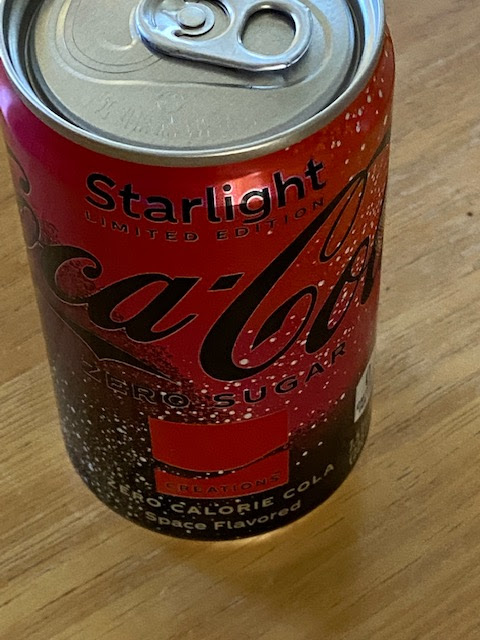
Space soda!

What does space taste like?

Seems like a strange question, does it not? And yet, Coca-Cola claims to have answered it with its limited edition Starlight Coca-Cola from its Coca-Cola Creations laboratory.


I bought the Zero version. My curiosity got the better of me, which shows you that I'm a sucker. For $5.99 a ten-pack of 7.5-oz. cans, you'd better believe I am. I took the hit so you don't have to. Don't say I never do anything for you. 

So, what does space taste like?

Coke says, "Inspired by space, Starlight was created with the vision that -- in a world of infinite possibilities -- somewhere in our universe, another kind of Coca-Cola, another way of connecting with each other, might exist." Okay, that's a big turd of nothing. I'm personally so sick of phrases like connecting with others that I am at the point where I would like to go to a marketing department and start connecting with others' noses with my fist. 

And the flavor? "Inspired by the infinite possibilities of space, Coca‑Cola Starlight fuses signature Coca‑Cola taste with unexpected touches, including a reddish hue and cooling taste sensation evoking the feeling of a journey to space." So, like Coke but with red dye 40.

According to Dennis Lee at food blog The Takeout, "Coca-Cola Starlight Tastes Like One Big Marketing Ploy: What do you think outer space tastes like? Coca-Cola is hoping you'll pay to find out." Yep.

Food Network reviews it positively (although mocking the marketing somewhat), saying, "if you go by this beverage, space tastes kind of like minty cotton candy sprinkled with vanilla, and has a sort of red tint. It’s pleasantly sweet and candy-like and just a bit fruity, which is excellent if that’s what you are going for. It might not be if you don’t really lean towards sweets, but in that case, you probably aren’t picking up a can of Coca-Cola anyway."

I'm drinking a can right now, and I'm not getting the minty. Definitely cotton candy. This could easily have been sold as Cotton Candy Coke without the happy Age of Aquarius-type centaur crap. It's about the color of Dr Pepper, though, so to cotton candy it up they would have had to done a more serious dye job.  

It's okay, but not that interesting. The main thing it does is make me think of one of my least-favorite ELO songs, "Starlight," from the album Out of the Blue.


According to the site Jeff Lynne Songs, Lynne conceived of the song while watching the night sky over Switzerland. Tierney Smith called it an "uncharacteristically dull ballad," and I agree. I hope that if Coca-Cola Creations takes another song title from Out of the Blue, they go with "Wild West Hero" or "Birmingham Blues" or "Across the Border." "Mr. Blue Sky" has seen quite a revival in recent years; that could work. "The Jungle" might be more their speed, with its brotherhood of animals feel. But “jungle” is a pejorative now, and Jungle Coke would undoubtedly be “problematic.” Across the Border Coke might imply tequila, but it could be okay.

For my money, "Starlight," like the soda, is a lot of sweet and not much fizz. Don’t bother with the soda unless you really dig cotton candy, minty or otherwise.

Saturday, June 27, 2020

Moon the moon.


Mooooon TOOOOIIILET!
For one-sixth gravity
I'm using you to pee
Today
Oh, flush potty
Don't be naughty
However I'm goin'
I'm goin' your way

According to the site Tech Crunch, NASA is looking for your help -- yes, you! sitting on the toilet looking at your phone! -- to design a better Moon Toilet: "Specifically, the competition seeks 'innovative designs for fully capable, low-mass toilets that can be used both in space and on the Moon.'" It seems "the agency wants to open this up to outside academics, researchers, designers and engineers because they’re hoping that fresh perspective from outside the aerospace industry can help them see potential solutions that otherwise wouldn’t have occurred to people used to working in the field." They're offering a prize of $35,000 for winning designs.

Well, I think that's just great. A lot of people do their best thinking on the can, and what better place to think about toilet designs? You have to admit that there's been a lot of innovation in the form over the last hundred years, probably due to people thinking hard on one end while giving it their all on the other. The low-flow toilet, for example, is a lot better now than when they were first mandated in 1992. Why? Because the smart minds connected to the smart hinds made a better product. (Still not as good as the old seven-gallon flushers, but there's no substitute for kinetic warfare on some things.)

So here's your chance to make 35 big ones to help our future astronauts drop some big ones of their own on our nearest celestial neighbor.

Meanwhile, if you'd like some inspiration, let Italian astronaut Samantha Cristoforetti give you the grand tour of the ISS can. It's actually pretty interesting and a little gross.


Friday, March 13, 2020

Ship just got real.

Malacandra or bust!


I have been surprised by the continuing audaciousness of one Elon Musk, a fellow with a pretty good approximation of a Bond villain name, with his thoughts on sending human beings to and colonizing Mars. Sounds like fun! In a terrifying, possibly not very fun way.

I'm not sure if this is the result of something he's been smoking, but Mr. Musk said he would like to build one starship a week for the purpose of colonizing Mars. Now, I'm no engineer, nor a scientist of any kind, as pretty much every teacher I've ever had would tell you, but I have always been interested in science fiction, even the hard-science stuff. And based on that, and what I have that passes for common sense, I think he may have a good idea here. Whether the advantages of colonizing Mars are evident is not the point; if you're going to do it, do it right.

Stories throughout the history of the science fiction genre about colonizing near planets have been generally rendered obsolete by the fact that Mars has turned out to be a lot harder to live on than we might have hoped. There was never a reason to expect the temperature to be pleasant, and the atmosphere is not breathable. We knew long ago that the gravity would be lighter than Earth's (38% at the surface), and in recent decades have discovered that human beings suffer over time in anything significantly different than Earth gravity. And despite our best efforts, we've found no water worthy of the name on the Red Planet. Our colonists can't just diddy bop down to the Price Chopper for a case of Poland Spring. That's a 68-million-mile round trip at its closest.

Let's assume, as I guess Mr. Musk has, that in time we would be able to construct means to allow the colony to be at least mostly self-supporting. This is a big assumption. Even the Vikings had to abandon Greenland when things got dicey. But let's say that, without inventing terraforming or some other wild science far beyond our ken, we find Mars land capable of supporting edible crops, a means of providing water and breathable air, a means of dealing with light gravity's effects, a source of reliable power, and whatever else people need. For a long time a steady line of supplies and personnel will still be required, and this is where the Musk plan makes sense.

In the stories I've read, space colonies usually start with a single, small crew on a single ship, or one gigantic crew on a humongous ship. But a fleet sent to provide a means of support during colonial establishment is not typical to the genre. Colonizing across oceans usually worked both ways, with small expeditions and settlements or large investments with multiple ships running back and forth, and yet our science fiction has usually settled on the first as a model. Maybe because it's more dramatic.

The whole thing could be made easier if we could figure out a way to get that space elevator in orbit, but it looks like Musk is not planning to wait that long.

So what do you think of his plan? Crazy? Inspired? Impossible? Inevitable? And if it's so crazy it just might work, would you sign up?

Wednesday, February 5, 2020

Fred's Book Club: The Shape of Things Not Yet Come.

Hello, kids, and welcome back to the Humpback Writers, the Wednesday book feature that isn't about writers with humpbacks, or even books with humpbacks. What is it about? Well, it's about half past seven on Wednesday, and that means it's Hump Day!

Today we're taking a little trip into the future. We are all interested in the future, because we will spend the rest of our lives there.

Actually, no -- we're taking a trip into 2007, when this book was published, asking the musical question:


Yes, Where's My Jetpack? is the thing all of us who grew up in the 20th century would like to know -- that or variations of it. "Where's my flying car?" "Where our Mars colony?" "Where's pre-buttered bread?" "Where's my robot butler?" "Where's Sealab?" "Where's the Jetsons' shower/dresser that gets you out of bed and ready for work in under twenty seconds?"

These are the kind of questions author Daniel H. Wilson, Ph.D., writer of fiction as well as of nonfiction books like this, has attempted to answer, and answer seriously. He explains in the introduction:
The future is now, and we are not impressed. The future was supposed to be a fully automated, atomic-powered, germ-free Utopia -- a place where a grown man could wear a velvet spandex unitard and not be laughed at. Our beloved scientists may be building the future, but some key pieces are missing. Where are the ray guns, the flying cars, and the hoverboards that we expected? We can't wait another minute for the future to arrive. The time has come to hold the golden age of science fiction accountable for its fantastic promises. 
This illustrated and well-made paperback then takes us on a tour of the most desired futuristic things that the public saw in science fiction but has found only in Nowheresville, No State, Population: Nothing. Daniel Wilson wants to tell us why.

It isn't enough to point out that in reality, flying cars would be a menace, because we drive crappily enough in two dimensions. Wilson brings us up to takeoff speed, summarizing the science needed not only to put hordes of personal aircraft aloft but to track and prevent collisions for them all. NASA was said to be leading the charge on this with automatic collision-avoidance technology and self-correcting flight controls. But the fact is, even if we get them, they are not going to be flying cars so much as inky-winky airplanes, because that futuristic anti-gravity stuff just isn't panning out yet.

The chapter on Smell-O-Vision is a minor classic, explaining how the sense of smell works and the history of people trying to monetize it the way movies and TV monetize the moving image. "One bankrupt company called DigiScents grabbed the market by the horns in 2000 and put out the iSmell device.... The small, plastic device generated odors by blending different 'scent primaries.' A collection of scented cartridges was heated in combination and the resulting smells pushed out by fan." Who wouldn't want that? Apparently everyone. Too bad; if it were able to generate all kinds of scents, it would have made a great tool for practical jokes.

I find one of Wilson's charms to be his knowledge of the history of science fiction. The chapter on the Moving Sidewalk not only mentions the 1964 World's Fair, but also Robert Heinlein's classic 1940 story "The Roads Must Roll," and even harks back even further to H.G. Wells's 1899 book When the Sleeper Wakes. Then he goes on to explain the problems with huge, perpetually moving roads and sidewalks that replace other forms of transportation, like people falling and dying (although he lists fictional and nonfictional answers to such problems). He does not, however, address the preposterous amount of energy needed to keep endless miles of conveyors running constantly -- really, "preposterous amount of energy needed" is probably the crushing problem behind so many of the things in the book.

(Another science-fiction dream, the Space Elevator, may not be known to the general public but would be awesome -- and, Wilson notes, may be closer than we think.)

In some cases, the profile takes a tentative step toward the futuristic item at hand, but can get no closer. The chapter on Food Pills details the many things trending toward instant, artificial foods, like microwave ovens and lab-grown "cultured meat," but this doesn't get us to the real idea of a food pill -- a capsule that contains all needed nutrients that by itself can provide sustenance to the human body as long as an actual meal. Wilson talks about the military's development of MREs, and the experimental CM, or Compressed Meal. ("A CM is one third the size and weight of an MRE but has the same number of calories. At this rate the food pill may be on the menu soon.") But we're left with doubts -- and maybe wondering why we wanted this thing in the first place.

The chapter on Ray Guns is fun, because sure enough the Pentagon has got a few of those daddies, sort of. Lasers, pulse laser guided lightning shooters, microwave beams, lots of good stuff in development, all of which have to be mounted on large vehicles, not in your shoulder holster. About the idea of the ol' shootin' laser, he writes, "The most noticeable obstacle is heat dissipation. Operational lasers are inefficient, converting only about 15 percent of electrical power into laser, the rest wasted in the form of extreme heat."

What we really want is the blaster, a ray gun that kicks like a mule but not as messy, showering sparks on targets, and unless military contractor Blasterizer has shown up in the last thirteen years, it doesn't look plausible anytime soon.

I wish Wilson could do an updated edition, because while some of the items covered have not yet arrived, many are getting closer -- Space Vacations, Smart House, Underwater Hotel, and Self-Steering Car, for example. No good news on the Jetpack at this time. (His chapter on the Unisex Jumpsuit leads me to another topic that I want to blog about soon.)

Wilson has two other books that make great companion titles: How to Build a Robot Army: Tips on Defending Planet Earth Against Alien Invaders, Ninjas, and Zombies, and the inevitable follow-up, How to Survive a Robot Uprising: Tips on Defending Yourself Against the Coming Rebellion. He's a sprightly writer, able to lay out complex subjects with brevity, wit, and a strong grasp of the subject. I enjoyed this book -- and if you're wondering where your teleportation device, mind-reading helmet, or invisibility camouflage have gone, you will, too.
Saturday, July 20, 2019

Moon men.

I'm not sure what to say about the Apollo 11 mission that put men on the moon for the first time fifty years ago today. So many have said so much that we've run out of intelligent or even reasonable things to say, and major media outlets are resorting to the stupid and offensive.

I take second place to no one in my admiration of the astronauts. I think they were brilliant and maybe a little crazy. You look at the size of the three-stage rocket in comparison to anything man-made you know, and someone tells you, "Okay, Neil, we're going to put you in the top of that thirty-six story thing and blast this bastard out of the atmosphere. You'll go about 239,000 miles as the crow flies, as far as all the planets in the solar system shoved together. That is, if you don't blow up, and if all the right parts fall off when they're supposed to and none of the wrong parts falls off at all. Then we're going to plop you on the moon in a little vehicle, and then we're going to get you back off the moon, and after a little rendezvous with the bigger vehicle, you'll all come back, another 239,000 miles, then a fiery death plummet into the ocean."

"Sure."

"You and Buzz will hit the moon surface while Mike stays up top."

"Sounds good."

"None of this seems crazy, does it?"

"When do we go?"

Now, I'm not saying that the conversation went like that -- they probably used a lot of smartypants mathematics -- but I think when you got it to its essence, that's where it was.

And it was glorious.


If I'd been a grown-up watching these guys, and could grasp the scale of the mission, I'd have probably thought they were crazy. When I was a kid at the Smithsonian National Air and Space Museum and I saw the cockpits on World War II airplanes, I thought those guys were crazy. If everybody was like me, we'd have never gotten off the ground.

Oh, I have my moments, but when it comes to heights, find another pigeon. I know plenty of guys who made it through jump school; I would have washed out for sure. Literally -- rather than evacuate the airplane I'd more likely have evacuated my innards. I can be brave about a lot of things, but I literally cannot make myself do things like that.

Or get on top of a gigantic rocket and blast off the planet.

Fortunately, it's never come up at work.

So you'll never hear any bad words about astronauts from me. Amazing bunch of folks.

The moon, however, is another matter. As we've examined before on this blog, the moon is a publicity hound that likes making trouble for me. I hope Neil and Buzz gave it a good kick in the moon pants while they were up there.

Tuesday, June 11, 2019

Star of stars.

Today is this guy's 81st birthday, or would have been if he were still with us. 


Jack Horkheimer was the director of Miami Space Transit Planetarium, but was known to most of us who saw him on PBS as the Star Gazer. Actually, I used to watch him when the show was Jack Horkheimer: Star Hustler back in the eighties.

Where we lived in New York City, which was late to adopt cable TV in our borough, I could get three PBS stations: WNET in the city, WLIW in Long Island, and WNJN out of Montclair, New Jersey. The latter two showed episodes of Dr. Who, mostly from the Jon Pertwee/Tom Baker/Peter Davidson seasons, although we also got Colin Baker and Sylvester McCoy. They were all rather fuzzy, because those two PBS stations came over UHF. Anyway, Jack Horkheimer: Star Hustler was a five-minute show used as a bumper, and what better place to show it than between episodes of a science-fiction series?

I always enjoyed Horkheimer's enthusiasm for the subject. He'd tell us what was visible and where as the year progressed, and discuss any cool events like comets or eclipses or meteor showers. The episodes I saw he always wore that windbreaker, standing against the universe, like we were out there and it was a little chilly.

Much of what he was talking about was lost on me, though. Living in the city, the night sky was usually obscured with light pollution and plain ol' pollution pollution; we were lucky to see the moon. To this day there are only a handful of constellations I can identify with confidence, including the Dippers and Orion. I certainly can't blame my ignorance on Jack. He tried.

Here's an episode from 1991.


As far as I know, he always ended the show with the same tagline: "Keep looking up!"

A year or so ago I thought of his show and looked him up; I was sad to see that he had passed away, but hardly surprised. I was very happy to see what he'd requested on his tombstone:

"Keep Looking Up" was my life's admonition
I can do little else in my present position


Thanks, Jack Horkheimer; you certainly were an astronomical star in your own right.

Friday, August 31, 2018

Space Force!

Did you get yours? I got mine.

Amazon has about a million "Space Force" inspired T-shirts since the president announced the plan to create a new outer-space-centered military service, but I got the one recommended by Instapundit. So you know it's for reals! And it happens to be a well-made, comfortable shirt, at least so far, which is more than you can say about a lot of shirts purchased online.

Why did I get it? Well, my favorite T-shirts have a lot of stains and holes. But also, because I thought that the Space Force was a good call by Trump. I noted last month that NASA has become kind of embarrassing in that the guys who put the first American in space, in orbit, and on the moon now can barely get a human off the ground. So it's important for the United States to keep working in human/space technology, and if NASA has other plans, the military can take action.

But that's only part of it -- NASA is a civilian organization, was formed purposely to be one and must remain that way. (Ike was a fan of rockets for military use but didn't think the military branches would be effective for space exploration.) But we are naive if we think that our international competitors are not weaponizing space, or planning to. So, we can yield the orbit of the planet to China and Russia and anyone else who can get past the exosphere, or we can fart around and pretend we're not doing the same thing they are while doing it, or we can say, hey, we're going to have a military space group and you'd better keep up, pilgrim.

I think it's a winner of an idea. Then again, I liked Reagan's "Star Wars" back when all the smart people were sneering that you couldn't "hit a bullet with a bullet," and the Russians were sweating bullets over it. So I expect others to think my T-shirt is either evidence of Trumpmania or is being worn sarcastically.

But no, I think the time for Space Force has come. The name comes across as silly, and will probably be changed to something dull like the U.S. Trans-Orbital Military (Major TOM!). But everyone will call it "Space Force."

"Space Force" seems a little Hanna-Barbera-ish, but the idea is as serious as nuking from orbit. If we want to be safe, we must be vigilant.

I'm sure these guys would agree.


Wednesday, July 25, 2018

Far over the horizon.

This Friday's a full moon, which is nice.

Anyway, in looking into the solar probe for my article last Sunday, I got to thinking about this insane information about our other big sky friend, Mr. Moonlight:


Holy Toledo!

I'd seen that factoid on Cracked and heard that it came from Reddit, but despite that it actually turns out to be true. No wonder it took three days at, well, astronomical speed to get our astronauts to the moon. It's not like driving to the shore for vacation. Although it must be said that the traffic is better.

Our moon is ridiculously far away, 238,900 miles, and yet so strong. We sometimes think it looks huge, especially at Halloween.

Here the moon is orbiting Earth at a height of seventy miles.


But looking at the real moon in the real sky, one might think it's what, maybe a tenth the size of earth? Actually the moon is more than a quarter of the size of our planet. It's bigger than Pluto, which might be one of the reasons for Pluto's demotion to dwarf planet.

So I have to ask: Why is this moon thing hanging around us? And so far away? And yet it still pulls the tides. Its dark side shows the impacts of some meteors we would prefer to have struck there rather than here. Life on earth may not have emerged without the moon, which is one reason we may be very much more alone in the universe than we think. Not every planet is lucky enough to have such a cool accessory. We're lucky it showed up one day, however weirdly it happened.

So if this all isn't moon-mind-blowing enough for you, let me hit you with this factoid about Michael Collins you may not have heard. It's not original to me, but it ought to be shared widely.

Collins was, among other things, the astronaut who stayed behind on the command module of Apollo 11 while Neil Armstrong and Buzz Aldrin became the first men on the moon. Not sure if there was a short straw involved, but it doesn't seem so. In addition to being the only NASA astronaut to inspire a Jethro Tull song, Collins took this famous picture from the command module of Apollo 11:


As Rare Historical Photos put it, inside this frame is everybody on Earth who ever lived -- except Michael Collins.

He may not have been the first man on the moon, but that is an amazing claim to fame.

Forty-nine years ago our three guys had just come back from the first manned landing on the moon. Sometimes it seems more incredible with the passing of time.

Sunday, July 22, 2018

Fun in space.

So the planned launch date for the Parker Solar Probe is (conditionally) August 6. I hope you haven't made any plans for that week. The probe will fly 89 million miles, give or take, to orbit our star at a distance of 4 million miles, 32 million miles closer than the planet Mercury. And you thought it was hot at the beach yesterday. The question of course is how the probe can get that close to ol' hot stuff and not melt. Simple: NASA is going to send it at night.

Thanks, folks, and don't forget to tip your bartender. He makes the jokes go down easier.


I applaud NASA for carrying out such interesting missions before a largely uncaring public. It's been a long time since Project Mercury made national celebrities out of a passel of test pilots and a bunch of nerds. Days like those may never come again.

And it's funny, because with the rise of the Internet and its attendant billionaires, nerds are being celebrated as never before. Commercial space flight becomes more possible all the time, making the final frontier open to not just plane jockeys and geniuses, but to the average slob (who happens to be stinking rich). At the box office, science fiction rules, or at least science fiction that involves fistfights and explosions (rare exceptions being films like Gravity, and it still had explosions). You'd think that we'd be hanging on everything NASA does.

Nah, it's always, "When are we going back to the moon? When can we send a human being to Mars? What have you been doing in the seven years since you put the space shuttle orbiters up on blocks, anyhow?"

Well, the public is dumb in a lot of ways, and always fickle. But there's also geopolitics to consider, and NASA's own part in this situation.

Back in the Mercury days, we were getting our astro-asses handed to us by the Soviet Union. First thing in space, first thing in orbit around the sun, first living thing in space, first man in space, first woman in space, first space walk -- those bastards were making us look stupid. We don't have that kind of pressure today. China may plant their godless flag on Mars before we get there, but it won't catch us off guard. It's not the same. Plus, as much as we're always trying to keep the Chinese in check (and vice versa), they are our capitalist trading pals now; we're not in a Cold War with them. Economic peewee Russia keeps grabbing the headlines because of their direct belligerence; the Chinese are playing a longer game. So the facts on the ground have a lot to do with the facts in the air, as it were. Because of this, NASA is not a key propaganda tool as it once was. It's a little hard to be chest-puffing about our space program when we have to beg rides from the Russians to get to our space station because we can't get anyone in orbit.

Even back in the halcyon days when America loved her astronauts, the support for the space program was not universal; as Tom Lehrer said it would be "twenty billion dollars of your money to put some clown on the moon". And there is something about the boffins at NASA that makes me think that our concerns are not their concerns. What's important to scientists is to find out what's out there, not necessarily to be there to look at it. They seem to think humans are a waste on space missions. After all, it was our first satellite, Explorer 1, that discovered the Van Allen belts, not Alan Shepard or John Glenn. The Project Mercury astronauts were little more than passengers, "meat in a seat." I'm sure that NASA has gotten wonderful information from the space shuttle program and the ISS, but that doesn't trickle down to us, the people who have to pay for it. We are psyched by the guy who climbs Everest; the eggheads would just as soon send a drone up to look at it.

And maybe it's just as well. If we ever get this Mars mission going for real, Millennials will be running most of the operations, and that's alarming. They will insist that the first person to walk on Mars be a differently-abled tattooed aboriginal non-citizen multiracial minority transgender atheist lesbian poet who will plant the UN flag. Focused on checking all the PC boxes, not the competence of the mission members.

When priorities are disordered, disaster follows. In space, get woke, go dead.

I hope I don't live long enough to see the politically correct Mars launch. Even if we made it I would feel like there should be Martians there, just so they would laugh at us.

Monday, August 14, 2017

Eclipse no.

We're a week out from the big event, the first total solar eclipse to sweep the United States since 1918.

And I could be more excited.

But I won't be.

There are two things going on that make me less than mad with eclipse-related glee:

Map: Up here in New York, we're going to see relatively little moon-mobbing action. It'll be about a 0.75 magnitude eclipse, which will look like someone took a bite out of a solar Scooter Pie. Time has a neat feature showing what the eclipse will look like in your zip code, which from here is: not much. It wouldn't likely suffice to keep King Arthur from burning Hank Morgan at the stake.


Weather: I've heard that, as a rule of thumb, you should deduct 10% accuracy for every day out of a forecast -- so, for example, for the fifth day of your weatherman's five-day forecast, assume he only has a 50% chance of nailing it. That said, as of today, our forecast for Monday, August 21, calls for possible thunderstorms, and being that this is the coolest, wettest summer in New York I can recall, I think it's probably on the nose.


What I'm really looking forward to is the next U.S. total solar eclipse, and we won't have to wait 99 years for it. It's going to fall on April 8, 2024, and this one will be flying right over the northeast. It won't appear directly over my house, but it would be a short drive to where it will.


Of course it's also going to be New York in April, which means:


Monday, March 13, 2017

Mammals from Mars.

There's a squirrel on Mars!


As reported in that stalwart organ of honest reportage, England's Sunday Express, NASA followers spotted this small fuzzy squirrel-like rodent in a 2012 surface shot by the Curiosity Rover. In fact, this story is five years old, and I can't believe it's only now being brought to my attention.

Obviously there's a cover-up.

If you need more proof, just consider this:


So it's clear there is some connection. 

Some questions remain, of course, despite this evidence:

1) Is this a photo of a native Martian creature? 

2) Was it an Earth squirrel shot up there by NASA... or abducted from Earth by aliens?


It was Dave Barry's blog that brought this story to my attention. Barry, of course, is a longtime chronicler of squirrels' war on humanity, and he and his commenters suggested more possible scenarios to this horrifying reality:

1) The squirrels have their own space program

2) The squirrels are in league with the Martians to enslave Earth

3) Squirrels are Martians and have been working against us this whole time, disguised as cute arboreal critters

All these possibilities are bad, but the solution is clear: We need more dogs. Dogs are not good at climbing, but sometimes these "squirrels" don't get away.

Keep alert, and keep watching the trees. The truth is up there.

Sunday, November 1, 2015

Friday, August 14, 2015

Signs.

Strange symbols appearing on the street:


My neighbor thought this meant they were going to tear up the road to go after the sewer lines, so we would have weeks of open sewers and no street. But I know better.

Aliens.

That's right: Landing instructions for the little green men. (They really are little and green, according to my secret UFOlogy connections. I'm not trying to be sexist here---they really are all men when they go on off-planet missions, but once home they can change back to one of their three primary genders: Male, Female, and Caitlyn.)

How do I know all this? My connections keep an eye on the spies planted by the little green men, the spies who go around painting landing instructions on quiet suburban streets, that's how.

I don't know too much more about the aliens, except that they intend to subdue us, have spent a lot of time on our planet, and they are said to be in control of all our major colleges and universities---which would explain a lot. I also have reason to believe these strange creatures are in control of the following:


  • the We network
  • Amway
  • the Presbyterians
  • Luxembourg 
  • the zinc trade
  • most U.S. Laundromats
  • Kim Jong-un
  • the Academy Awards
  • Portland (both of them; actually pretty much anyplace named Portland)
  • Hillary Clinton's e-mail server
  • the weather


If you think about it, it answers a lot of strange and mysterious questions. Why is The Simpsons still on the air? Aliens. What happened to all the bowling alleys? Aliens. The popularity of soccer? Aliens. The EU not falling into smithereens? Aliens. Trump? Aliens. Missing socks in the wash? Do I even have to say it?

The little green men, by the way, have a terrible weakness for Easy Cheese, so carry a can with you at all times. Keep an eye out for mysterious markings on the street, and keep watching the skies.