Fred talks about writing, food, dogs, and whatever else deserves the treatment.
Thursday, November 28, 2024
But it was delicious.
Monday, September 23, 2024
So hibernate already.
We got some new neighbors. They're up from the city. Actually, they aren't even here full-time yet. They're still having work done on the house next door.
The family is friendly. Jewish, very Orthodox. No wild parties on Friday nights. The kids sort of like our big fluffy dog, Izzy, but don't want to get close to him. As I understand it, the Orthodox don't have anything particularly against dogs -- but they are very confused by them. Possibly the idea of a pet as a companion strikes them as odd. I've heard that expressed from other people too, as it happens.
For his part, Izzy would love to play with them. But the kids are also terrified of him, because their experience with dogs is so limited. They don't seem to get that even a dog who is trained to sit will not do so because someone yells "Sit!" from twenty feet away.
I discovered myself that there is a big learning curve with dogs, much of which I've detailed on this very blog over the years.
The kids wanted to see the dog over the fence, which was fine. Even protected by the fence, they'd all scatter like pigeons when Izzy made the slightest move toward them.
I've seen other kids who came up from the city who also are scared of dogs, but for different reasons. We had a black family who came from a neighborhood where only the bad guys had big dogs, so big fuzz Tralfaz scared the kids silly. I felt bad for those kids, and I still do. Creeps ruin everything -- even dogs.
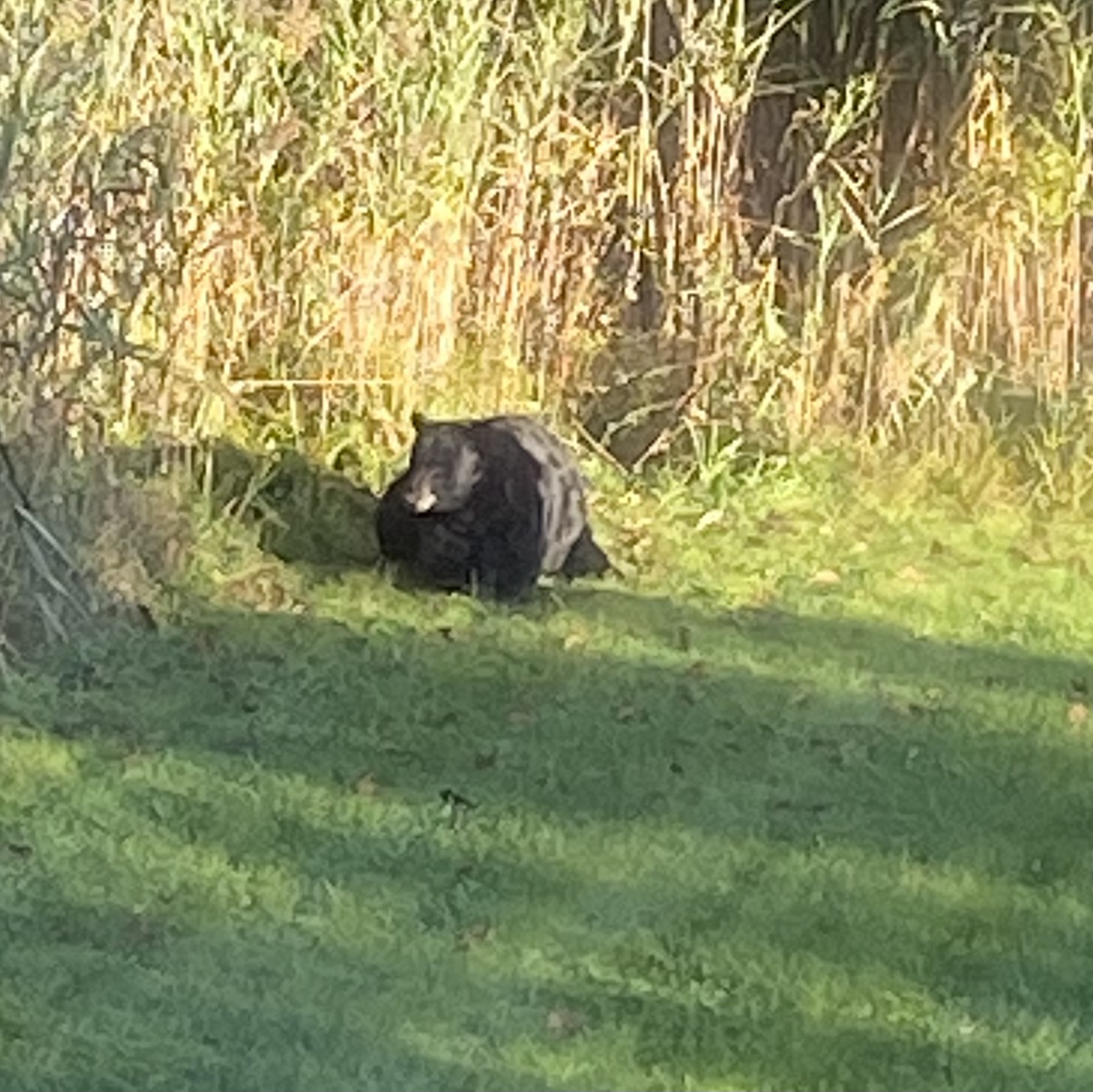
Anyway, the Orthodox family went home Sunday morning. Which was good, because if the kids had seen this guy in my backyard, they might never have returned.
Friday, July 28, 2023
Urbi et orbi.
Sunday, January 22, 2023
Memey like Sunday morning.
![]() |
| Good morning... What hurts today? |
![]() |
| Noted this on Lileks's blog the other day |
Thursday, March 31, 2022
Duck and cover.
Yes, it looks like it's the return of Duck & Cover!
🦆+📔
No, not the act that killed vaudeville, nor the world's worst law firm, nor even my excellent duck-centric novel available in serial form on Amazon.
I am of course referring to the classic rules for survival in the event of a nuclear blast, to duck down and take cover. I had a science teacher in high school who, during what we called "shelter drills," said sarcastically that this would protect us from the nuclear holocaust. He was right, in a way, especially since being in New York City, I figured we'd go up like a Roman candle in the first breath of a nuclear exchange. Duck and cover wasn't a bad idea, if we still were dealing with A-bombs; in the bombing of Hiroshima, 30 percent of the immediate deaths were caused by falling debris. But by the time I was a kid we had ICBMs with H-bombs, so we were all going to be crispy critters, as they used to say.
Which brings us to this, for which I wish I could take credit, or at least thank the person responsible:
I guess I'm in a crappy mood to start this Thursday. Got any good news?
Saturday, December 25, 2021
Boroughs of holly.
To the tune of "Christmas in Killarney," it's "Christmas in the Boroughs," for those of us who grew up in the city but not in the City:
The freakin' songs, the freakin' tree
The hum of the wheels on the BQE
It's Christmas in the Boroughs
With all of the folks at home
In Dyker Heights, there ain't no fights
Some guys put up a billion lights
So you 'n me, we'll take the D
And hope we don't get mugged
The door is always open
The goombahs come for lunch
Canarsie John, before he's gone
Will throw a Sunday punch
The night is dark|
We'll light a spark
And drink some Natty in the park
It's Christmas in the Boroughs
With all of the folks at home
Christmas in the Boroughs
Is sometimes kinda squalid
But Santa's my compadre
And he'll do me a solid
Our songs are sung
We're havin' fun
And no one's callin' 9-1-1
It's Christmas in the Boroughs
With all of the folks at home
The hum of the wheels on the BQE....
I'm handin' you no bull---
No matter where you roam
It's Christmas in the Boroughs
With all of the folks at home.
Thursday, April 15, 2021
Thursday, November 12, 2020
Sad mayoral history.
I thought the graphic below from National Review was very interesting, especially to those who keep wondering why their cities suck so hard. The point is not that Republicans do such an awesome job, but that one-party systems have no incentive to provide any service.
You will notice that the last row is an important addition from yours truly. Fixed it for ya, NR!
For those who would like more information about the administrations of Bradley Stokes and Dave the Orangutan, I refer you to the following texts:
Detective Comics 179 (January 1952):
(NB: I know Bruce Wayne is "Mayor of Gotham City" in this issue, but it's just a stunt by Stokes where prominent citizens get to be Mayor for a Week when he goes on vacation -- Bruce didn't have the time or authority to do much. Clever fund-raising gimmick, Stokes.)
2000 AD 366-443 (1984-1985):
Thursday, August 27, 2020
In old New York.
Between 1939 and 1941, the Works Progress Administration collaborated with the New York City Tax Department to collect photographs of every building in the five boroughs of New York City. In 2018, the NYC Municipal Archives completed the digitization and tagging of these photos. This website places them on a map.As Jon pointed out, what this essentially does is turn a map of New York City c. 1940 into a Google Street View. I found it to be a delightful time suck on a busy week. (There's also a 1980s version available, but I didn't find it to be as complete.)
Here are some photos of New York locations found through this "Street View," to give you a taste. The watermarks are unavoidable; the signs in front were some location or tax code used by the photographers and not a clear indicator to the streets.
![]() |
| Columbus Circle. The Majestic Theatre had become the Park in 1911. |
![]() |
| Near the Lincoln Tunnel (less than five years old at the time) |
![]() |
| West side downtown, near what would be the World Trade Center . Streets downtown were paved with ballast stones from ships, some of which are still visible at the South Street Seaport. |
![]() |
| South Ferry area, where a man in a hat is immortalized unawares 80 years later, along with a few palookas |
![]() |
| The Porto Rico line sailed between Manhattan and Puerto Rico for 75 years; more at this link if you're curious |
These are not pictures of all the great, well known structures, the Penn Stations and Ebbets Fields. These are the places where people lived and worked, from a time when New York had just started replacing so many old walk-ups with the glass towers that line its streets today.
And yet so many things look familiar to me, even though they were gone long before I came on the scene. It may have been shorter, but it was still the New York I once loved.
Wednesday, April 29, 2020
Fred's Book Club: Courage in Reporting.
This week's book is by one of the few really sharp and honest reporters of whom I know, someone who does not toot the courage horn by sitting in a studio defended by the resources of a network, but demonstrates it by going out in the world to find things called facts and write stories based on them. I mean City Journal's own Heather Mac Donald, and her book, The Burden of Bad Ideas: How Modern Intellectuals Misshape Our Society.
I feel you can make a distinction between two types of reporters who look at societal problems: the first, your average J-school grad, says Look at this problem! Do something! The other, much more rare, says Why is this a problem, one that has proved so hard to solve? Mac Donald is squarely in the second camp, and this book is a great collection of her pieces on these problems.
"The reality I have observed again and again in welfare offices and urban classrooms across New York and elsewhere is so dissimilar from that presented in the mainstream media that I sometimes wonder whether their reporters and I occupy the same universe," she writes in the introduction. "Maybe this is a matter of my background. I came to writing about urban problems and social policy as an innocent, without a preconceived theory about the neighborhoods that have dominated domestic policy debate for almost half a century now."
This book was published in 2000, but hardly anything has changed in the last twenty years, and where things had changed for the better, as in New York, they are rapidly changing back for the worse.
What Mac Donald learned in her work is shown in this book, with chapters like "The Billions of Dollars That Made Things Worse," "Why Johnny's Teachers Can't Teach," "Public Health Quackery," and "Revisionist Lust: The Smithsonian Today."
One of the most powerful chapters to me was "Homeless Advocates in Outer Space," which described a 1990s program by the Business Improvement District of Times Square to do exactly what advocates for the homeless seem to think has never been tried -- provide a no-strings-attached outreach to feed and clean and house the homeless, then offer every kind of help to get them on their feet provided they refrain from drug and alcohol use for a period of time. "One year and $700,000 later, only two people had accepted housing," Mac Donald reports. And this is only one of the programs described, a hint of the millions spent that helped hardly anyone. She concludes, "A sane homeless policy would acknowledge two basic realities. First, many people on the streets need treatment, not housing. For the sickest, legislators need to change rules against involuntary confinement, and states need to recommission mental hospitals emptied by deinstitutionalization. Second, for the rest of the homeless the best medicine is the expectation of responsible behavior -- the expectation of work and civil and lawful conduct in public spaces."
When The Burden of Bad Ideas was published, the New York Times Book Review said "this book has the freshness of a stiff, changing breeze." With the rush among governors and mayors to empty prisons and allow tremendous homeless encampments, and ding-dongs like Mike Bloomberg disowning all the policies that made his political leadership successful, I think it's safe to say that Mac Donald's essays, backed by interviews, observation, and deep research, have been completely ignored by those empowered to make better public policy. In fact, just last year she had a look at San Francisco's intractable homeless situation and found a situation even uglier than described in Burden. I doubt her work finds a welcome in the New York Times Book Review today.
I would advise anyone interested in the problems of urban decay to read The Burden of Bad Ideas. Urban problems have been given the breath of new life since the book was published. The causes have not changed, but now the idiocy that led to bad public policy has seeped into an urban population incapable of seeing how its participation in bad ideas leads to its own misery. This book ought to be required reading for every political science major in the country.
Instead, of course, Mac Donald gets silenced on campuses by the usual idiots who can't bear to hear anything resembling the truth.
Friday, February 14, 2020
Town and country.
There's a new lady in the area; she has a couple of young children and a tiny little dog. (No, she doesn't live in the Witness Security Program/FBI Safe House; I don't know where she lives but it's not there.)
I tried to keep away from her, I ought to let you know that. She was coming down the block with little dog but no little kids, and I was in the front yard with Senior Varsity Dog Tralfaz. Tralfaz is an enormous hairy beast, although the friendliest pup you know, and he sometimes scares children and other dogs with his enthusiastic greeting. That being: A few really loud barks, then he barrels at them like a locomotive. Who would be alarmed by that?
![]() |
| Typical action scene |
Anyone would be alarmed by that, I know, so I dragged and cajoled him against his will into the backyard until the lady went by. Well, he immediately pulled me to the farther end of the house to watch when she came out the other side, but he was quiet about it. Once she had gone, I took him back to the front to resume what we were aiming to do out there in the first place -- walking up the street, in the same direction from which she had come.
What I didn't realize was that as soon as she got to the end of the block, she and her dog turned around and started back up in our wake.
So now we had the world's slowest chase: me trying to keep my crazy bear from realizing the little dog was behind us, Tralfaz dawdling to sniff every molecule that the little dog had left behind, her and her dog strolling along, and me also trying to glance back to see if they were gaining on us (they were).
When the inevitable happened and we met, our greeting was quite friendly. Tralfaz immediately went nose-to-nose with the little dog, and at first all was fine; then the little dog did an aggressive growl and the lady had to pull him back. Which was no problem, as she is quite tall and presumably strong and her dog weighs maybe ten or fifteen pounds, maybe a tenth of Tralfaz's fighting weight.
We chatted a bit, complimenting each other's canine chums; she asking about dog groomers. I found out that she and the family just moved up to the Hudson Valley from the city and are just finding their way around. And then she said something that surprised me: that she'd cleaned up after her dog and didn't know what to do with it so she left it on the fire hydrant.
That sentence didn't compute for me, so I just let it fly by as we went on to the next topic. Soon we parted, and I took Mr. Friendly back down the hill.
Sure enough, hanging from the fire hydrant closest to my house was a plastic pet waste bag.
I realized suddenly that she really is from the city originally, and probably a neighborhood where there are municipal trash cans on every corner. Clean up after your pup there, drop it in with the Styrofoam coffee cups and chip bags and soda bottles in the corner can, and be on your way. This is something she didn't know about suburban life, that while we may have sidewalks in our neighborhoods, we don't have public trash cans.
We have to take care of our own trash. I use an outdoor bin in the backyard. Another family I know leaves the waste bags hidden behind the bushes until trash day. Another family keeps the garbage can outside all the time for that purpose.
Not to belabor a distasteful topic, but I had to think about how to deal with it. Of course if I speak with her again I'll suggest she follow my lead on this. Meanwhile, there was a dog waste bag hanging on a fire hydrant in front of the house of my despised neighbor, the dog hater, the one who I have mentioned will probably be led out of his house by the feds one day.
I told my wife about this situation. She thought that it was hilarious, but I knew we'd get blamed for this. And really, I don't want any confrontations with the unpleasant occupant next door. I don't want any contact with him at all.
So, while walking Nipper later, under cover of darkness, I took the bag off the fire hydrant and put it in my holding pen. The lady will probably think the garbage men picked it up, that it's part of whatt they do -- so if I'm not astute, the fire hydrant could turn into a veritable Christmas tree of dog poop.
The moral of the story is, I guess, comes from the old Town Mouse and Country Mouse tale by Aesop, or maybe the Town Mouse, Country Mouse, and Suburb Mouse by Roz Chast. Or something. The point is, moving from one kind of place to another is a culture shock. First thing to do is find out how to get rid of your garbage. It's not the same everywhere.