Showing posts with label philosophy. Show all posts

Wednesday, January 26, 2022

Deep thoughts.

From the deep thoughts factory at FredCo.

🧠 According to the Cleveland Clinic, your brain processes 70,000 thoughts per day. This means that by the time you turn 50, you've had approximately 1,278,340,000 thoughts. That seems like a lot, especially if, like me, the bulk of your thoughts are devoted to Is there anything to eat? and I'm tired. But if you had one thought for every dollar spent by the federal government's $1.9 trillion budget this year, you would be more than 74. And that's just the budget, which doesn't include mandatory spending, or entitlements, which was $4.6 trillion in 2020. Think THAT many thoughts and you'll be almost 180.

🐕 Buridan's Ass is the philosophic example of the donkey that starves to death, being unable to choose between two identical and equidistant bales of hay. It is tough to be caught in a dilemma like that, as with a smart or athletic student who can't decide between two great colleges that offer a full ride. Most of us are more familiar in real life with the damned-if-you-do, damned-if-you-don't type dilemma, where two or more choices all suck in roughly equal proportion. In real life, the donkey would probably just wander over to one bale and eat. If you tried it with a Golden Retriever, he would eat both meals and go running off to find something to play with or pee on. 

🐶 Speaking of dogs, one of the advantages of having them around is that they make you feel productive even when you aren't. Adult dogs sleep up to 14 hours a day. I only want to sleep that long. 

😴 Speaking of sleep, according to the National Institute of Neurological Disorders and Stroke, the reason you don't usually punch and kick people while dreaming is that "Your arm and leg muscles become temporarily paralyzed, which prevents you from acting out your dreams." Isn't that helpful? Last night I dreamed I was with James Bond as one of a bunch of his sidekicks, planning to kidnap a foreign agent by getting him drunk. It devolved into a hunt for the hodag along a city street, all previous plot elements forgotten. If I'd been running and punching and leaping in bed as well as in sleep, someone could have gotten hurt. Or it might have made a video for the 'gram. 

💤🛌 Which brings us to what I was doing between bouts of sleep, which was taking out the dogs. Large dog Tralfaz got it in his head that he had to go out 700 times last night, and of course Izzy (a.k.a. Me2!Me2!) wanted to go as well. I tried to be patient because it could be chemo-related, but I am a tired puppy myself right now. The Harvard Health Letter reports that deep sleep may be when the brain clears toxic waste created in the normal course of cell life. And my brain feels pretty toxic this morning. So that's enough thoughts for now. 

Wednesday, January 27, 2021

Fred's Book Club: Hopelessness and Survival.

It's Wednesday once again, which means Hump Day, which means it's time for the Humpback Writers, our stupidly named book feature that looks at books. We often like to look at the lesser known works of famous writers, or more obscure writers and books, but today we have an author and book that are quite famous, and for very good reason. We're featuring them today because January 27 is the International Day of Commemoration in memory of the victims of the Holocaust, as decreed by the United Nations. And the book is Man's Search for Meaning, by Holocaust survivor Viktor E. Frankl

When you're in the publishing business you read an awful lot of books and articles on how to have a good life, but this is the only one I know of that was written by a man who spent three years in Nazi concentration camps. You're supposed to go to a spa in India and talk to a guru and then climb a mountain and stuff, right? Nope. There's a reason why those kinds of quests go many places but never get anywhere.

Dr. Frankl was a brilliant young psychiatrist when the Nazis rounded him up. In a very short time he lost family, career, and all the work he had done on a massive philosophical and psychological thesis. As for his friends:

It was the first selection, the first verdict made on our existence or non-existence. For the great majority of our transport, about 90 per cent, it meant death. Their sentence was carried out within the next few hours. Those who were sent to the left were marched from the station straight to the crematorium. This building, I was told by someone who worked there, had the word "bath" written over its doors in several European languages. On entering, each prisoner was handed a piece of soap, and then----but mercifully I do not need to describe the events which followed. Many accounts have been written about this horror. 
     We who were saved, the minority of our transport, found out the truth in the evening. I inquired from prisoners who had been there for some time where my colleague and friend P--- had been sent.
     "Was he sent to the left side?" 
     "Yes," I replied.
     "Then you can see him there," I was told. 
     "Where?" A hand pointed to the chimney a few hundred yards off, which was sending a column of flame up into the grey sky of Poland. It dissolved into a sinister cloud of smoke.

Long before reading this book I'd read Leon Uris's Exodus, and Aleksandr Solzhenitsyn's A Day in the Life of Ivan Denisovich, and other books about the Holocaust and brutal prison (and death camp) conditions. The thing that is so amazing about Frankl's book, that still intrigues me, is that he combines his horrifying personal story with clinical observation, all of which will go to the making of the book's conclusion about purpose and human life.

Seeing himself and others as subjects, he looks at the phases of psychological change in the camps. The first phase is shock, shock at the terrible thing that has happened, with thoughts of escape by any means, even suicide. Eventually would come the second phase:

Apathy, the main symptom of the second phase, was a necessary mechanism for self-defense. Reality dimmed, and all efforts and all emotions were centered on one task: preserving one's own life and that of the other fellow.... It can be readily understood that such a state of strain, coupled with the constant necessity of concentrating on the task of staying alive, forced the prisoner's inner life down to a primitive level. 

Frankl would find himself numb to the suffering of others, suffering that would have caused a horrified reaction at any other time in his life.

With the inescapable presence of suffering and death and injustice, Frankl got to see what kind of men survived and what kind did not. The ones who were smoking their meager cigarette ration instead of trading cigarettes for food or clothes were ones who had given up. The ones who believed they would be free by Christmas would lose hope and die when the day came and went. ("The death rate in the week between Christmas, 1944, and New Year's, 1945, increased in camp beyond all previous experience" -- an observation later echoed by Commander James Stockdale.) Ultimately the survivors were ones who had found meaning in their lives, something that made the unendurable endurable:

A man who becomes conscious of the responsibility he bears toward a human being who affectionately waits for him, or to an unfinished work, will never be able to throw away his life. He knows the "why" for his existence, and will be able to bear almost any "how."

And how does a man find this meaning? That was the subject of the rest of the book, his other books, and his career.

All I can offer here is a brief overview of this book, which itself is not long -- my Washington Square Press paperback runs just 179 pages, not including the extensive bibliography. It is very readable, though in parts shocking even to those of us who have read other accounts of the Holocaust, and ultimately very sensible. 

Frankl, who died in 1997, hoped that his hard-won lessons might enlighten mankind to avoid anymore such genocides, and even prevent nuclear war. In that, he admitted he could be overoptimistic, but one can never say he and his work were without meaning. I recommend this book unconditionally to anyone.

Thursday, September 3, 2020

The blindness of the intelligentsia.

Today we address the latest fad from publishing, courtesy of a major journal known for its deep dives into thorny intellectual problems. I am of course referring to Esquire magazine.

"Fact Checking Is the Core of Nonfiction Writing," notes the title of the article in question. "Why Do So Many Publishers Refuse to Do It?"

Well, as someone who has done fact-checking work for more than twenty years, I can tell you one reason right off the top of my head: Publishers are cheap. Even in the heady days of 2000, when publishers had money, and the Internet hadn't started to pick off newspapers and magazines like tin monkeys in a shooting gallery, publishers were tightfisted about copyediting and fact-checking. Why? Because the production budget margins were slim, and anything that wasn't sales (advertising, special direct sales, subscriptions), fat paychecks for talent, editorial bonuses, or loaded expense accounts was overhead. We were overhead. We were speed bumps that the editors and writers hit on their way to the sunny uplands of publishing glory. We were the damp sock in the face that said "This author writes like a fourth-grader with narcolepsy" or "Everything in this piece is a lie." It was never phrased that way, but that's how it feels on the other end of the sock. Who'd want to pay for that?

But that's not what the author is driving at here. Best-selling true-crime-story peddler Emma Copley Eisenberg is asking why book publishers don't pay for fact-checking staff to make sure the books they publish are accurate.
Fact checking is a comprehensive process in which, according to the definitive book on the subject, a trained checker does the following: “Read for accuracy”; “Research the facts”; “Assess sources: people, newspapers and magazines, books, the Internet, etc”; “Check quotations”; and “Look out for and avoid plagiarism.” Though I had worked as a fact checker in two small newsrooms, did I trust myself to do the exhaustive and detailed work of checking my own nonfiction book? I did not.
      From reading up on the subject and talking to friends who had published books of nonfiction, I knew that I would be responsible for hiring and paying a freelance fact checker myself. This is the norm, not the exception; in almost all book contracts, it is the writer’s legal responsibility, not the publisher’s, to deliver a factually accurate text.
      As a result, most nonfiction books are not fact checked; if they are, it is at the author’s expense. Publishers have said for years that it would be cost-prohibitive for them to provide fact checking for every nonfiction book; they tend to speak publicly about a book’s facts only if a book includes errors that lead to a public scandal and threaten their bottom line. Recent controversies over books containing factual errors by Jill Abramson, Naomi Wolf, and, further back, James Frey, come to mind.
I'm willing to take her question at face value here. The main reason that publishers don't want to fact-check -- and neither do authors -- is it means less money for everybody else. She says that for one her books she had thousands of pages of documents and hours of transcripts. I am not questioning her work ethic at all. I am saying that it would take the fact-checker about the same amount of time to go over all this information, even if it were well organized (which most writers are not), so what does she expect them to be paid? The starvation wage for such work is $20 an hour, so you're looking at possibly $20,000 at least if you want such research checked. That's all going to come out of sales, and thus out of the writer's pay. How many of them would sign on for that, especially writers who are more confident about their research?

Unbelievably, Eisenberg was able to get someone to do one of her books for just twelve grand, for which she paid herself out of pocket. I credit her for the willingness to do that rather than face fire or possibly lawsuits for getting the facts wrong. And she was lucky to get a good fact-checker; elsewhere the article cites the story of a writer who hired a freelance fact-checker that was not so good, and introduced more errors into the work. Not many people really have experience in the field, you know, and those that claim to often have worked for biased publications or celebrity outfits that just want a rubber stamp on what they publish.

Then there's this thought:
But the reason why the publishing industry has been slow to implement such guidelines for fact checking may lie further down in the foundation of the whole system. Without widespread consumer awareness that most books are not fact checked, or about which imprints publish which books, there’s no real reason for publishers to care about fact checking. If it comes to light that a book contains major errors, it’s the author, not the publisher, whose reputation takes the hit.
She's right about that, but doesn't make the case why the publisher should care. I've done a lot of work for a publisher that will put almost anything labeled nonfiction in print, all kinds of stuff, and they really and honestly don't care if it's truthful. Why should they? No one's going to say, "This book on the Reptilian Conspiracy leaves out crucial data! I'll never buy a book from Knucklehead Press again!" No, they'll say, "Joe Bloe's book on the Reptilian Conspiracy is a waste of time! Don't buy it!" And if the sales are lousy, the editors at Knucklehead won't bother to contract Mr. Bloe for more books. It's still cheaper than having a big fund for fact-checking and lawyers that doesn't come out of author's royalties. But Eisenberg, who I suppose as a reporter is studious about facts, seems to think publishers can pay for this out of the unicorn golden fart fund, because the Internet has demolished the book publishing industry pretty well, and most books lose money.

The person who brought this story to my attention -- you probably guessed I'm not an Esquire reader -- was fuming because publishers ought to pay! for fact-checking, to stop the spread of fake news! I'd like to know whose fake news was intended by that statement. The healthcare pros who said we couldn't visit Grandpa's deathbed but it was okay to mob the streets for a protest? The fact-checkers at Rolling Stone who gave a thumbs-up to the Duke Lacrosse story? The sharp-eyed researchers at CNN who approved the "fiery but mostly peaceful" reportage?

NB: This is fake but accurate.

For some reason, the same people who ask "Who watches the watchmen?" about the police are completely willing to trust reporters and fact-checkers, as if they don't have their own biases and prejudices. Or, more likely, they know they have biases and prejudices, but they're the "right kind." Which is how I've gotten in trouble over the years for my fact-checking work.

One last point, and this may be the most important point: Insane or not, con artist or not, the book author will almost certainly know more about his subject than the fact-checker will, but the fact-checker can only go by accepted wisdom. So in cases where the book goes against conventional wisdom, the fact-checker would red-pencil everything until the publisher has no choice but to pay a kill fee and cancel the project. What does this mean? Surely half the diet and nutrition books peddled to the lay audience would never see the light of day. And no book questioning orthodoxy on global warming, sexual identity, or the sanctity of certain politicians would ever get to galley stage. What would be next? Books arguing against Keynesian economics, the 1619 Project, abortion and euthanasia, and whatever else is a "protected subject" would never be published. Many people in the business, almost left-wingers all, might say "So what?" Here's what: Other books under the don't-question-orthodoxy rule would include Darwin's On the Origin of Species, Copernicus's De revolutionibus orbium coelestium libri vi, Pasteur's The Germ Theory and Its Applications to Medicine and Surgery, and Newton's Philosophiæ Naturalis Principia Mathematica. In other words, if I de-platform (as the kiddies say) the cranks and the crooks because they disagree with mainstream opinion, I'm likely to kill the truth as collateral damage. Better to publish them all and let the truth work its way forward. 

Tuesday, June 16, 2020

Boredom and dumbdom.

Many commenters, including our commenting pal P.L. Woodstock, have surmised that one reason the recent peaceful protests turned into an orgy of violence and destruction so quickly is that being holed up for months due to Chinese Death Virus caused a crush of animal spirits to be sprung on the cities of America. People have been so frustrated and angry at things beyond their control that something, somewhere had to give. I believe it. I also believe there are bad actors who wanted to use the genuine outpouring of outrage to vicious ends, but let's give frustration its due as a major contributing factor. That and boredom.

I am convinced that boredom is very much underestimated as a motivating force for humans, both human achievement as well as human destruction. It sure doesn't look pretty.
Get a job, kid.
Just on a small, personal scale, boredom can cause all kinds of trouble. Bored with eating healthy (as who wouldn't be)? Obesity and diabetes and such. Bored with your spouse? Infidelity and lawyers and court orders. Bored with the ol' nine-to-five? Embezzlement and arrests and lawyers and ugly orange jumpsuits.

Boredom can be a positive thing, too. Maybe some theoretical scientists would enjoy thinking deep thoughts for laughs, but I suspect that if engineers weren't bored by regular tasks they wouldn't tinker and try to make new and useful inventions. Really, if you have food, clothing, shelter, and a reasonable expectation you won't be killed, why bother with anything? You could lay around in your spare time. But boredom impels us to find something interesting.

An article in a former newspaper called the New York Times made me think a little more about this; it examines the benefits of repeating familiar experience vs. encountering novel experience. And there are benefits to the former, because we do not process everything the first time around. I dislike seeing movies over and over, but if I watch one I haven't seen in a while I always see something I'd missed. That's even more true for day-to-day experience, as no day is exactly like another, as much as it may feel that way when you pull into the company parking lot on Monday morning. Heraclitus's famous quote, that you never step into the same river twice, still applies. Everything in life is in flux. But it doesn't feel that way, especially when you've stepped into that not-same-but-kind-of-same river a hundred times.

Boredom seems like it should be just a non-motivator, a big nothing. And indeed bored people can find it hard to get motivated by almost anything, a situation that smacks of depression. But boredom is not a mere nothing. It feels like a heavy weight, and that's something. It also has a powerful partner in frustration. Where one is the other generally follows.

It may be that boredom is the main impulse for so many of our advances. Maslow's hierarchy of needs tells us Safety First, but something impels us past the point of safety. Those upper tiers of the pyramid must allow for the fact that boredom and other impulses may drive us to sacrifice the lower basic needs.


Why did the human race ever keep moving till it covered the globe? Was it all just because food ran out here or the weather got bad there? Was it turf wars with other tribes, or resentments within our own? Or were we sometimes just sick of looking at one another and wondered what else might be over yonder?

The problem is, the really creative ways of relieving boredom, the ones that lead to advancement, are difficult, and may require talents and skills we don't have, like musical gifts, analytical thinking, navigation, a knack for math or looking at problems different ways. But setting crap on fire, beating someone to a pulp, or breaking windows? That stuff is easy.

Like so many things, it's hard to build straight with the crooked timber of humanity. Our flaws are inextricably tied to our virtues. Sometimes I wish things were better than they were, but a lot of the time I'm surprised things things aren't a lot worse.

Sunday, June 2, 2019

Trust.

I've been thinking a lot since the beginning of Easter -- Easter is still going, of course; it runs until Pentecost (this year on June 9) -- about trust. It has been an issue for me since I started to claw my way out of paganism and agnosticism many years ago.

Can one be a pagan and an agnostic? Well, I gave it my best shot.

The advantage of both paganism and atheism is this: that they answer the question "If God is good, why do bad things happen?" The pagan may be pantheistic (seeing bad things as the result of bad spirits or gods) and feel that bad things may be countered by getting power for oneself; the atheist simply says that God is not good because he does not exist. The Christian is the one who must square this circle, and it hardly needs to be said that I'm not the first one to run against this stumbling block. It doesn't help that I'm naturally pessimistic and that faith is like a second language to me.

The early Christians, and saints throughout the ages, did not find the bad things in life to be bad. They found the harshest persecutions to be nothing compared to the glory yet to come; they found lessons and endurance in the most difficult of life's circumstances. The average cradle Christian on the street may look at that and say, "I think I'll go see what the pagans and atheists have to offer instead."

When one is not blessed with an extraordinarily powerful faith, but does believe in a good and loving God, how does he fill the gap between the bad things that can happen and the belief in a merciful and loving God? God did not spare His own Son the Cross. How much more will He let happen to me? Doesn't he know how weak I am?

People would tell me to simply trust in God. Christian writers who informed my budding belief knew that trust in God was crucial. But how I could I trust God when he allows typhoons, earthquakes, birth defects, volcanoes, etc. etc. etc.?

A friend of mine told me that trusting in God just meant saying, "Whatever happens, it's going to be okay." And he could speak with some authority, having buried his teenage daughter a few years earlier -- she had died suddenly of natural causes. If he could survive that and still have faith, that at least told me it could be done.

I came to think eventually that my problem was that I was treating trust passively rather than actively. That may work with people, but not with God. I trust you because I lent you fifty bucks and you paid me back last week. I don't trust Joe because he made a pass at my wife. My trust is a reaction to others' actions.

But trusting God is different. It requires me to take an active approach. I have to make the decision that whatever happens, I am going to trust in God and not go back on it. This requires effort, at least for me.

So I've tried to adopt this attitude and so far I think it's going okay. I have my dark days, where nothing seems to be going right; you have probably heard my whining from wherever you live. You certainly can find it on this blog. But I have enough faith to believe this is ultimately a destructive and unhelpful attitude, and that I can find a better one if I put in the effort.

What the heck; I've come this far.


Friday, October 27, 2017

Great things and small.

I was thinking about this whole Hollywood scandal with that Weinstein guy. Not that I know any inside information. There are newborn antelope in Africa who are better connected than I am. But I remembered the first time I'd heard of Harvey Weinstein was in connection to one of his Miramax films that he was defending despite its vile subject matter and the childish means it told its story. He was acting like a poor innocent lover of art who couldn't dream of why people should be offended, all the while doing everything to gin up as much fury as he could.

What a jerk, I thought, and if I could see that from a million miles off, couldn't everybody?

I know that plenty of well-known gropers, creeps, and men who otherwise can't behave themselves get a pass in life because they are rich, because they can buy favors, because they can buy loyalty, because they can buy people's silence. Often they can just terrify people with the slightest hint of what horrible things they and their army of lawyers can do to them, to their reputations and careers. And sometimes they get away with things because they're on the "right side," they think the "right way" and support the "right causes." In other words, they may be well known as disgusting pigs, but they're allowed to get away with little things because they're right on the big things.

Yes, I realize I'm calling the subjugation, humiliation, and even rape of women a "little thing," but I didn't make this situation or define its terms.

And maybe it's exactly backward. Really, where did we get the idea that some schmuck who cheats at penny poker is a good ally when things are really serious?

I don't have to get biblical on you to make the case, but I will, specifically Luke 16:10: "If you are faithful in little things, you will be faithful in large ones. But if you are dishonest in little things, you won't be honest with greater responsibilities." Would you trust a guy who cheats at gin rummy even for funsies to do your taxes? to manage your money? Probably not, because in real life we know a cheater is a cheater. It's just a game is a meaningless excuse, because to a lot of big-time cheaters everything is a game. Their funsies is your ruined existence.

We love stories about the petty crook or awful sinner who comes through in the big stuff. Off the top of my head I give you wastrel Sydney Carton from Dickens, thief and murder-solver Bernard Rhodenbarr from Lawrence Block, Dustin Hoffman's petty schnook from 1992's Hero, and every bad-boy antihero scalawag out there. But the reason these characters are interesting is that they're unexpected.

In the last fifty years we've turned it all on its head. In the 1970s you were surprised when a movie cop was not corrupt. Now our pop culture heroes are all antiheroes; there's a strong wellspring of goodness lurking in every low-down punk, while every angel of charity is an evil creep. But that's not how it works in real life.

I know people who have really turned their lives back to front, inside out, to be good and upstanding, and I've also known people who never had to because they've always been kind and brave and decent. I love and respect them both. But I have also known human sphincters who never wanted to become good, never cared; always thought that genuine goodness was stupid at best, weakness at worst. People like them will always prefer the darkness, because the light burns them.

So what does this have to do with Harvey Weinstein? After all, the people who wanted large things from him (campaign support for national and international causes) got what they wanted, didn't they? He didn't stab them in the back, right?

Look at it this way: People who are rotten in small things -- especially when they are not really small -- will be rotten clean through. You know that some of Weinstein's friends are familiar with this principle; they would be among those objecting to the foreign policy position on friendly dictators that says "He may be a son of a bitch, but he's our son of a bitch." And yet it didn't matter when Harvey was their son of a bitch.

Those who were using Weinstein for his money while he was using all kinds of women for his base desires were offering him cover as sure as if they were giving the police phony alibis on his behalf. The Harvey Weinsteins of the world are contagious, and you're better off staying away from them entirely.

Even if it means you wind up with all the fame, wealth, and prominence of a newborn antelope.

Monday, June 12, 2017

Don't take advice from bugs.

Jiminy Cricket is an idiot.

Jiminy Cricket is, of course, the counselor for Pinocchio in the Walt Disney animated film. The character was in the original Carlo Collodi book, but was nameless and didn’t have much of a role.


The Blue Fairy in Disney’s version puts the cricket in a new suit and puts him to work. And he gets a name, too.

The two reasons I call Jiminy an idiot can be traced to his two big songs in the movie, “When You Wish Upon a Star” and “Give a Little Whistle.”

Reason number one is easily explained: When you wish upon a star, you don't automatically get what you want, and thank God for that. If we got all our wishes we would be unimaginably horrid creatures in the long run. Meanwhile, kids who hear that song and want something good---Dad to come home, Grandma to get well---will wind up miserable when these things don’t happen, and then they become cynical teenagers, and expand that to bitching about prayers going unanswered, and we have to listen to them whine and refuse to go to church. Thanks, Jiminy.

You betcha!

Reason number two: Let’s look at the lyrics from that second song.

When you get in trouble and you don't know right from wrong,
give a little whistle!
Give a little whistle! 

[Whistling's connection to moral decision making thus far unclear …]

When you meet temptation and the urge is very strong,
give a little whistle!
Give a little whistle! 

[No serious problems yet ...]

Not just a little squeak,
pucker up and blow.
And if your whistle's weak, yell "Jiminy Cricket!" 

[Giving himself some job security here]

Take the straight and narrow path
and if you start to slide,
give a little whistle!
Give a little whistle!
And always let your conscience be your guide!

Aha!

The problem is that not everybody’s conscience is a good guide. And I ought to know, since I’ve heard plenty of people talk about doing lousy, rotten things to other people and being perfectly at ease with their souls. Yes, I’m sure your conscience agrees that leaving your family in need to marry some floozy to “find your path” and “be the authentic you” was the right thing to do. Your kids will understand. Probably around the time they’re abandoning their own families.

But you say, “Hey, the conscience is said to be the part of you that knows right from wrong and is said by some philosophers and most theologians to be a gift from God. How can it be wrong?”

Here’s where two millennia of Catholic teaching shows us a better understanding of the human heart than either modern psychology or Jiminy Cricket.

The Question and Answer Catholic Catechism by the late Fr. John Hardon explains that our own actions and habits over time may cause our conscience to become corrupt, or at least unreliable. It defines eight types of unreliable conscience:

Scrupulous conscience: A conscience that is too timid to decide right from wrong, and may judge lawful things as unlawful out of fear. The hyper-religious person who condemns everything is a popular stereotype of this.

Perplexed conscience: A conscience that sees an act being performed as sinful, and the same act not being performed as sinful. Someone who believes going to war for the country and failure to answer the call to go to war for the country as sinful acts may be said to have a perplexed conscience.

Lax conscience: A lazy conscience that sees virtue in sin, letting things pass or deciding it’s no biggie. "Robbed an ol' widow? Hey, not like she's got long to live anyway."

Pharisaic conscience: A conscience that trivializes grave sins but magnifies small matters. Jesus knew some of them. A vegan who rears back in horror at the idea of eating an egg but would like to throw acid in the face of a Republican might just have a pharisaic conscience.

Hardened conscience: A conscience that approves of everything, completely corrupted by sin. Basically half of our modern culture.

Certain conscience: A conscience without a prudent fear of being wrong, which can lead to stubbornness and error. Those who see themselves as 100% saved by their faith can easily fall into this trap.

Doubtful conscience: A conscience that can never decide for or against a course of action, and may not act at all. Prince of Denmark, call your office.

Erroneous conscience: An upside-down conscience that tells the person that a bad act is good and a good act is bad. Basically the other half of our modern culture.

Someone with a scrupulous, doubtful, or perplexed conscience would never be happy on this earth; one with a hardened, erroneous, certain, pharisaic, or lax conscience would go forth and cause all kinds of misery with a happy grin. And there’s Jiminy telling them all it’s A-OK.

So you see, Jiminy is an idiot. Then again, despite his name being a mild euphemism for taking the Lord’s name in vain, Jiminy is just a bug. It’s kind of a lot just to ask him to wear a suit, let alone sing and dance. How can we pile theology on top of it?

Wednesday, May 25, 2016

Guava.

There's a sushi place we get food from occasionally. While I'm not a big fan of sushi, I do like the fact that in lieu of after-dinner mints, they give you these:


I had no idea what these were, what the label said (besides "Classic Series"), or what they were supposed to taste like. I didn't recognize the little fruit on the wrapper.

A bit of searching taught me that the fruit is guava, and this fine Chinese candy can be purchased through Amazon. "Classic Series," rather than being puffery, seems to be the actual name of the candy, and the company appears to be Hong Yuan. Asian Supermarket 365, which also sells the candy, describes it thus: "Even if guava is not your favorite fruit, you may also this candy. It tastes delicious and natural, not too sweet."

Well put! I believe it's true that you might like this even if you don't like guava. I can't say for sure, because I don't think I've ever had guava. It's fun to say: Guava Guava Guava. A baby could say it. I guess guava (guava! guava!) is a hole in my culinary education.

But the reason I support their assertion is that grape candy, as we all know, is almost a completely different flavor from actual grapes. The same goes for other candies. It's no original observation on my part to note that we have contrasting and simultaneous ideas for flavors like blueberry, blackberry, watermelon, and others based on what candy and actual fruit taste like. You would never confuse watermelon's flavor with that of a watermelon Jolly Rancher, for example.

It could be a conundrum for Plato or the Scholastics: Is there a watermelon essence that is above and beyond the actual watermelon? A World of Forms watermelonness that Jolly Rancher captures to some extent, even without physical watermelon? If you replace a watermelon slice by slice with artificial watermelon, at what point does it cease to be watermelon? And that doesn't even to address the kumquat issue. Where do they fall in all this?

It's too much for me. I'll just say that I do like the guava "Classic Series." It is indeed tart but light, refreshing in the way an after-dinner candy should be. Unlike After Eight mints, you can even eat one at seven thirty. I'd like to try Hong Yuan's lychee candy, which I'd bet I'd like too -- since I have no idea what lychee tastes like.

P.S.: Guava Guava Guava! Heh.

Saturday, March 5, 2016

Inside out.

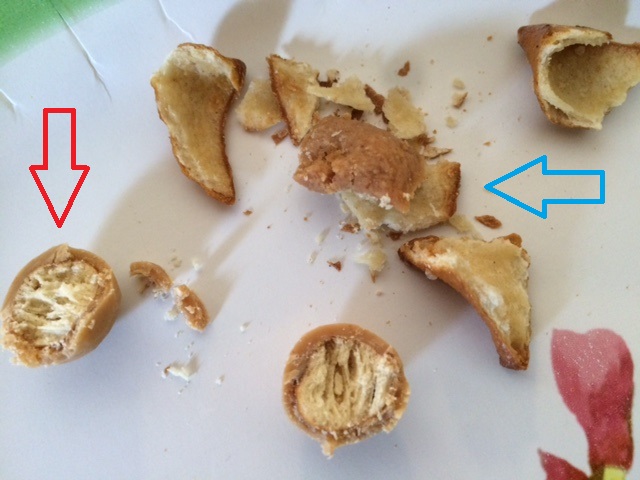
Clash of the snacks. But this is more than just a battle of taste. This is a battle of philosophy.

In this corner, ConAgra-owned H.K. Anderson's pretzel nuggets filled with peanut butter:


And in this corner, Hormel-owned Skippy's P.B. Bites, peanut butter nuggets filled with, uh, pretzel:


Two tasty snacks, both with the great taste of peanut butter and pretzel. But they are opposites. PB inside/pretzel outside vs. pretzel inside/PB outside.


Each is the yin to the other's yang. Identical, yet completely different.


Can a person hate one and love the other? How? And yet, how could one love both, as one is the inside-out version of the other?

But can they really be that different? Perhaps this is one of those "Last Battlefield" Trek things?


At what level are they the same? In what realm are they different? Can one repel, one attract? Is one the normal, the other the obverse? Converse? Inverse? And what about Combos, huh? No one's even considered how Combos work into this.

Would one be unable to choose, and be caught between them like Buridan's ass, starving? Or just scoff them all down like a Colorado stoner?

Can one possibly reject one, and keep the other?

Yes. My wife liked the Anderson nuggets better. Says the Skippy ones are too sweet.

See, this is why most philosophers are men. Women take all the fun out of it.

Sunday, February 28, 2016

Or would you rather be a mule?

Once upon a time, I, Chuang Chou, dreamt I was a butterfly, fluttering hither and thither, a veritable butterfly, enjoying itself to the full of its bent, and not knowing it was Chuang Chou. Suddenly I awoke, and came to myself, the veritable Chuang Chou. Now I do not know whether it was then I dreamt I was a butterfly, or whether I am now a butterfly dreaming I am a man.

You're a man.

In the first place, while mammals dream, insects don't even sleep as we do. They may be in state called torpor, sort of like you after Thanksgiving, but their little buggy brains don't function the way ours do even in sleep. It is extremely unlikely that insects dream at all. So you're not a butterfly dreaming you're a man.

Even if butterflies could dream, how would they know enough to dream such a thing? Bugs have a very limited concept of the creatures around them, unless they are excited to attack. A butterfly wouldn't know what a man was even if you sat him down and talked about it all day. He could only think of it in butterfly terms, which, let's face it, are pretty limited.


And I don't want to start any fights here, Teach, but I really doubt you ever did dream you were a butterfly. You know what I dream about? My boss is a pest and I don't know how to do my job, I'm on a stage and never saw the script, my fly is open at a funeral, I missed the last bus to someplace I was supposed to be yesterday. I don't dream of being any other kind of animal. How could I? My dreams take my experience and my anxieties and put them through the paint mixer and pour out some stupid concoction based on that. Being a very non-human creature is completely alien, and doesn't come up on Morpheus's Wheel of Fun. Unless you've actually been a butterfly in this lifetime, I flat-out don't believe you could have dreamed you were one.

If you're going to keep up that story, I'm going to want to know how you felt looking at the world with compound eyes, and sucking up your lunch with the ol' proboscis.

No, I smell a rhetorical question here based on a fabrication, and I'm not going to play this game, Teach. Come back when you have a question based on the dream about falling off your house, or your mother catching you naked on the golf course.