Showing posts with label common folk. Show all posts

Friday, June 21, 2024

Six months and a day!

I used to work with a trust-fund baby. Actually, I probably worked with several of them over the years, because a lot of the people I met in the artistic side of the magazine business had to be able to get in through the rich-kid gate, to wit:

1) Graduate from a good college;
2) Work as an unpaid intern;
3) Live in Manhattan on a crap salary.

After getting through those three phases, they could start to make a decent living. You will note that those three phases require something to back said junior staff member, generally Mommy's + Daddy's checkbook. That enabled them to take jobs that paid nothing or next to it, without worrying about student loans or making the rent. 

I'm not saying they had it easy, nor were they bad at what they did; I am saying that it was perfect way to keep out the riffraff. 

I, the riffraff, came up the hard way, commuting from the outermost borough, being broke for a long time, and never following the path that led to the glamorous and creative end of the business. But I made a living. 

The TFB that I mention at the top of this post, however, was a real classic of the type. Nice guy, and very intelligent, probably more so than I. But he was like a friendly alien dropped on Earth who had to try to guess what Earth people were like in order to go unnoticed. He could be a smartass but did not have a rough edge. He was curious about the lives of skilled laborers like my father. He always looked perplexed. He spent days contemplating aloud the purchase of a rice cooker. Should I buy or not? If so, what kind? A cooker or a steamer? Is one brand superior to another? What quantity of rice is proper? It is a puzzlement. 

Just use the microwave like everyone else!

I remember him telling me about his grandparents. Grandpa, the head of the family in a very real, very fearsome, and very financial sense, was from Massachusetts, but for tax purposes he officially lived in New Hampshire for six months and a day. That 50.01% residency kept him from having to pay Massachusetts' high income tax. New Hampshire only taxes interest and dividend income.

I have since learned that "Live Free or Die" might as well be replaced as New Hampshire's motto:


This is one of the reasons why, when politicians set out to tax the rich, the middle class always finds its taxes going up. The poor saps in Boston who can’t declare residency outside the state get stuck with the bill for the big spending plans that "taxing the rich" was supposed to fund.

Now, I have no idea how Mr. Boston Brahmin Grandpa voted, but if he was like the contemporary wealthy, he would continue to vote for the very policies he was fleeing, wherever he went. In doing so these moneybags screw over the state in which they amassed their fortunes and also the state in which they expect to keep them. 

I do not understand why someone, looking at the laws in their home state and regarding them as unfair and unjust, would support those same laws elsewhere. But they do. Thus, New Yorkers have been accused of ruining Vermont, Bay Staters of ruining Maine, and Californians are being accused of ruining Colorado. It's like they can't help themselves. 

I'm not sure why I brought all this up today, except I was thinking of that trust-fund baby and his grandfather. While TFB was studying this strange form of life known as the "middle class," we were studying him. I've never met anyone like him, but I'll bet in his youth he was like everyone else around him. 

Peculiar fellow. I don't even know if he ever got his rice cooker. 

Tuesday, June 20, 2023

Dead Body Cooper.

The topic of D. B. Cooper came up around the table, and one of the younger folks asked who that was. Well, it's been a long time since that fateful night -- November 24, 1971 -- when a man calling himself Dan Cooper threatened to blow up Flight 305 from Portland to Seattle. 

I told her a little of the story. How the average-looking middle-aged dude got on the plane and once they were airborne told one of the young stewardesses that he would blow them all up with his bomb unless he got $200,000 -- and four parachutes. That once he got the money and got the pilots to lift off again, he leaped out somewhere over the vast forests of Washington while alone in the cabin. That he knew that a 727 was one of the few jets that had a rear staircase openable from inside, that the plane could be flown at 10,000 feet so the cabin would not need to be pressurized and he wouldn't end up like Auric Goldfinger when the stairs were opened. That he and the money and the bomb disappeared into the cold, rainy night. That a reporter's mistake caused his name to be given as D. B., and that it's possible the hijacker was naming himself for a daring comic book character virtually known in the USA. That Cooper was never caught, and the case remains the only unsolved skyjack in history.


She said, in a nutshell, good for him. He planned a heist and got away with it. 

It surprised me, although it's well known that Cooper was, and in some quarters still is, a folk hero. No one got hurt, he got his dough in a 22-pound sack of twenties, and vanished into the forests of the Pacific Northwest. Everyone likes a heist! And everyone likes a guy who can (all together now!) stick it to the MAN.

Well, he wasn't exactly Robin Hood. He stole all that dough and kept it for himself. Or at least that was his intention. Personally, I believe that ol' Dan Cooper has been rotting corpse for fifty-plus years, and one day someone will find him. 

While parachutists have re-created the jump from a 727, they didn't do it at night in the rain over dense forests. Even then, the force of the jet engines has been described as being tackled from the back, so it's not easy feat. While at first the FBI thought Cooper had to be an experienced skydiver, it turned out that one of the parachutes, which was donated from a skydiving school, was used for ground training and had been sewn shut. Cooper took that one as a reserve chute. He may not have needed it, but a more experienced jumper would have realized it was no use. The other chute he took was an older type -- non-steerable. Which probably wouldn't have mattered anyway, in dense forest with the half-moon completely covered. But he would have had no control over where he came down. 

Some of the money was found buried on a sand bar in 1980 -- $5,800, all clumped up. A massive search was once again raised, but no other bills were found. 

I've always tended to be a law-and-order guy, so Cooper's no hero to me. Maybe no one got hurt, but there were three young stewardesses on that flight who thought it was going to be their last night on earth. One admitted to being paranoid and frightened for years after the event. The crew members were older, and the captain a tough veteran of World War II, but it was a hell of a night for them, too. 

FBI agent Ralph Himmelsbach, who was on the case for years until his retirement, said, "He used foul language to the stewardesses. He's a sleazy rotten scumbag and I hope he died a miserable, wretched death."

Had Cooper survived, he'd be in his mid-nineties or more now, so I think Himmelsbach probably got his wish. But he, like agent Larry Carr, who took over the case, thought that Cooper did not survive the jump -- and even if he had somehow landed without dying or breaking a limb, he would have been deep in the forest, lost (the plane had to deviate from its flight path because of the need to conserve fuel at that altitude), wet and freezing, in a business suit and dress shoes. 

The forests hold a lot of secrets. One day someone will find some bones, shreds of a cheap suit and some parachute fabric, maybe even a pair of busted sunglasses. And that will finally put an end to the story of the man who got away with it. 

Saturday, May 6, 2023

Horse of a different color.

Tom Lehrer made an astute observation lo these 64 years ago: "the reason that most folk songs are so atrocious is that they are written by the people." This was in the late 1950s, when the scourge of folk music was sickening the might of this great nation. Since then we're had a lot of other things to sicken us. 

But if there's one folk group I have a soft spot for, it's Britain's Steeleye Span. Their nation being much older than ours, they have a better excuse to sing folk songs, because Brits were around long before professional songwriters got into the business. Also, Span went electric in 1971 like Bob Dylan did at the Newport Folk Festival in 1965, which probably offended the most annoying folk-loving people. And third, they had the angel-voiced Maddy Prior, who would have elevated any group of singers. 

Maddy did not sing lead vocals on the song I draw your attention to today, however, which I bring up on account of this being the Kentucky Derby day, the first leg of the Triple Crown. That song is "Skewball," a folk song of long and confusing lineage.


According to Dr. Wikipedia, "Skewball" was the name of a racehorse of the 1700s, and the song is about the animal's greatest challenge. Now of course, being a folk song, every damn thing about the story is completely folked up. "His name has been recorded as 'Squball', 'Sku-ball', or 'Stewball'" says Wiki, and I sure hope it was not Stewball, which sounds like a dish made with the leftover parts of a gelding. So the song is sometimes called "Stewball," which remains unappetizing. A skewbald horse is patchy white on a nonblack coat, so that name makes more sense. 


Like so.

Also, the name sounds like screwball, a more recent Americanism but one that sets our hero up as a zany character, and helps put the race in a kind of Seabiscuit vs. War Admiral, David vs. Goliath frame. 

You gallant sportsmen all, come listen to my story
It's of the bold Skewball, that noble racing pony

In the song, performed with gusto and tension by Steeleye Span (the late Tim Hart on lead vocals), Skewball has been brought to Ireland from England to race, and is the underdog against the great mare Griselda, whose very name is fearsome. Our hero has one advantage -- a delightful owner, a sportsman of a type vanishing today:

Arthur Marvel was the man that brought bold Skewball over
He's the diamond of the land and he rolls about in clover

A popular and lucky man, in other words, wealthy and cheerful, the kind to take losing and winning with the same grace, and nowadays you'd know he's the murderer in the first ten minutes of the movie. But back then, they knew even a rich white guy could be a decent sort. Was that the real name of the owner at that time? It hardly seems possible, Arthur being such an important English name and Marvel coming into the English language in the 14th century meaning something that causes astonishment. Seems very appropriate, certainly.

Soon heavy bets are placed and the race is on. Skewball quickly demonstrates another interesting and dare I say zany quality, by chatting with the jockey:

Then halfway 'round the course up spoke the noble rider
"I fear we must fall back for she's going like a tiger!"

Up spoke the noble horse, "Ride on my noble master!
For we're halfway round the course and now we'll see who's faster."

Well (spoiler alert!), Skewball wins the day, overtaking the mighty Griselda. Then he and the jockey order booze and toast their worthy opponent: 

Past the winning post, bold Skewball proved quite handy
And horse and rider both ordered sherry, wine, and brandy
And then they drank a health unto Miss Griselda
And all that lost their money on the sporting plains of Kildare

And that's the story, and it's a neat little song. If more folk songs were like this, there'd be more to love about them. But no, they were always about tools and jails and fights and sung by lily-handed middle-class communists, at least back when Tom Lehrer was turning his gimlet eye toward them. 

Just remember, kids, that hard liquor is not good for horses. If you actually have a talking horse, however, then he might be different. Just make sure you haven't been drinking before he starts talking, or the cause of his loquaciousness might be suspect. 

Sunday, October 16, 2022

Vote Socialism, Freeze in the Dark.

Got a little message from our utility company the other day, the people whom we rely on for our gas heat and stove and water heater and electricity. 


All the years I've lived here, through times of pricey fuel and reasonable fuel, I've never seen a message like this. So let's ask: Can you explain the high prices in more detail? 

The rising cost of natural gas supplies has increased customers’ natural gas and electric winter bills for Orange & Rockland (O&R) and the rest of New York State’s electric and gas utility companies.

The cost of natural gas has been driven upward as:

Demand for the commodity has risen,
Exports have increased, and
Supply is limited. 

These and other factors have caused a decline in the amount of natural gas in storage in the United States.

So, I looked to the Web to ask, Why could exports have been increased? Why is supply so limited? And the first hundred hits were all of the Don't Blame Us CYA variety of government data spewers and their flunkies in the press, along with environmental groups that are dancing in the cold for the high price of natural gas and petroleum. So I checked some of the sites of people actually in the business of natural gas production and sales, like Shell. I was surprised but not shocked to see that China is the world's largest importer of liquefied natural gas, which means that once again China's activity is helping ruin things for the rest of us. The United States leads the world in LNG exports, but it seems like we could use some of that stuff closer to home right now. I'd rather we had more fuel of our own and less cheap crap available in Walmart.

Then there's the problem of Europe getting its gas cut off by Russia because of the sanctions imposed over the invasion of Ukraine. "Europe demand for LNG sets off global competition for supplies," says the International Energy Agency, and that "Russia’s continued curtailment of natural gas flows to Europe has pushed international prices to painful new highs". Gee, didn't someone give Russia a kind of backhand green light to invade Ukraine? I seem to recall something like that.

Of course, European leaders who have been bragging about dropping nuclear energy and going to solar and wind while really running everything on Russian natural gas are in for a colder winter than we are. How much does woodfire contribute to global warming? 

So long, Black Forest; nice knowin' ya. 

Speaking of which, New York closed its Indian Point nuclear power plant last year -- seems like we could have used some of that nice, clean, cheap nuclear-generated electricity this winter. Thanks, Governor Cuomo! Another win for you!
 
We could have been drilling for more natural gas, I suppose, but we're not supposed to do that anymore. Some folks like to say, "We can't drill our way to lower gas prices." And yet we're told that our high prices now are due to low supply. Gosh, doesn't that mean... help me out here... that if we made more supply by drilling... gas would cost... could it be?... LESS? Man, math is hard.

So, since O&R can't get more fuel, its only answer for us is "managing usage." In other words, freeze in the dark. 

Some of the tips they give are fine, and worth doing even when fuel is inexpensive. Get your heating system inspected and cleaned? Sounds great. But it's not free. It's another expenditure when homeowners are being stretched by inflation, but maybe it would pay for itself in fuel savings. Maybe. Also: tighten up insulation, switch to LED lights, use smart thermostats, and so on. That stuff is free, right? 

You ever get the feeling that the world is being run by the stupidest, most vile people imaginable? Some are just stupid; some are just vile; most are a happy combination of both. Vote them out before we aren't allowed to do it anymore.

Friday, July 15, 2022

Junkers, clunkers, heaps, hoopty wagons, beaters.

I was walking the younger canine up the hill by the larger houses last Saturday when it became clear that someone had graduated from high school. Not just the public high school either, but -- as became apparent by the sign on the lawn where the party was held -- a private school. I think everyone in the class was invited, because there had to be fifty cars all along the street. 

I couldn't help but notice that they pretty much all looked brand-new, too. I'm not assuming that every single student at the school got a new car for graduation, but it would be hard to argue against that suggestion. 

And good for them, if that's the case. I lived within the confines of New York City as a youth; I didn't even bother getting my driver's license until I was in my twenties. Of course, if someone was buying me a new car, I probably would have done so, but I knew no one was going to do that for me.

The thing is, the gang I hung around were a little eclectic and from a range of backgrounds. We were all middle class -- everyone had a dad, and every dad had a job, and a lot of the moms did too -- but we were across the spectrum within that class. So our first cars were all pretty crappy, including the one I got when I finally did get my license. Even the kids that got their parents' old cars got some seriously old cars. All were used, all rusted, all too small, too hot, all with options that no longer worked, some with holes, all with funny noises, all with the tantalizing promise that this could be the day we broke down on I-278.

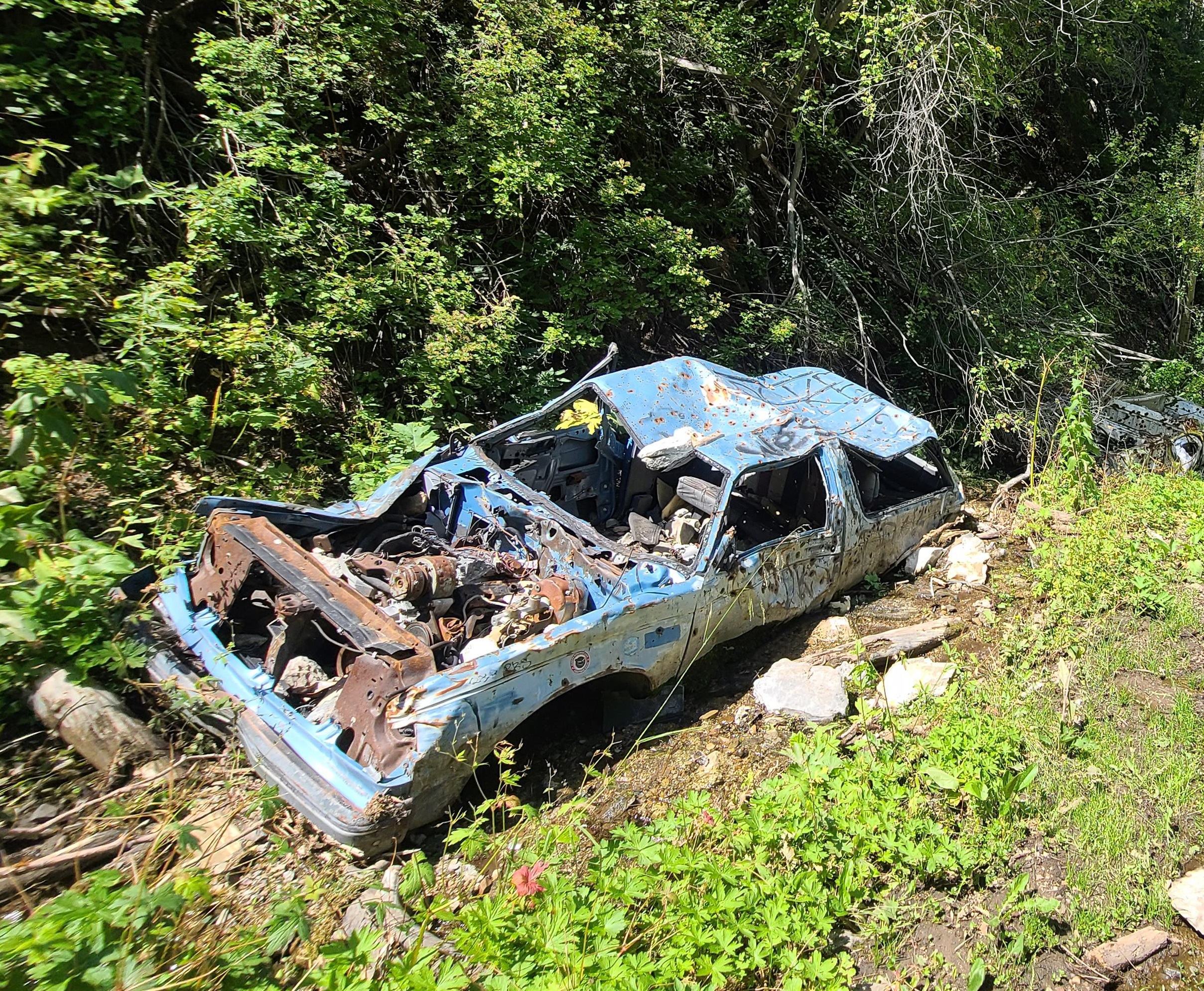
My first car [artist's impression]


And let's face it -- a junker like that could be a colossal pain in the ass. One night I took my girlfriend out and she dumped me over dinner, and I went to take her home and my car wouldn't start. Her dad came to get her, and I sat in the parking lot roiling in misery, waiting for my own dad to come help me get the freaking 18-year-old piece o' crap going so I could get home and brood.

Then again, bad cars can make for good stories. Riding with seven guys stuffed into a compact sedan on a hot August day to get pizza (one guy lying across three laps in the back) was not a lot of fun, but was hilarious even at the time. When you're young, you can stand a lot of inconvenience, at least if you're with your friends. 

I think that is one of the lessons you learn from starting out with a bad car -- inconvenience is part of life. Freedom means not having the best of everything, but it's worth it. 

I know it's tempting to make this a we walked uphill both ways in the snow and liked it story, and I would hate to have a crappy and unreliable vehicle now at my age. But there are other valuable lessons an old beater of a car can teach a youngster, such as:

🚗 The kid is more likely to have worked for the money to buy the car, and thus it is much more valuable to him;

🚗 The kid may learn to handle basic repairs and maintenance, like changing tires or oil; 

🚗 The kid may learn that human dignity is not tied to the cost of possessions;

🚗 But the kid may learn some humility for not having the costliest car among peers.

It's an truism that hardship -- even the minor hardship that comes from an old car -- builds character, and indeed it can. If the person prefers to sit in resentment and jealousy, then no. But if the person learns from experience, especially to laugh at the troubles of driving a clunker, then yes, it can build character. And my old friends are still some of the biggest characters I know. 

Tuesday, February 2, 2021

When push comes to shovel.

As I write this Monday evening, it has been snowing for almost 24 hours. It may continue for another 24 hours. I just shoveled the walkway for the second time. The snow was more than two feet deep.

Been a while since we had a real roof crusher in these parts. Haven't missed it, either. But, bad back and all, I braved the weather to do my bit to keep things clear. In fact, I even wrote a song about it. A ballad. The Ballad of Me.

❆❅💪👨❆❄

Oh, Frederick Key was a mighty man
And a mighty man was he
He strode outside to fight the storm
With great integrity

Frederick took his mighty blade
A shovel scoop of yellow
And went to work upon that snow
Like a mighty, manly fellow

He shoveled here and shoveled there
Flinging snowflakes like a nitwit
He made it to his parking pad
Thirty-five steps on his FitBit 

Then Frederick took his mighty phone
And with his great know-how
He called a man most manfully
To come and bring his plow

Then Frederick took himself inside
Having made his mighty call
And took with mighty manliness 
Some mighty Tylenol

☃🌨⛇

I think schoolkids will be singing this one some day, don't you? 

NOW it's four a.m. on Tuesday and I just shoveled the walk for the... fifth time? I've lost count. The bulk of the storm is over but it looks like we'll have some flakes around here for the remainder of the day, self included. The dogs, who woke me up at three, are sleeping peacefully in the hall. I'm going to put my head on the table and blarg. Blarg.

Monday, December 28, 2020

Old snobs and new.

On the whole, I think I prefer the old-fashioned snobs, the kind one hardly sees anywhere anymore. I think they were a better class than our newfangled snobs. 

Stay back, hoi polloi.

They certainly share things in common, mainly the unbridled joy of being able to look down upon the mass of humanity. And that can be maddening to us in the rank-and-file. And yet the old snobs had it all over the current crop in multiple ways. For example:

1) They were cultured. They supported opera and other classical music, artists whose ardent devotion to their work showed in every stroke of paint, great books of historical importance, and they did it with their own money, not by making the government pay for it. They supported the Western culture that supports everything else. They did not think you could cut the legs under the table of civilization and it would float in air. They preserved Bach and Brahms; they didn't write articles celebrating the social importance of Cardi B.

2) They never tried to pretend to be "commoners." One might point out stories of little jaunts as "normal people" by Victoria and Albert, or rich women posing as shepherdesses, but that's just what those things were -- poses. They didn't try to be "street" when the "street" they came from was a "cul de sac." A snob in those days dressed in ragged clothing was not trying to be an oik any more than a guy dressed up as Green Lantern at ComicCon thinks he can fly. But slovenly hipsters with trust fund money on bikes in Brooklyn think they have cred.

3) They had noblesse oblige. Charity may have been and still be a haphazard thing, but it was considered a social obligation. When a war broke out, rich people were involved, and for real. When a rich person bought his way out, like Teddy Roosevelt's father in the Civil War, it was shameful, whether known publicly or not. They were expected to have skin in the game. Second and third sons were sent off to fight, not "raise awareness" for things. God, I am sick of rich people trying to raise my awareness.

4) They believed in tradition and heritage and God. See #1 above. Were they hypocrites? Sure, many of them, but like François de La Rochefoucauld they believed that hypocrisy is the tribute that vice pays to virtue, so the social benefits were enforced even if the sinner was lost. Now we have believers in the Year Zero, who think that the world and its people can be remade if everything is co-opted into the great project, everything up to and including faith in God, which tells us that the so-called Liberation Theology is not dead -- worse, it now has precious little theology. As C.S. Lewis famously concluded, "Of all the tyrannies, a tyranny sincerely exercised for the good of its victims may be the most oppressive.  It may be better to live under robber barons than under the omnipotent moral busybodies.  The robber baron's cruelty may sometimes sleep, his cupidity may at some point be satiated; but those who torment us for our own good will torment us without end, for they do so with the approval of their own conscience."

5) They tried to help in ways that sometimes helped. See #3 above. Also see the work of William Gladstone, a British PM best remembered here for being skewered constantly by rival Disraeli, but a reformer who for whatever his other faults went out to help get poor women off the streets in genuine acts of charity. He also got rid of peacetime flogging in the navy, so that was nice. Modern snobs are more concerned with making themselves feel good about themselves, and if everything goes to hell, at least they tried. 

6) They were not everywhere you looked. The old snobs kept to themselves. One of the worst things about modern snobs is that you can't get away from them. There are more of them and they are all entitled to wonderful careers. Most have parents to support them in unpaid positions that pad the résumé, and the connections to get the good jobs before the talented climbers can even apply. They may have lots of money from the folks or they may not, but they're always turning up in workplaces, especially in media and government, where they want to make change. The only change these modern snobs should be making is four quarters for a dollar, and why? Because in the old days...

7) They thought they were better for better reasons. Personally, I don't mind being accused of ignorance; everyone is ignorant about some things. And I know I have little appreciation for the most high-minded offerings of culture. But I will not stand to be called evil because I don't subscribe to the modern shibboleths of Critical Social Justice, or that I know recycling is a money-wasting joke, or that I despise abortion and I love my church. Yet our modern snobs must not just look down on me, but call me all kinds of synonyms for evil. 

I'm not saying that it would be better to be poor in, say, Victorian London than in modern Detroit. The fact is that all kinds of advancements have made life better for people of every class in the last 150 years. I am saying that we now have what Glenn Reynolds calls the worst ruling class in the history of this great nation, all of which can be traced back to bad ideas from European Communists. 

Why are the bulk of our Communists people who grew up with money, rather than the unwashed poor? Answer that and it explains everything.

Wednesday, December 25, 2019

Fred's Book Club: Good Things Come in Trees.

Welcome back to the Humpback Writers, the book club that takes place on a Wednesday even if that day is a major civil and religious holiday. Nothing stops us, not even Christmas!

But then again, Christmas is strongly involved with today's book. It's another child's picture book, the second since we started this feature last summer. And to me, it is a classic.


The Tale of Three Trees, as retold by Christian writer Angela Elwell Hunt, was first published in 1989 by Lion Publishing of Illinois. I believe it is still in print. Hunt says that the author of this tale is unknown; I'd never heard it before I read this book, and a brief look around the Internet tends to take me back to this book. I did see another version of it on the Bible.org site, not as well written and without Tim Jonke's terrific illustrations.

So is it a real folktale, or just something concocted in modern days? Beats me. I'm no folklorist. But it's a great Christian fable.

In brief, this is the story of three trees that have big dreams. One is dazzled by the beauty of the stars, and wants to be a great treasure chest; one wants to be a mighty sailing ship and cross the world on the business of kings; one wants to remain where he is and grow so tall that people look up at him and think of heaven.

Well, things don't usually work out the way we hope.

All three trees are cut down. The first tree goes to a carpenter's shop, but instead of being used to make a treasure chest, he is made into a hay box for a stable. The indignity!

But then (and pardon me for the bad stitch on the spread):


You can probably guess how things turn out for the other trees.

Hunt does a lovely job with the story, and Jonke's rich and evocative illustrations pair perfectly with it. I'd recommend it to anyone, but especially families with children getting a Christian education; they can learn about their faith, but they can also learn lessons that are so seldom seen in children's books these days, like hope and humility.

The book touches on a number of things -- rudiments of the life of Jesus, but also dreams being fulfilled when we least expect it and not in the way we'd hoped. I once knew a priest who worked in a college; he liked to tell the kids that we head on out with our Plan A (like Jesus's triumphant entry into Jerusalem) and we wind up running into Plan B (the Crucifixion) but we can be amazed by the way things turn out with Plan C (the Resurrection). Plans A and B are what men work, but Plan C is God's work.

Any Christian knows stories like that, of people with a plan for life that comes to nothing until after they fail, and then it's nothing like what they expect. This is seen in many of the great saints, like the bloodthirsty soldier and duelist, Íñigo, injured by a cannonball, converted to a real faith, and transforming Europe as St. Ignatius of Loyola. My old buddy G.K. Chesterton wrote about the similar transformation of St. Francis of Assisi, a spoiled, lavish youth, fanboy of troubadours and jongleurs, who went off to become an adventurous hero and wound up nearly dying in captivity.

Francis, at the time or somewhere about the time when he disappeared into the prison or the dark cavern, underwent a reversal of a certain psychological kind; which was really like the reversal of a complete somersault, in that by coming full circle it came back, or apparently came back, to the same normal posture. It is necessary to use the grotesque simile of an acrobatic antic, because there is hardly any other figure that will make the fact clear. But in the inward sense it was a profound spiritual revolution. The man who went into the cave was not the man who came out again; in that sense he was almost as different as if he were dead, as if he were a ghost or a blessed spirit. And the effects of this on his attitude towards the actual world were really as extravagant as any parallel can make them. He looked at the world as differently from other men as if he had come out of that dark hole walking on his hands. 

It's not that much of a stretch to see the same happening -- thwarted plans leading to miraculous lives -- in so many unknown "little S" saints around us, or even, fictionally, in a little tree. Things fall apart; God can put them together. That's what He came here to do.

Thanks for reading, and I wish you a most happy Christmas on this Christmas Day.

Friday, March 31, 2017

Old sayings.

One bit of weather wisdom my mom always said -- when appropriate; she didn't just go around repeating it all the time -- was: "Mackerel sky, not 24 hours dry."

Here is a picture of the sky I took yesterday at 9:43 am. Note the fish scale-like clouds skimming the expanse of blue.


And here I sit, 21 hours later, and it's raining.

Plus snow. That counts as non-dry.

I have never known that rhymey bit of folk wisdom to fail. 

I used to hear other Old Farmer's Almanac kind of rhymes, like "Red sky at morning, sailor take warning; red sky at night, sailor's delight." I don't know if that one works. I'm not even sure what that one means. A sailor might be delighted with a good stiff wind that would blow the shingles off my house; that wouldn't be too good for me. Maybe delight refers to something else? That's even scarier -- you know what they say about sailors.

Not all of them rhyme, or work at all. The tale that March either comes in like a lion and goes out like a lamb or vice-versa is nonsense. Around here March comes in like a pain in the ass and takes a powder the same way.

Ben Franklin was good at these kinds of maxims, but his don't always rhyme and they're not always predictive. His Poor Richard's Almanack gave us gems like these: 

A false friend and a shadow attend 
only while the sun shines.

Analysis: True. Does not rhyme; is not predictive.

A flatterer never seems absurd: 
The flatter'd always takes his word. 

Analysis: True. Rhymes; is not predictive.

An honest man will receive neither 
money nor praise, that is not his due.

Analysis: True. Does not rhyme; is predictive. 

A cold April
The barn will fill.

Analysis: No idea if true. Sorta rhymes, is predictive. 

I would like to be thought a genius like Franklin, but as I am not a genius, maybe I could at least make a better presentation than he. In other words, write some terrific folk maxims that both rhyme and tell the reader what to expect. Here are some I whipped up just now:

On Saturday you hear the knell
Jehovah's Witness at the bell

Unless you like to be annoyed
All attorneys must avoid

He who discards a lone sock Sunday
Is destined to find its brother Monday

Car wash today
Rain on the way

If you're not careful
When you boff
Nine months later
Mazel tov! 

All right, so they suck. I told you I wasn't a genius. I can't make a famous scientific experiment by flying a key on a kite out there in the rain. Might make headlines, sure, but when Franklin did it he was brilliant; if I did it I'd just be lit up.

Tuesday, March 8, 2016

Funny lookin' people.

People make fun of funny lookin' people. In a movie, if you want to show disgust for a bunch of (usually white) people, maybe doing something stoopid like going to church, get a bunch of funny lookin' people and film them lookin' bored. And funny. Unlike the cool kids in Hollywood, these people are obvious all stoopid. If they were smart, they'd be good lookin', right?


Of course, in the Internet age we don't even need TV or movies to make fun of average people. Sites like People of Walmart celebrate the underclass, if by "celebrate" you mean "expose to massive ridicule."

I think our modern attitude is most obviously seen with teenagers, who are not only the biggest offenders and consumers of stuff that's insulting to average goofy folks, but also its biggest victims. They think everyone around them is a geek or dork or just an old fart, because they don't look like people in the media. And yet they take little comfort in their own society, because most teens are pretty funny lookin' too, whatever the YA books say. No wonder life is so painful for even the cool kids.

The fact of the matter is, most people are funny lookin', not just the adults in the vicinity of children. You may think that in places like Hollywood, people would be much more attractive, and you might be right to some extent. Where show business is important, good looks are worth cash money; saying that professional actors look better than normal people is like saying professional athletes are in better shape than normal people. It's a tautology. However, the agents, lawyers, grips, caterers, janitors, everybody else who works to get those pretty faces on screen? Funny lookin'. Ever see Henry Waxman (D-Beauty) who represented Beverly Hills in Congress for four decades?

Yeah, I know.

Our perceptions have become skewed because of our continuous media diet. This may go back as far as the ability to reproduce line art, but it's everywhere now. If you spend a lot of serious screen time every day, the world looks like a stark division between hilarious horror show and sexy catwalk.

The fact is, God must love funny lookin' people, because he made so many of us. Bald, dentally impaired, scrawny, dumpy, saggy, baggy, chubby, weak-chinned, bent-backed, knock-kneed, big-nosed, stoop-shouldered, droop-eared... And that's not even counting the self-inflicted goofiness of bad clothes, bad haircut, bad habits, bad tattoos, bad piercings, bad attitude.

Bad makeup.

What I say is: Relax. Embrace your funny-lookin'-ness. Sure, there's always room for improvement, but don't go crazy over it. Better to be healthy and happy and good than good-lookin' and rotten. It's an imperfect world, and if you have to choose to be better inside than outside, focus on the inside.

Except for hygiene. It's healthy. And it's better to look bad than to smell bad.